
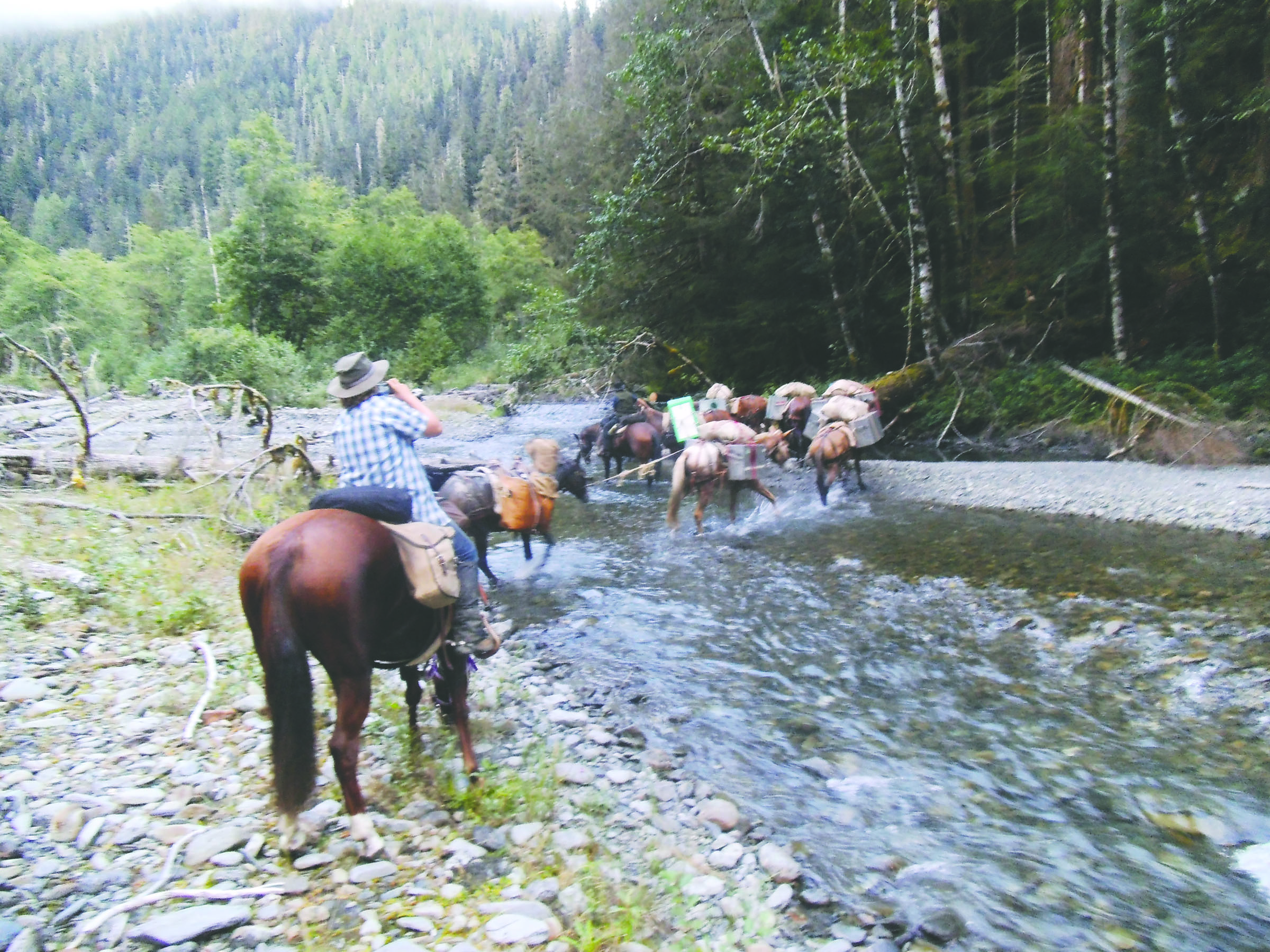
EARLIER THIS MONTH, Olympic National Park officials contracted Sol Duc Valley Packers’ owners Larry and Sherry Baysinger to use their mules to bring in tools, equipment and supplies needed to help move the historic Enchanted Valley Chalet away from the fast-eroding bank of the Quinault River so it wouldn’t fall in.
They spent 10 days working closely with house-moving contractor Jeff Monroe of Sequim and his friend Del Davis, a house mover from Everett, and Park Service and helicopter crews who, Sherry says, “worked from dawn till dark” to move the chalet.
“The weather was awesome, the valley spectacular and we felt honored to be a part of this project,” she says.
She and friend Sara Woodard of Olympak Llamas spent weeks preparing the menus in advance, cooking and freezing and buying groceries to feed the crew.
The chalet lies within the park’s wilderness area, where motorized vehicles ordinarily are banned because of the Wilderness Act. That’s why mules were used to carry the majority of supplies.
The National Park Service used helicopters to fly in large equipment and materials, such as the steel beams and hydraulic jacks, which were too large or heavy for the mules.
Larry says they were brought into the project last spring when Jeff talked to Rod Farley about who could provide the mules and was told to call Larry, saying, “If anyone could do it, it would be us.”
The Baysingers have been working with ONP both as paid and volunteer workers since 1985.
“Our first packs were big hefty garbage bags tied to the horn on a saddle,” says Sherry with a smile.
Jeff asked the Baysingers to pack and to cook for his crew. They knew they needed help so asked Sara, and she agreed to help.
The park had a long list of restrictions and requirements, including needing a food-handlers permit. It also wanted a detailed report on how they were going to prepare and preserve the food for the duration of the trip.
They bought a small freezer and ran it on a generator in the horse trailer at the trailhead stock camp to keep all their frozen food. The food was bundled, packed and stored for each day. It then had to be packed in and stored at the camp in bear boxes. So the group had to be very organized and efficient at pulling the meals for the day out of the freezer.
“The park asked what we were going to feed the movers, so we told them spaghetti and salmon — in other words, real meals — so they wanted us to cook for them as well,” Larry says.
“[We cooked for] the contracting officer, the backcountry ranger, the helicopter landing zone crews; plus, they kept a trail crew in the valley in case we had an emergency. So we cooked for 10 to 15 people three meals a day for 10 days.”
In all, Larry rode close to 15 miles each way with an elevation change of 1,700 feet almost daily, going back and forth to the stock camp to pick up supplies from the base at Graves Creek Stock Camp, located about 11/2 miles below the trailhead.
“We were very fortunate,” says Larry. “We had good weather and only lost one horse shoe the entire time. And I ran my stock up and down that trail every day for 14 days.
“Couple of times, I was able to trade some of my stock off to get fresh, but I rode my lead quarter horse, Ranger, every day. He lost one hind shoe, and all I had to do was nail it back on”
“Everything went like clockwork,” says Sherry. “Nothing went wrong. If it had rained or the place got fogged in, the helicopters couldn’t have brought equipment in, and the project would have gotten delayed.”
Any delay of a few days or more would have meant taking down the camp and putting it back up when the weather was better.
Because everything went so smoothly, Sherry says, “We felt like we were there doing something that was meant to happen because otherwise, one thing could have thrown it off track.”
In addition to people food, they packed 2,000 pounds of certified weed-free packer pellets up the trail to feed the stock.
“When a horse eats hay, the manure drops on the ground and makes a mess,” says Larry.
But those packer pellets quickly break down to nothing when passed through the digestive system, so hardly a sign of manure appears on the trail.
Sherry says she and Sara built their own sump for the location, practicing Leave No Trace.
“For the sump, we cut a patch of sod, turned it over and laid it to the side. [We] dug our hole. [We] threw leftover food, our dishwater or whatever waste we had in there, and when we left, [we] put dirt back in to fill it up and covered it with the piece of sod,” says Sherry.
“While it was hard work, it seemed every night we had a full moon so you could step out of your tent at night and see everything up there. It was just so beautiful.”
________
Karen Griffiths’ column, Peninsula Horseplay, appears every other Sunday.
If you have a horse event, clinic or seminar you would like listed, please email Griffiths at kbg@olympus.net at least two weeks in advance. You can also write Griffiths at PDN, P.O. Box 1330, Port Angeles, WA 98362.