
By Gene Johnson
The Associated Press
SEATTLE — Washington state faces a federal court order to fix under-roadway pipes that block migrating fish by 2030, but a budget passed by lawmakers puts the state at risk of missing the deadline and could delay salmon recovery even as the Pacific Northwest’s endangered orcas are starving, said supporters of fixing culverts.
The Legislature’s two-year transportation budget devotes $100 million to fixing culverts — large pipes that allow streams to flow under roadways, but can prevent salmon from reaching their spawning grounds.
The $100 million is about one-third of what Gov. Jay Inslee requested, and far less than what many — including some lawmakers, state officials, conservationists and Native American tribes — agree is necessary.
- Related

Salmon-eating sea lions targeted at Columbia River damMay 7, 2019
“We are extremely disappointed in the Legislature’s last-minute decision to underfund culvert removal,” Lorraine Loomis, chair of the Northwest Indian Fisheries Commission, said in a written statement. “Underfunding culvert removal at this point makes it almost impossible to meet the court’s deadline and will slow salmon recovery.”
Salmon recovery has become an urgent priority as the region’s resident orca population has fallen to 75 members. The orcas primarily eat chinook salmon.
The Legislature did direct about $50 million to other salmon-restoration efforts, including a dam removal on the Nooksack River and floodplain work along the Dungeness and Cedar rivers. But even lawmakers who wrote the transportation budget said they were unhappy with the culvert money.
The House budget called for $214 million and the Senate $274 million, but when legislators met to negotiate their differences, they settled on $100 million. Proposals for more spending relied on passing a carbon fee, borrowing more money or imposing weight fees on vehicles earlier than planned, none of which happened.
“We’d love to give more. Can’t. Don’t have any money,” said Senate Transportation Chairman Steve Hobbs, a Lake Stevens Democrat. “I hope it spurs the conversation that we need to raise some other revenue to pay for this. It’s a huge expense and it has to be done.”
Inslee’s office called the Legislature’s action inadequate.
“We need to do much work to abide by the U.S. Supreme Court decision, our treaty obligations and to protect salmon,” spokeswoman Tara Lee said in an email. “[Inslee] will be considering options on how best to obtain adequate levels of funding.”
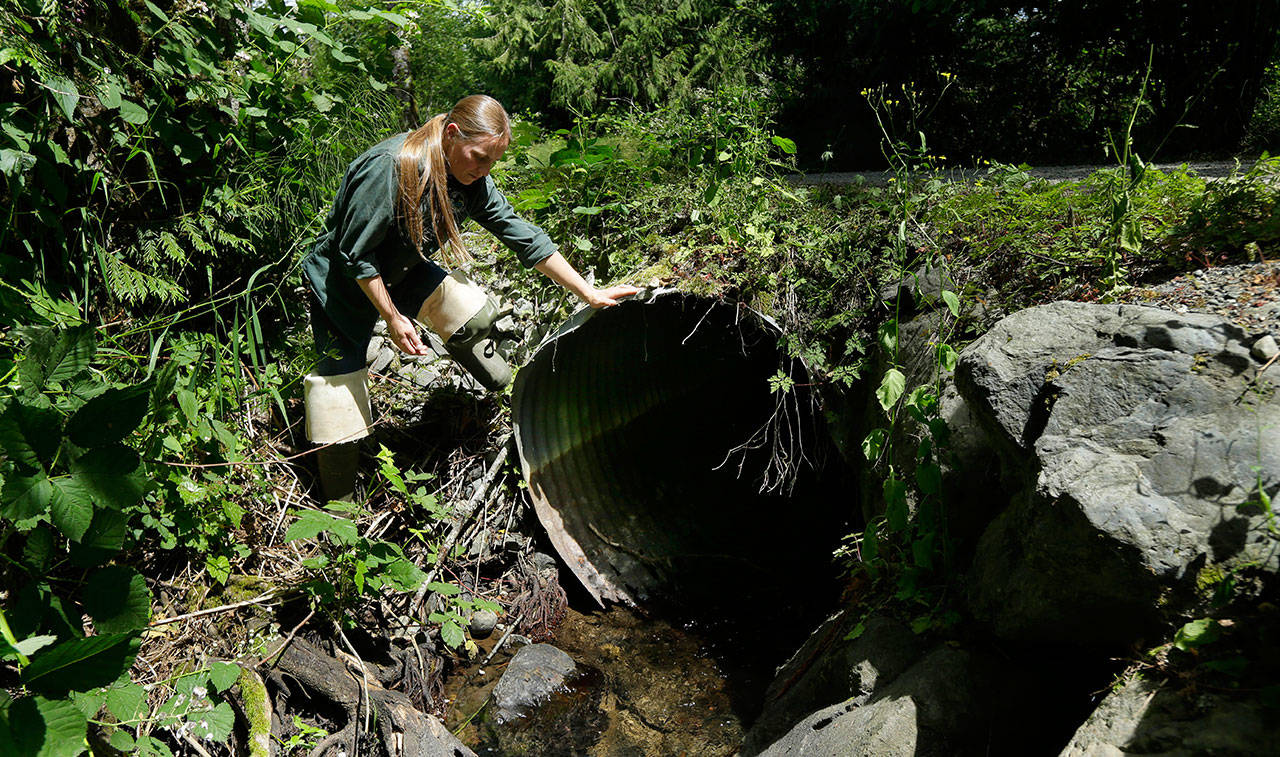
The culverts can be too steep for salmon to climb, and downstream pipe openings are sometimes elevated above the river surface, creating a dead end for fish swimming upstream. The pipes can also become clogged with debris.
Tribes and the Justice Department sued the state in 2001, saying that because the culverts reduce the number of salmon they deprive the tribes of fishing rights guaranteed by treaties dating to the mid-19th century. The state had been working to replace the culverts with wider structures that allow fish to pass, but so slowly that it would take more than a century to finish.
In 2013, U.S. District Judge Ricardo Martinez ordered Washington state to fix or replace more than 1,000 culverts blocking access to 1,600 miles of salmon habitat. He gave the state until 2030 to reopen about 450 of the worst ones, restoring most of the blocked habitat. His decision was upheld last year by a divided U.S. Supreme Court.
The state already has fixed culverts on land owned by the Departments of Natural Resources, Fish and Wildlife, and Parks, but the Transportation Department’s culverts are more complicated and expensive to address because they run under highways and can require moving utilities. The department still has about 400 culverts to fix.
Transportation officials sought $275 million for culvert replacement in the 2019 to 2021 budget.
The money was to pay for 60 projects and to design about 100 more — projects that would then be ready to be completed in 2021-23, when the department intended to seek $550 million.
The department eventually would seek two-year budgets averaging more than $700 million through 2031.
“I feel bad for the DOT,” said Tom Jameson, who chairs the state’s Fish Barrier Removal Board. “It’s going to make it more difficult for them to comply.”