
By GENE JOHNSON
The Associated Press
EDITOR’S NOTE — The Daily Herald of Everett, a sister newspaper of the Peninsula Daily News, has in-depth coverage of the Oso slide. Latest slide and Snohomish County information can be found on the Herald’s website, www.heraldnet.com.
Related story: “Snohomish County mudslide — how to donate to victims, how to report someone missing”: https://www.peninsuladailynews.com/article/20140328/NEWS/303289959
SEATTLE — The warnings could hardly have been clearer.
One technical report told of the “potential for a large catastrophic failure” of the 600-foot hillside above a rural neighborhood near the mountainside community Oso, about 55 miles northeast of Seattle on the Stillaguamish River.
Another noted plainly that it “poses a significant risk to human lives and private property.”
The danger was so apparent that Snohomish County officials mulled buying out the properties of the residents who lived there.
Instead, the county continued to allow the construction of homes nearby. Seven went up even after a significant slide approached the neighborhood in 2006.
Whatever the wisdom of its decision, the county might never be held liable in court for not doing more to protect residents, an outcome that would leave victims of last month’s devastating landslide one fewer avenue for recovering financially for their damages.
Whether government agencies or landowners can be held liable for damages caused by landslides in Washington state is highly dependent on the facts of each case.
Generally, governments are not liable except in narrow circumstances, such as if an agency specifically tells the residents they’re safe before a slide, or if an agency takes it upon itself to fix a hazard but actually makes things worse.
“This is a terrible tragedy and still very fresh. But it is nonetheless my concern that people turn to the government as the insurer of last resort,” said David Bruce, a Seattle lawyer who represents governments in landslide-liability cases.
“The fact of the matter is that in the Puget Sound basin and the foothills of the Cascades, there’s a tremendous amount of landslide-prone areas. The government isn’t here to prevent people from suffering natural catastrophes.”
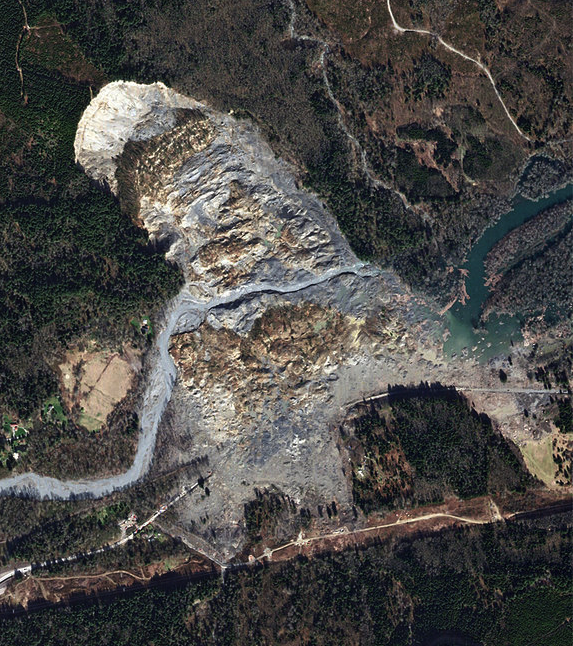
The massive slide northeast of Seattle on March 22 obliterated the hamlet, temporarily blocked the river and wiped out a state highway, entombing dozens of victims in a slurry of mud, logs and debris.
Thirty bodies have been found. More than a dozen people remain missing.
Financial losses to homes and property total about $10 million, Gov. Jay Inslee said.
A major disaster declaration from President Barack Obama has cleared the way for help to the victims, but some lost their second homes, which aren’t covered by disaster aid.
Homeowners insurance is also unlikely to cover the damage, though such policies might if it is ultimately determined that logging at the top of the hill helped cause the devastation.
It seems all but certain that at least some of the survivors or the estates of victims will sue to recover some of their damages, though such cases can be tough to win, lawyers said.
“I hope there is some recourse,” said Davis Hargrave, a 73-year-old architect from Kirkland who lost his second home. “Were we informed of this danger? No, a very emphatic no.
“The county is happy to send you a bill for your utilities every month. Could somebody drop you a postcard and say, ‘Hey we got word the mountain could fall on you?’ Not even a postcard.”
Karen Willie, a Seattle attorney who represents victims in landslide cases, said her office has started investigating the myriad issues that could determine whether the county or any uphill landowners — most notably, Grandy Lake Forest Associates LLC, which logged a pie-shaped area of about seven acres at the top of the hill — might be held to account.
The state also owns some land near the slide.
Grandy Lake Forest did not immediately return a call seeking comment. Several geotechnical experts have said they believe the main causes of the landslide were record rains and river erosion at the foot of the hill, but some have said logging could have played a role by removing trees that would have helped absorb the rainfall.
The state Department of Natural Resources has said that in its logging, Grandy Lake strayed about one acre into an area that was supposed to be protected because of groundwater concerns.
“I think that’s going to be a key player here,” said Joseph Wartman, a University of Washington engineering professor who is helping lead a federally funded team examining the landslide’s causes.
“What we generally know is that logging and clear-cutting were not likely to enhance the stability of this landslide. The question is how deleterious those effects are.”
Landowners generally can be held liable for any harm they unleash through logging or other activities, especially if they fail to exercise reasonable care. But it can be a heavy burden for plaintiffs to prove that a landslide wasn’t simply a natural occurrence.
The technical reports from 1999 and 2000 did not warn of a catastrophe on the order of what happened last month.
But Willie said she was nevertheless stunned when she began reading one by Tracy Drury, a geotechnical consultant who warned of “significant risk to human lives and property.” It isn’t clear to what extent residents knew of the reports.
Some have told reporters they never knew the county had considered whether to buy out their properties.
“The Drury report is very strong language for a scientist to use,” Willie said.
“Think about that: If somebody read you Drury’s report and said they’d buy your property at fair-market value, and then you have to drive there with your kid in the car, would things have been different? I think so.”
But outrage doesn’t necessarily translate into liability.
“The beginning point of the law is that it’s the responsibility of the landowner to be aware of the dangers on their own property,” said David Bricklin, a Seattle lawyer who has represented landslide victims.
“If you go to the county and say, ‘I’m worried about the landslide risk,’ and the county says, ‘Well, we’ll do an investigation and figure it out and we won’t issue a building permit unless it’s safe,’ then the county’s in trouble. But that’s not typically what the county does.”
Drury’s report warned that buying out the properties along the river would be difficult because some owners wouldn’t want to leave. Instead, the report suggested placing a log structure in the river to protect the hillside from erosion.
The Stillaguamish tribe eventually did so.
Bricklin noted that when local governments deny someone a building permit, they can be sued for depriving the landowner of property rights. But they can’t be sued for issuing a permit.
“It puts pressure on agencies to issue permits even when they think they know better,” he said.
