
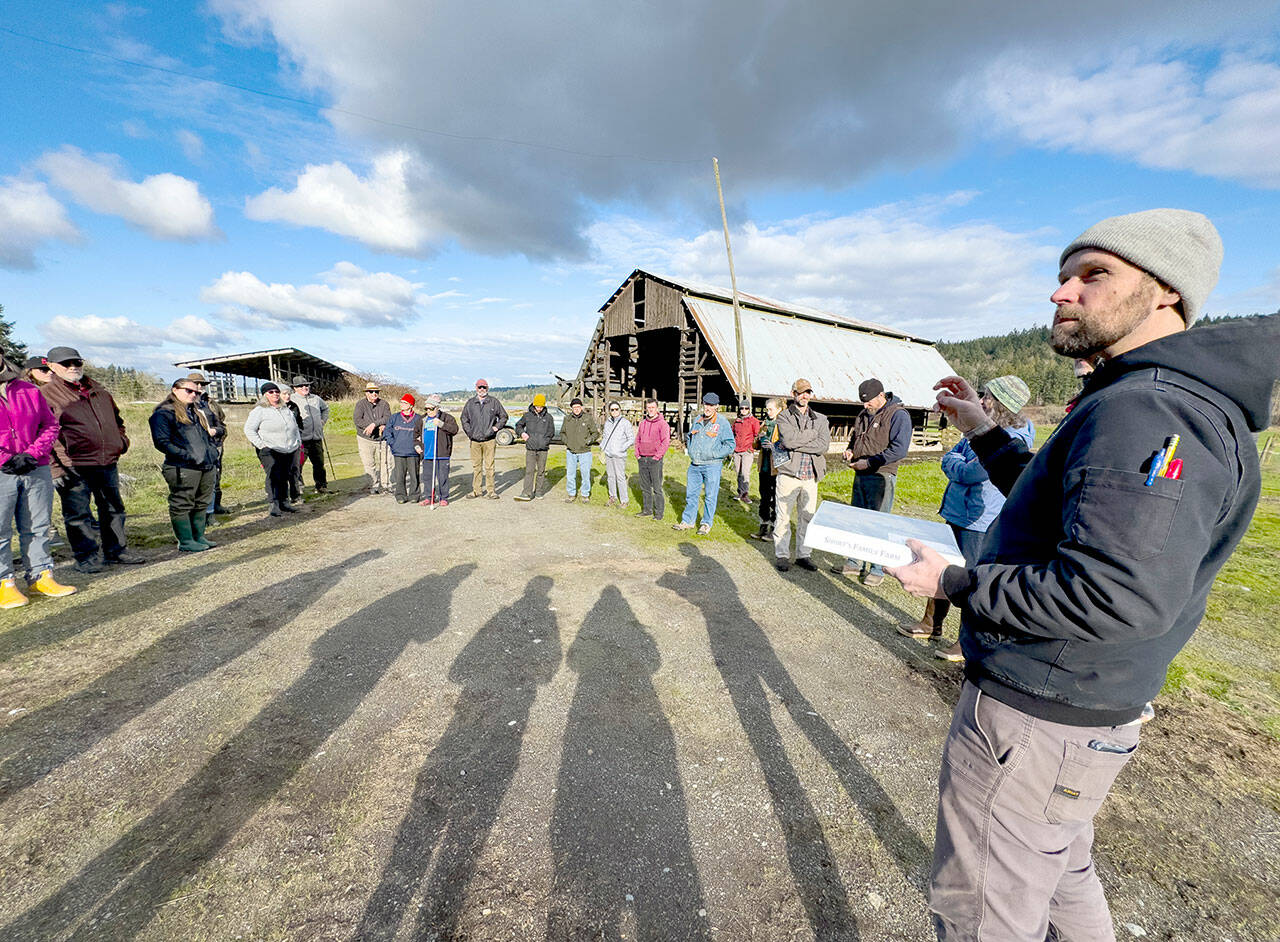
Erik Kingfisher, Stewardship Director of Jefferson Land Trust, explains the role of the trust after the sale of the Short’s Family Farm is completed to the Port of Port Townsend to an assembly of port commissioners and interested parties during an orientation on Wednesday. (Steve Mullensky/for Peninsula Daily News)

Erik Kingfisher, Stewardship Director of Jefferson Land Trust, explains the role of the trust after the sale of the Short’s Family Farm is completed to the Port of Port Townsend to an assembly of port commissioners and interested parties during an orientation on Wednesday. (Steve Mullensky/for Peninsula Daily News)

Short’s Farm challenges assessed

Port to consider how to manage its first foray into agriculture

CHIMACUM — The sight was enough to cause a herd of 2 year-old black and red Angus cattle to stop grazing and tussling and stare: 40 strangers trekking on the gravel road next to their pasture, talking, pointing and taking photographs.

The cattle were the last of Roger and Sandy Short’s farming operation and would be gone by August.

The strangers were members of the Port of Port Townsend’s Short’s Farm steering committee on a visit Wednesday to the 253-acre property. They had been tasked with creating a plan for the property that will be delivered to port commissioners in July.

Joining the committee on the two-hour visit were port staff, the Shorts, farmers from neighboring properties, port commissioners Carol Hasse, Pete Hanke and Pam Petranek and Jefferson County District 2 Commissioner Heidi Eisenhour.

“This is to get an understanding of what’s here, what we would like to see in the future and how we’re going to get there,” Executive Director Eron Berg said.
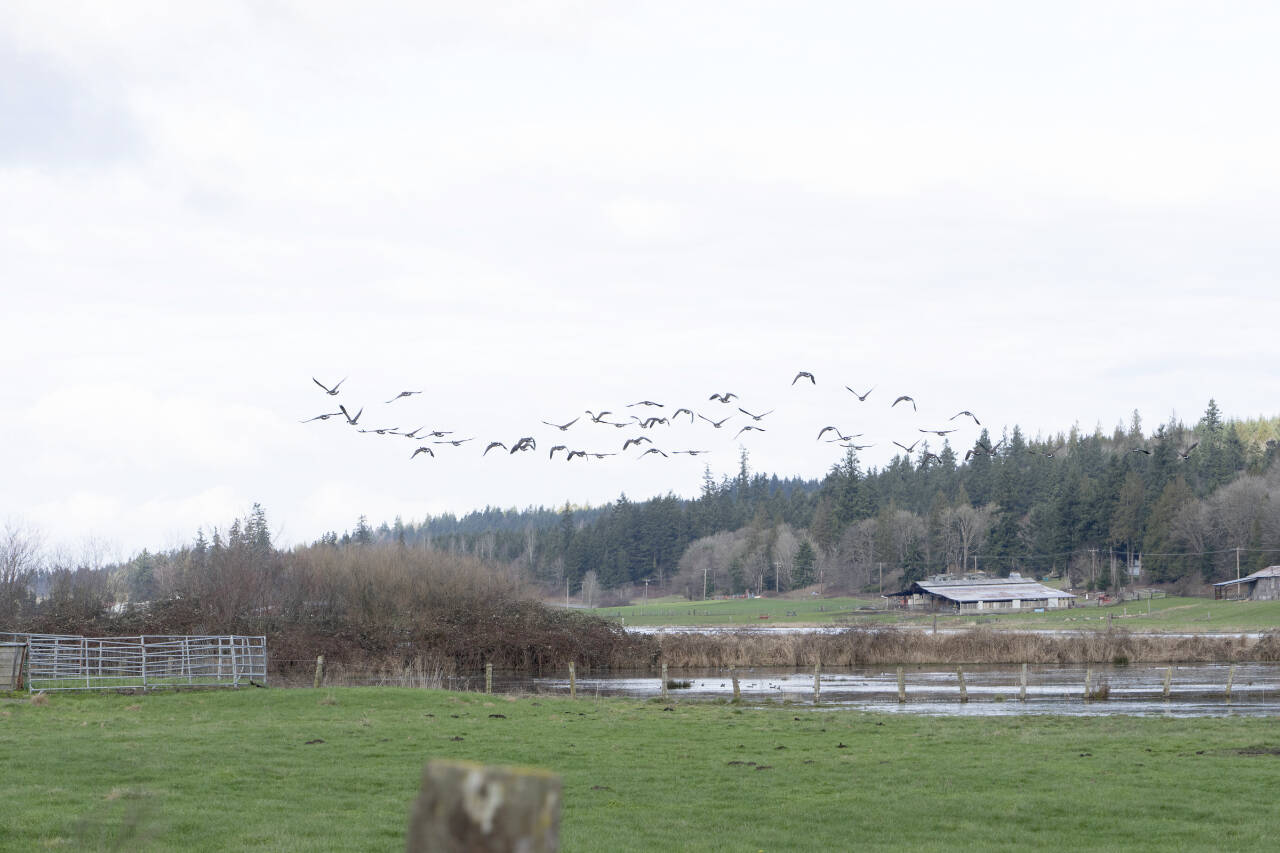
A flock of Canada geese take flight from the wetlands at the Short’s Family Farm on Wednesday. (Steve Mullensky/for Peninsula Daily News)

A flock of Canada geese take flight from the wetlands at the Short’s Family Farm on Wednesday. (Steve Mullensky/for Peninsula Daily News)

The port purchased the farm from the Shorts last year for $1.4 million with $1 million assistance from the state. Among its motivations for the acquisition, Berg said, were developing its agricultural value to benefit the Jefferson County community and contributing to habitat restoration.

The port engaged the participation of master’s students in the University of Washington’s department of urban design and planning who will help with community outreach and assisting the steering committee. They met with the Shorts last week.

Although this was its first foray into farming, the port’s original comprehensive plan in 1926 — two years after it was established in 1924 — included supporting agricultural development, Berg said.

The biggest and most urgent challenge when it came to making the farm economically viable, the steering committee appeared to agree Wednesday, was removing invasive reed canary grass that caused the Chimacum Creek to flood and turn a significant portion of the property into a lake.

Although popular with migratory waterfowl like the ducks and geese that flocked on the quiet water on Wednesday, the flooding makes the land unusable for livestock and agriculture for part of and sometimes the entire year.

Reed canary grass

Roger and Sandy Short, previous owners of the farm that has been operating as Short’s Family Farm since 1945, answer questions from interested parties during a walk around the farm on Wednesday. (Steve Mullensky/for Peninsula Daily News)

Roger and Sandy Short, previous owners of the farm that has been operating as Short’s Family Farm since 1945, answer questions from interested parties during a walk around the farm on Wednesday. (Steve Mullensky/for Peninsula Daily News)

Roger Short said invasion of the thick, aggressive reed canary grass that clogged Chimicum Creek had prevented him from accessing about 40 to 50 acres of pasture for his cattle for the past couple of years.

Al Latham, who represented the Jefferson County Conservation District on the steering committee, said because of reed canary grass, “This is most difficult restoration site in the county.”

North Olympic Salmon Coalition Executive Director Rebecca Benjamin said reed canary grass also contributed to decreased water quality and higher water temperatures that compromised salmon habitat.

“There are a lot of challenges to overcome,” she said.

In addition to challenges thrown up by Mother Nature, the steering committee also must navigate man-made limitations on the farm’s use.

A conservation easement the Jefferson Land Trust acquired from the Shorts in 2016 for $800,000 dictates what is and is not permitted on the property, Erik Kingfisher, stewardship director with Jefferson Land Trust, told tour attendees.

“It protects the agricultural production values and habitat values,” Kingfisher said. “It will always be managed as a farm and prevented from conversion and development.”

Any plan for the farm must take into consideration the deed restrictions. For example, there are about 10 acres with agriculture and residential buildings and other impermeable surfaces like roads on them — this amount can’t be increased.

Buildings

The steering committee will need to consider what buildings to keep and which ones should be demolished and replaced. Berg suggested an old barn from the 1880s might be a candidate for a Heritage Barn Rehabilitation Grant Program from the Department of Archeology and Historic Preservation.

The steering committee also will need to decide whether or not to continue to allow hunting on the property when the Short’s license with the Washington Department of Fish and Wildlife expires this year.

Despite the many challenges of turning the farm into a going concern, Berg said that after 100 years in operation the port was at last engaging in a project that had been a part of its mission for almost 100 years.

“We’re so pleased to see the level of interest in this project,” Berg said. “It’s something the port has aspired to and in our centennial year we’re finally here.”

Steering committee member David Seabrook said he was optimistic about finding a path forward to reaching workable solutions for the farm’s long-term success.

“I see a lot of possibilities,” said Seabrook, who is also an East Jefferson Fire Rescue commissioner. “This is a first step in a sustainable food system in Jefferson County.”

Looking ahead

The next meeting of the Short’s Farm steering comittee will be 5:30 p.m. Feb. 21 at WSU Jefferson County Extension, Kivley Center, 97 Oak Bay Road., Port Hadlock.

The steering committee will bring its recommendations to the Port of Port Townsend commission to discuss at its workshop at 9:30 a.m. July 10, to be conducted at the Point Hudson Pavilion, 355 Hudson St., Port Townsend.

For a list of all Short’s Farm steering and community meetings go to portofpt.com/shorts-family-farm

The public is welcome to attend all meetings.

________

Reporter Paula Hunt can be reached at Paula.Hunt@peninsuladailynews.com

More in News

Santa greets well wishers who showed up at Haller Fountain in Port Townsend on Saturday to witness the lighting of the community Christmas tree. About four hundred fans of all ages turned out for the annual event. (Steve Mullensky/for Peninsula Daily News)
Community celebration

Santa greets well wishers who showed up at Haller Fountain in Port… Continue reading

WSDOT updates highway projects

Hood Canal work expected in spring

Jefferson County is expected to make cuts to staff, services

$5.2M deficit brought down to $1.1M; vote expected on Dec. 22

Wreaths Across America tribute slated for Saturday

The Michael Trebert Chapter of the Daughters of the… Continue reading

Body found in Bogachiel River likely missing fisherman

A body recovered from the Bogachiel River this weekend is… Continue reading

Sequim’s 2026 budget is about 11 percent less than this year with fewer capital projects and a new cap on municipal funding. Staffing will increase by 1.1 full-time-equivalent employees following retirements, position changes and new hires. (Matthew Nash/Olympic Peninsula News Group)
Sequim approves $51.6M budget

Utility increases to continue for five years

Santa Claus, the Grinch and career and volunteers with Clallam County Fire District 3, IAFF Local 2933 and the Community Emergency Response Team (CERT) will accept food and toy donations this week as part of Santa’s Toy and Food Fire Brigade in Sequim. The food and toy drive will end on Friday at Sequim Walmart with donations accepted from 9 a.m. to 9 p.m., and Santa arriving to hand out candy canes and take photos from 5 p.m. to 8 p.m. (Matthew Nash/Olympic Peninsula News Group)
Toys, food to highlight Sequim Santa Brigade

Program will culminate Friday with booth at Walmart location

Sequim Museum volunteers Bob Stipe, Scott Stipe and executive director Judy Reandeau Stipe stand with Dan Bujok, VFW district commander, and Ken Bearly, Carlsborg 4760 post commander, at the museum’s Veterans Monument. It’s recently been refurbished and organizers welcome past and present veterans and their family members to apply for a tile to be placed on the east side of the wall. (Matthew Nash/Olympic Peninsula News Group)
Museum seeks veterans to add tiles to monument wall

Rededication ceremony tentatively set for early 2026

Weekly flight operations scheduled

There will be field carrier landing practice operations for aircraft… Continue reading

Denny Bellow, left, waves as he departs the Sequim Food Bank to collect food as part of the 15th annual Cranksgiving event on Nov. 22. Cranksgiving drew a record 84 cyclists and resulted in donations to the Sequim Food Bank of more than $6,400 and more than 2,000 pounds of food, Executive Director Andra Smith said. The event was open to riders of all ages and involves swag and prizes donated by local merchants and national bicycle brands. Over the years, it has brought in more than 10 tons of food and more than $27,000 in donations, with participants purchasing food from along Washington Street. (Monica Berkseth/For Olympic Peninsula News Group)
A record-setting Cranksgiving

Annual event benefiting Sequim Food Bank sees highest number of riders

Aaliyah Clark of Poulsbo (378) and Monica Castleberry of Lacey (21) lead a young runner at the start of the Jamestown S'Klallam Glow Run in Blyn late Saturday afternoon. The race had a record-breaking 900 participants this year. (Michael Dashiell/Jamestown S'Klallam Tribe)
RUN THE PENINSULA: Record-setting crowd at Jamestown Glow Run

A record-setting huge crowd of nearly 900 people ran in… Continue reading

U.S. Rep. Emily Randall.
US Rep. Randall speaks on House floor about insurance

Example of fictional family shows premium increase of more than 1,000 percent