
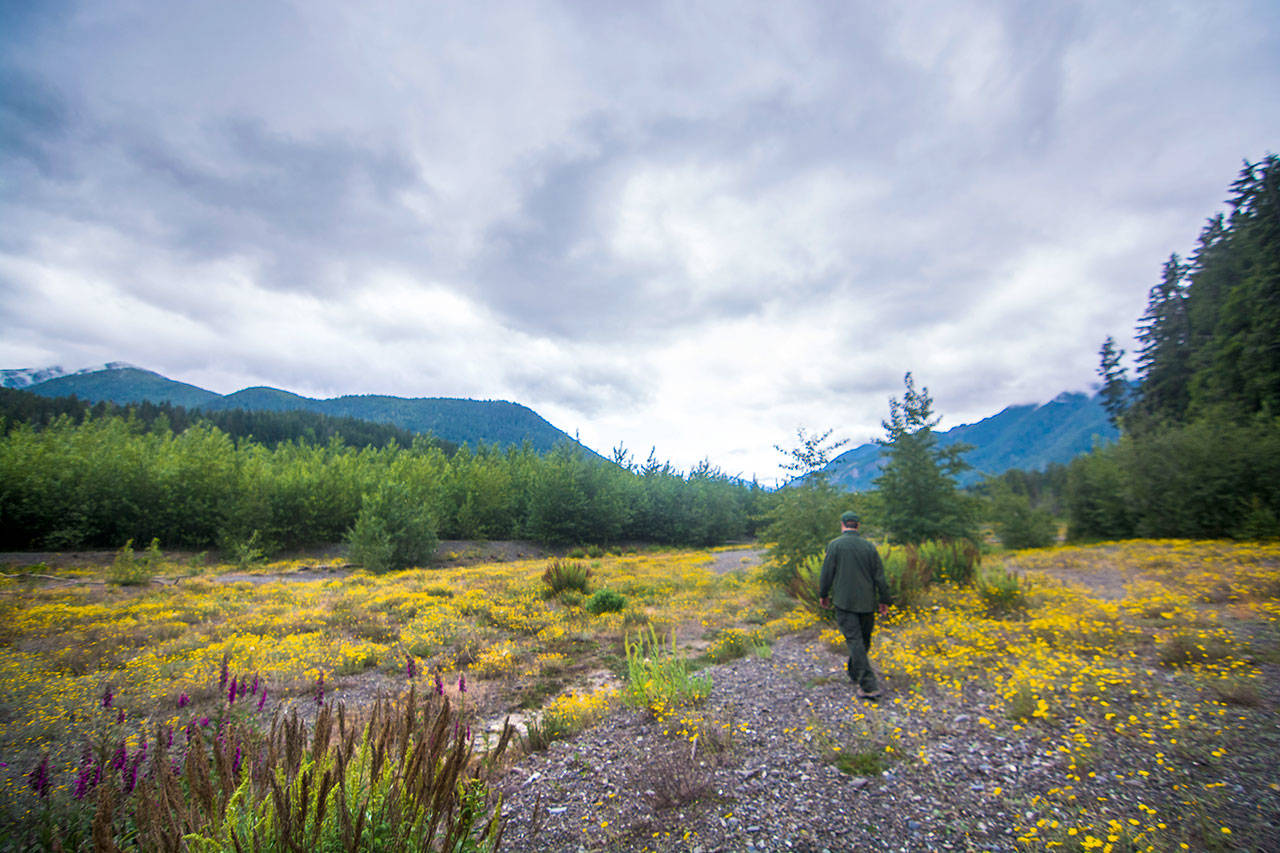
PORT ANGELES — Josh Chenoweth stood in a cobblestone field full of blooming Oregon Sunshine in the lake bed of the former Lake Aldwell as he marveled at the diversity of plant life that has flourished because of the Elwha revegetation project.
The project and Chenoweth’s job heading the reffort both come to an end this fall, but in many ways the transformation of the valley is just beginning, he said.
Now it’s time for Chenoweth — botanical restorationist for the National Park Service in charge of the revegetation effort — and the dozens of others who have helped with the project to step back and let nature take its course.
“It’s definitely just the beginning in a lot of ways. Vegetation communities take hundreds of years to form — and evolve — and I hope to see it,” said Chenoweth, who has been on the project for the last 11 years.
“I’m hoping not to go anywhere so I can continue watching it for the next several decades because it’s just going to be an amazing transformation over the years.”
The former Lake Mills and Lake Aldwell reservoirs already have seen significant transformations since the National Park Service led the $325 million effort to restore the Elwha River to its natural state with the removal of the Elwha and Glines Canyon dams. Both dams were gone by 2014.
With help from dozens of volunteers, the National Park Service planted 320,000 plants and threw close to 7,000 pounds of seed in the two lake beds and in the adjacent areas since the removal of the two dams.
What they planted the most of was Douglas fir, but they also planted grand fir, western red cedar, western white pine, cottonwood, thimbleberry, salmonberry, black cap raspberry, Nootka rose, big leaf maple, riverbank lupin and others, he said.
The park grew the plants in a nursery — the Matt Albright Native Plant Center, located east of Port Angeles in Robin Hill Farm County Park — before planting them in the lake beds. Each year they would plant 60,000 to 80,000 plants, most of which would need to be transplanted at about the same time.
“We could never have done this without volunteers,” he said. “It’s very labor intensive and monotonous.”
Chenoweth said he and the other involved knew the work they were doing was unprecedented and it wasn’t clear how things would play out.
“What we were planning to do when we recognized that nature was going to do as well as it did in the fine sediments, was to provide a diversity of species,” he said.
“We planted a lot of species that might take awhile to get out there to increase the diversity, which in theory, should increase the functional resilience.”
In the earlier years of the project, plant life flourished in the areas covered in fine sediments, but many of the areas covered in coarse materials like cobblestone remained bare.
At the end of last year the fine sediments were dominated by red alder that had an average height of 25 feet, he said. There were about 12,000 stems per acre.
“That was way faster than anyone has predicted,” he said.
The success in the fine sediments allowed crews to focus on the coarse sediments, which in the lower lake bed — where Lake Aldwell as located — are now covered in Oregon Sunshine, riverbank lupin and other species.
Oregon Sunshine — which thrives in dry, well drained gravel at various elevations — has found success in some of the coarsest areas of the lake bed. The bright yellow flower took hold in areas covered in cobblestone and gravel.
The riverbank lupin has been key to the revegetation effort, Chenoweth said. Without the lupin, many other species wouldn’t have been able to survive.
“We had a lot of mortality until the lupin started growing,” he said. “That mitigated some of the harshness of being out here in the sun and wind and gave those plants the extra moisture they needed in the hot summer.”
He said the lupin will continue to play a large role in the revegetation of the lake beds because when the plant dies it adds nitrogen to the ground, making it possible for other plants to live.
“Now that we’re on this path of successions, I think it’s going to keep going without much assistance,” Chenoweth said.
He said it could take decades before the tall perched terraces at the area of the upper reservoir become forested. They are covered in coarse material, but perched 20 to 60 feet above the floodplain.
He expects those to be the home of a “novel plant community, something very different than what you would find in the same proximity to the river,” he said. “It will be a different suite of species.”
Chenoweth said the two lake beds still need to be monitored. Though he is formally leaving the project this year, Chenoweth also teaches at Peninsula College and he hopes to see students help monitor the progress in the coming years.
The two transforming lake beds would become their laboratory, he said.
He said it is difficult for the National Park Service to find funding that would support an extended monitoring effort, which is one reason the transition would be a good fit, he said. He said Huxley College on the Peninsulas also would be involved.
“That’s why it’s a perfect transition to bring it over to the college, where something like that can be a good teaching lesson and a good relationship builder between the park and these educational institutions,” he said.
He said there is still is still enough bare ground in both of the lake beds that there is a need to watch for non-native species such as Scotch broom.
“It’s important to keep monitoring for that and keep active all the invasive species management teams,” he said.
________
Reporter Jesse Major can be reached at 360-452-2345, ext. 56250, or at jmajor@peninsuladailynews.com.
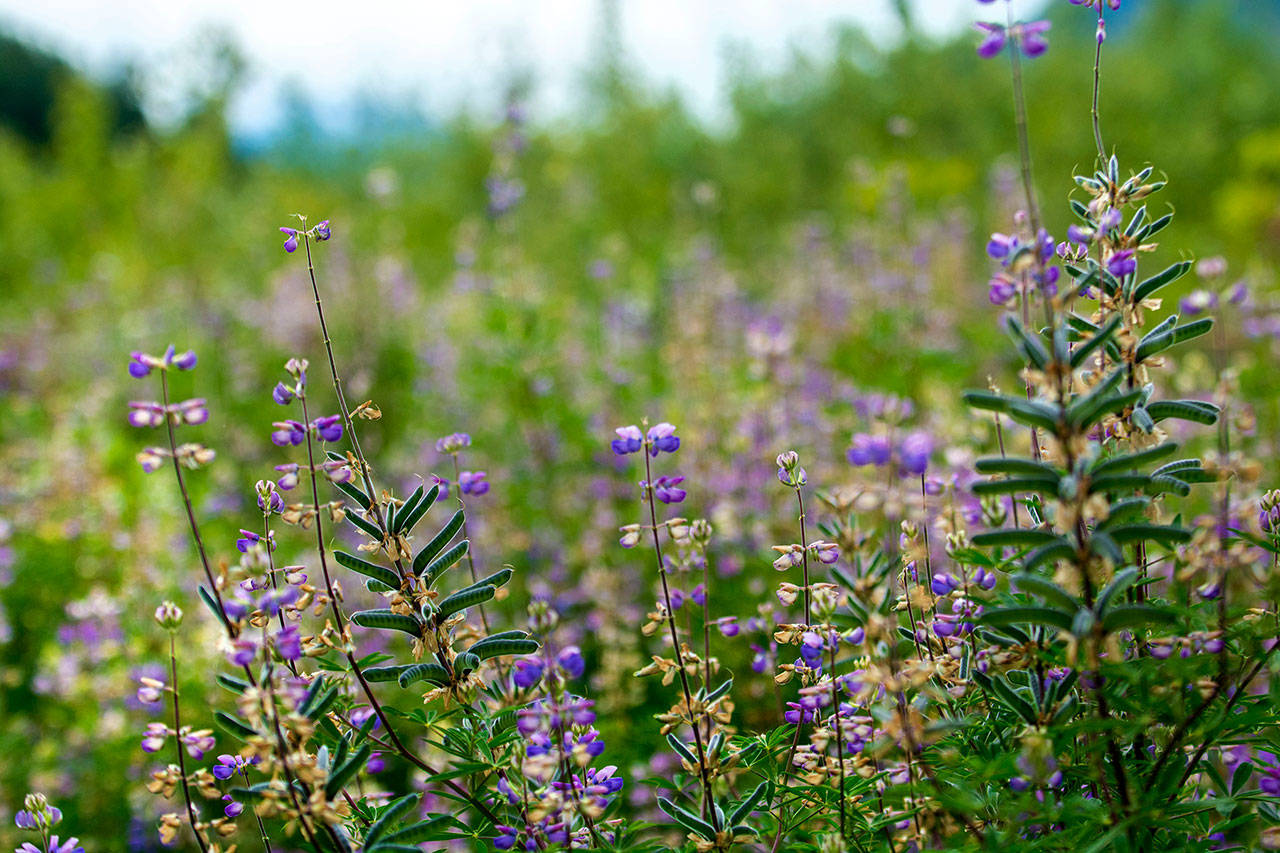
Riverbank lupin blooms in the former Lake Aldwell lake bed. (Jesse Major/Peninsula Daily News)
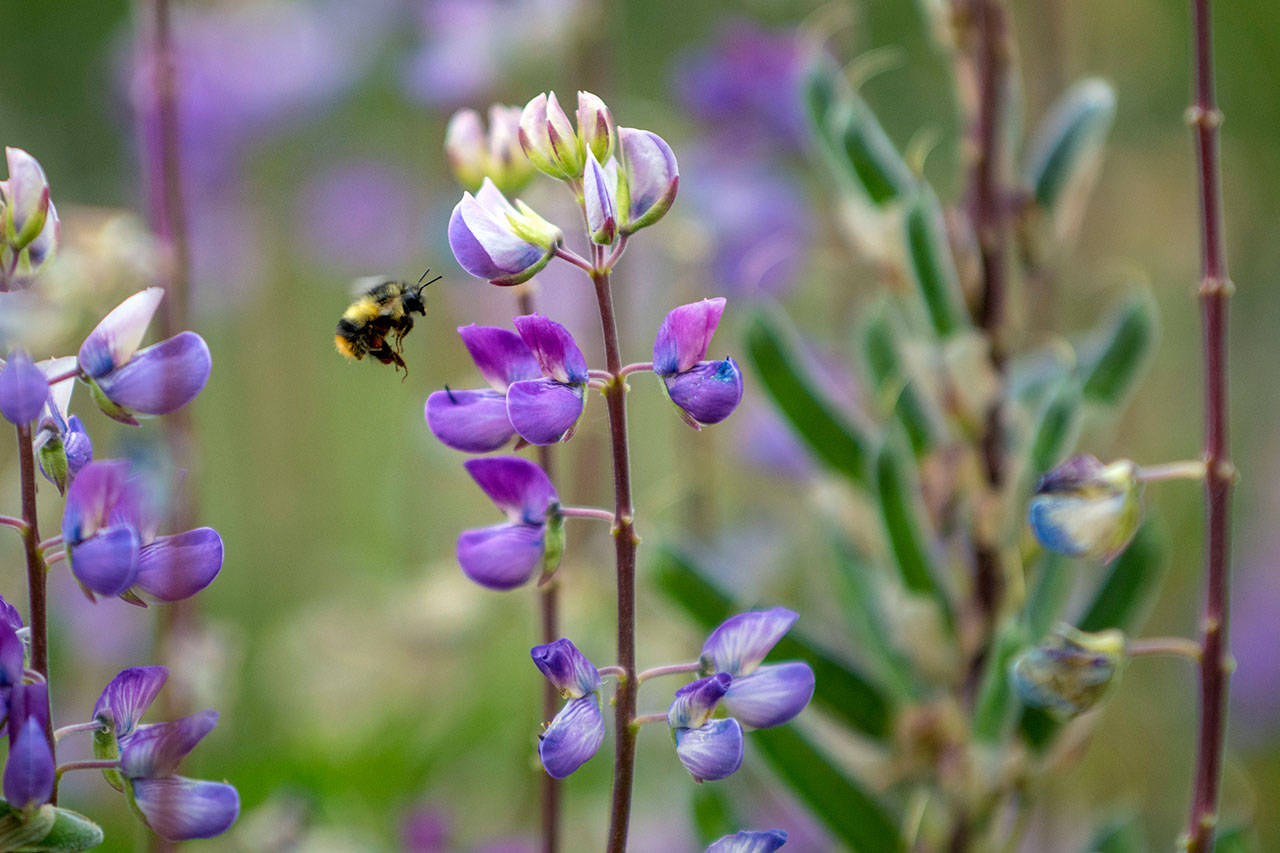
A bee lands on riverbank lupin thats is flowering in the fomer Lake Aldwell lake bed. (Jesse Major/Peninsula Daily News)
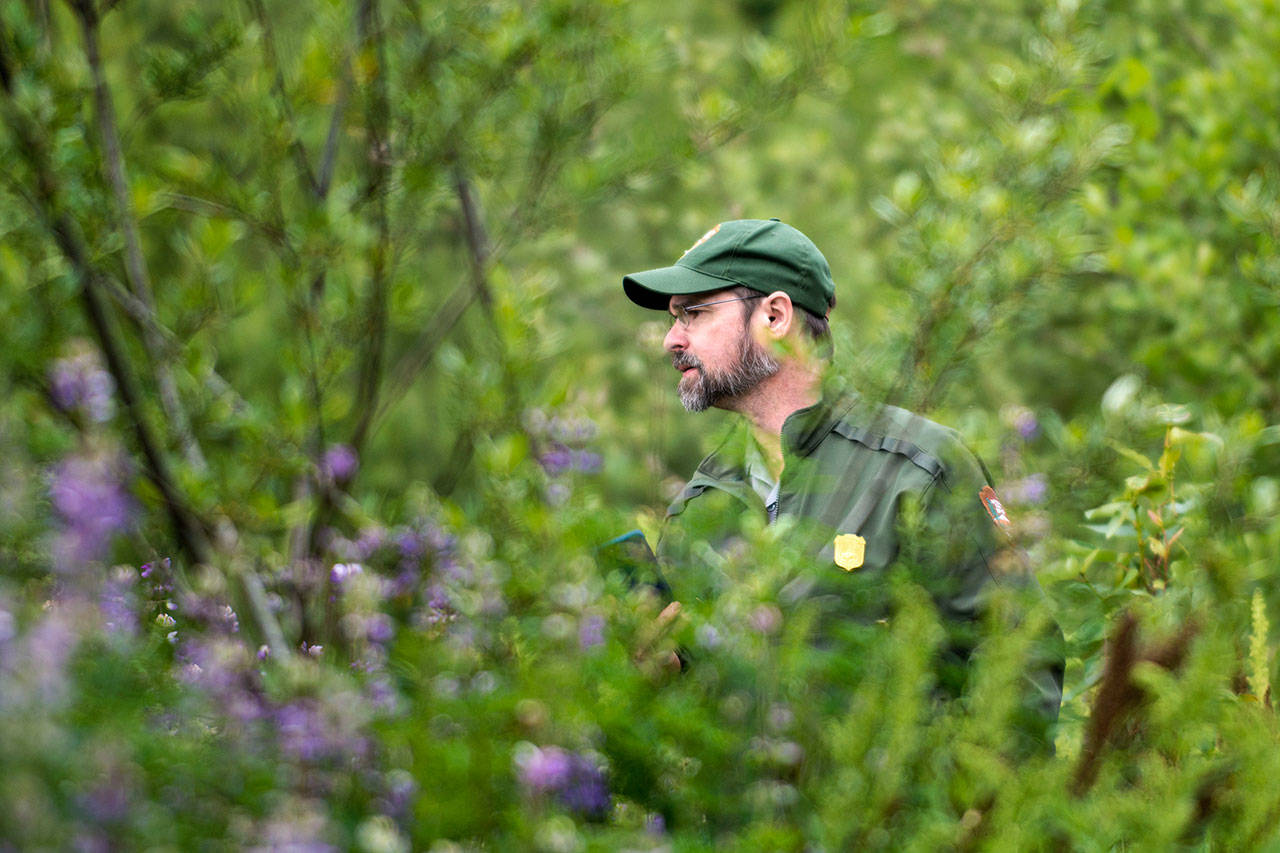
Josh Chenoweth, who has headed the revegetation effort in the Elwha Valley, looks over plant life that has taken hold in the former Lake Aldwell lake bed. (Jesse Major/Peninsula Daily News)
