
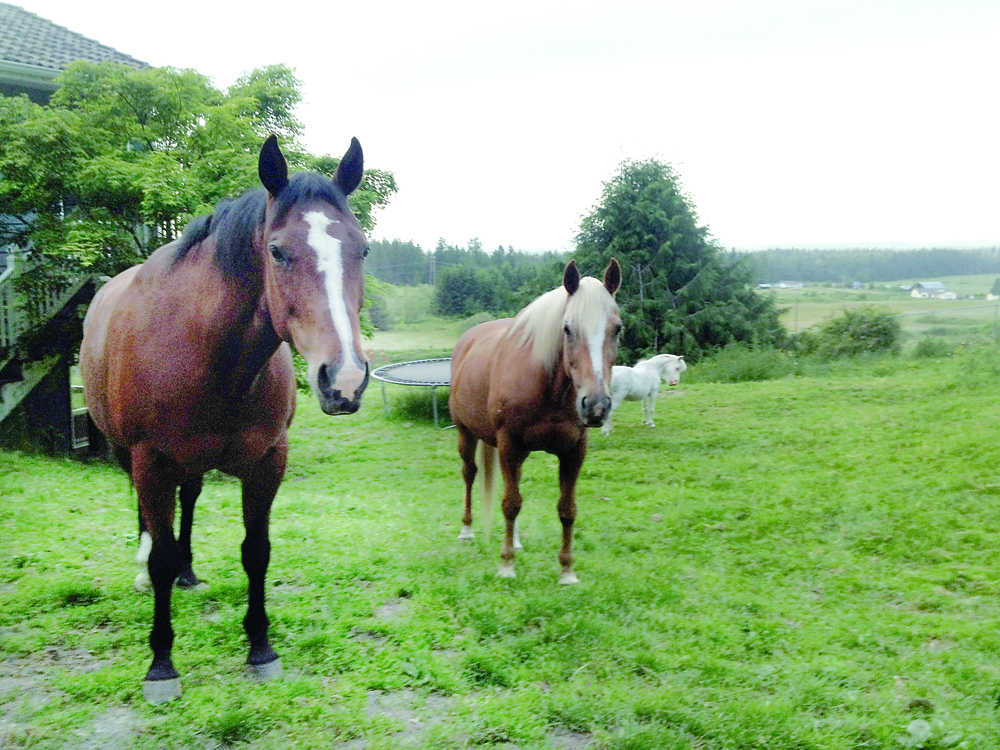
TO SHAKE, RATTLE and roll is fun when dancing to good music — not so much when it’s an involuntary movement coming from your horse.
About a year ago, my farrier and I noticed Indy’s reluctance to pick up his right hind hoof.
Occasionally, it even shook slightly when first picked up, and then after a few seconds, it would stop.
At that time, we discussed the possibility of a neurological problem, but it seemed to go away until last month.
In early December, when our regions saw extremely cold temperatures, Indy developed a very large, and obviously painful, sheath, so I asked my horse vet, Dr. Erik Splawn, to come check Indy out.
He found nothing obviously wrong with Indy.
As a gelding, Indy could have become swollen simply from not moving around much in the cold weather or have been bitten by a spider in that region.
I mentioned Indy’s shaking hind leg, but when he picked up the hoof, Indy showed no sign of a problem.
He was reluctant to pick up the leg, but that could have been because of his swollen sheath.
Dr. Splawn took a blood draw to test for problems, such as cancer, but that came back negative.
He gave me medicine for Indy, and over time, the sheath went back to normal.
My farrier returned last fall.
Friend Z Barker suggested trying Brad Erickson.
Based in Forks and a graduate of Mission Farrier School in Snohomish, he came last week for the first time.
Naturally, before he started working on each horse, I briefly explained each one’s issues and behaviors.
With Indy, I shared his reluctance to pick up the hoof.
So Brad crouched down and moved in slowly to pick up the leg, avoiding lifting the hoof up high or sudden.
As soon as he started picking up the hoof, it started to tremor.
Brad, still keeping it low to the ground, held the hoof firmly until the tremors stopped.
Then he slowly flexed it forward and then back, but with no more signs of quivering.
He then repeated it on Indy’s left rear hoof.
Immediately, the lower part of the leg started quivering.
I was shocked. There had never been any previous sign of a problem on the left.
“Definitely looks like some nerve problem,” Brad said. “Could be nerve damage caused by trauma — he kicked something or got kicked — or he’s got something neuromuscular going on. I don’t think it’s stringhalt because he’s not suddenly jerking it up or out.”
Behaviors
Of course after he left, I immediately went online to research equine neuromuscular problems.
It seems the three most common are stringhalt, shivers and equine polysaccharide storage myopathy (EPSM).
Stringhalt has a quicker, more spastic type of movement.
EPSM is a metabolic condition related to skeletal muscle dysfunction, which has to do more with muscle weakness, stiffness and even behavioral changes.
Shivers seems to describe Indy’s behavior: “When someone reaches down to touch the leg and asks for it to be held off the ground, or as soon as it’s lifted, the leg starts to shake or quiver for 10-30 seconds. The condition can also come and go.”
That certainly describes Indy’s problem.
Of course, at this stage, I can’t be certain of anything except he does have something going on involving his nerves.
Through research, I learned horses affected with shivers share some of the same metabolic issues that affect those with EPSM, so I am going to try to follow the feeding suggestions, which are designed to move the horse away from a high carbohydrate diet and to provide approximately 20 percent to 25 percent of total daily calories from protein and fat.
I’ve never been a believer in giving a horse rolled oats (oats with molasses).
For that reason, I used to supplement the horses’ feed with Purina Strategy, which has high protein, fat and oils, and is low carb.
It was only because the feed store that sells it is farther to drive that I recently switched to a senior feed, which may have high fat but also has molasses in it, so it’s also high carbohydrate, and according to research, that is to be avoided.
Obviously, I will be switching back.
There are other brands of appropriate feeds, so read the labels.
While it can take about four months to be able to tell if a feed routine is working for your horse, often you can quickly tell by your horse’s behavior, or even the hoof growth, if something is not working.
For example, when Lacey was working hard and competing in barrel racing, I fed her Purina Ultium because it gave her the extra nutrients and energy she needed.
But in the off seasons, she got too hyper.
She did well when I switched back to Strategy.
So that’s my plan for now: to feed local grass hay (avoiding the first cutting, as that’s higher in sugars and carbs), a salt lick and supplement it with Strategy.
Likely, I will include more vitamins or minerals as I learn more about the disease.
Reminder
When riding on public trails in town, such as the Discovery Trail, Robin Hill Park or Larry Scott Trail, please practice Leave No Trace habits in parking lots and kick all manure piles off to the side of the trail.
Let’s all do what we can to keep those trails open to horses.
________
Karen Griffiths’ column, Peninsula Horseplay, appears every other Wednesday.
If you have a horse event, clinic or seminar you would like listed, please email Griffiths at kbg@olympus.net at least two weeks in advance. You can also write Griffiths at PDN, P.O. Box 1330, Port Angeles, WA 98362.
