
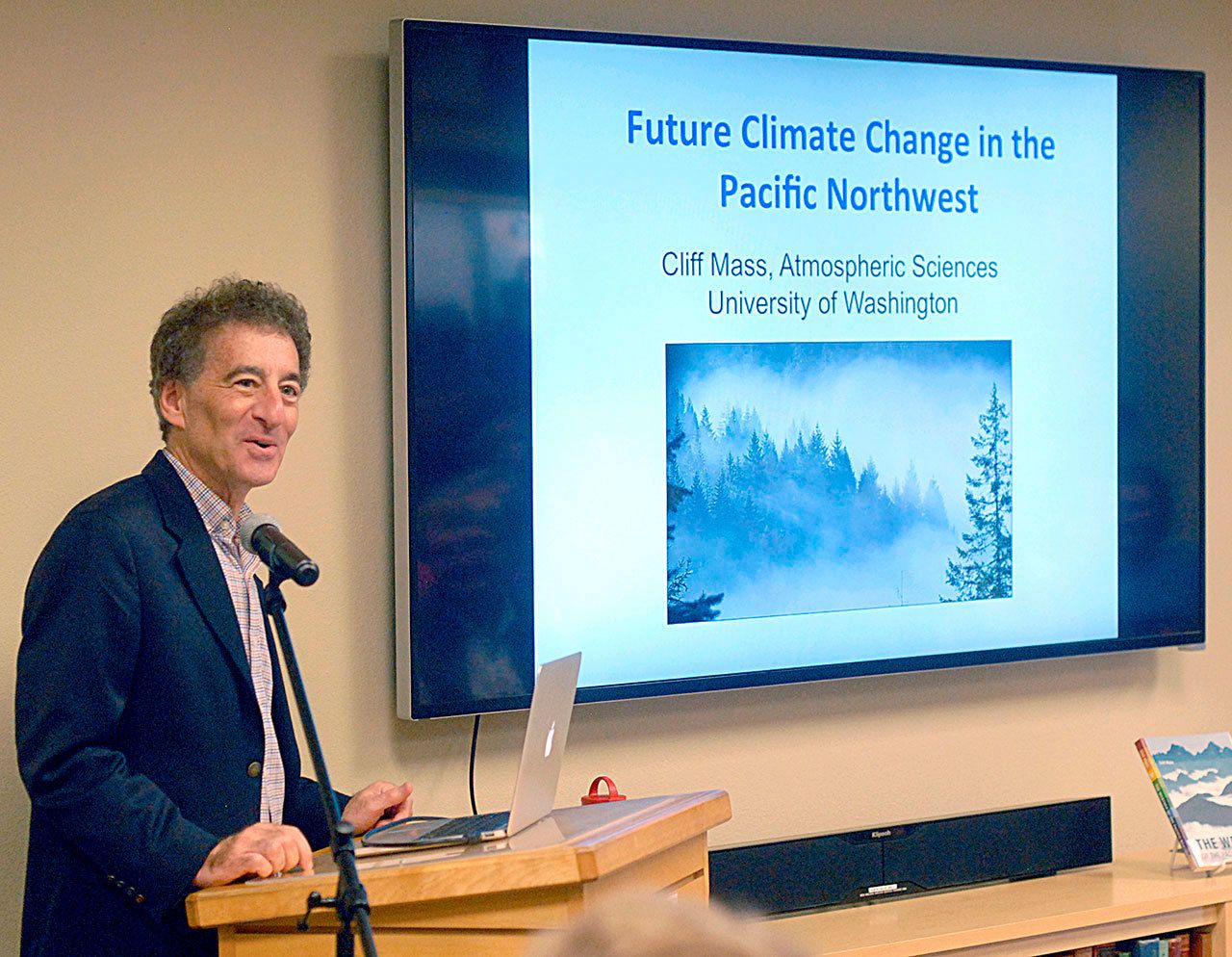
PORT ANGELES — Climate change has had little effect so far on the North Olympic Peninsula, a prominent scientist told a Port Angeles audience this week.
That will change later this century when the impacts of anthropogenic, or human-caused global warming become profound, said Cliff Mass, University of Washington atmospheric sciences professor and Northwest weather expert.
“It’s going to happen and we’ve got to get ready for it,” Mass said in a Wednesday lecture at the Port Angeles library.
Climate change is the sum of natural variability and such human influences as greenhouse gas emissions, Mass said.
“Up until now, natural variability has dominated over human greenhouse gas impacts,” Mass said.
“But this is going to change, particularly by the end of the century.”
Using long-range computer models, Mass and his colleagues predict that the state will warm by 3 to 8 degrees Fahrenheit by 2100.
The good news is that Northwest precipitation is expected to increase, albeit slightly, while other regions experience drought.
The bad news is that global warming will result in less snow and more rain in the Pacific Northwest, Mass said.
“That’s a serious issue, because we store water in the snowpack,” Mass said.
Perhaps the biggest impact from climate change in the Northwest will be flooding, Mass said.
Atmospheric rivers or Pineapple Expresses — warm, moist currents of water vapor stemming from tropics — will intensify, Mass said.
“It appears that we’re going to have what we call super atmospheric rivers,” Mass said.
“These atmospheric rivers are big rain producers.”
Contrary to media reports and warnings from some politicians, there is no evidence that climate change will result in more intense windstorms, Mass said.
“There is so much hype in the media it drives you crazy,” Mass said.
“You’ve got to be aware of those who hype that the current events, that current storms are an indicator of global warming.
“But you’ve got to be wary about the other folks who say that global warming is not an issue,” Mass added.
“They’re both wrong. It is an issue, but most of the action is coming up.”
A standing-room-only crowd of more than 150 packed the library’s Raymond Carver Room for the 90-minute lecture.
Mass broadcasts a weekly weather information segment on KPLU, a Seattle-Tacoma public radio station, and authors a popular weather blog at www.cliffmass.blogspot.com.
He also penned the 2008 book “The Weather of the Pacific Northwest.”
Because of the influence of the Pacific Ocean, coastal regions like the North Olympic Peninsula will warm up more slowly than inland areas like Eastern Washington, Mass said.
“There’s a lot of thermal mass in the oceans,” Mass said.
“It takes time to warm them up.”
Mass displayed a graph depicting the daily mean temperature in Port Angeles dating back to 1895. The graph showed a series of peaks and valleys but no clear trend.
“It hasn’t changed,” Mass said.
“There’s really no overall trend in temperature here in Port Angeles. That’s true of a lot of the coastal areas in the state. The reason? The Pacific hasn’t warmed up.”
Similarly, precipitation in Port Angeles has been fairly constant since 1920.
“This is the story around here,” Mass said.
“The climate hasn’t changed much. But by the end of the century it probably will.”
Even without any influence of greenhouse gases like carbon dioxide, Mass said there is “no doubt” that anthropogenic climate change has already hit the Northwest.
Examples of human-caused climate change include irrigation in Eastern Washington, which cooled the area by 1 to 4 degrees, and the growth of cities like Seattle that have warmed low-level temperatures by 2 to 10 degrees because of combustion, the buildings and concrete.
Jets and fossil fuel-burning ships leave trails of clouds that affect the weather.
Even if there were no humans, the climate still would change because of natural variability.
“It gets complicated fast, but there are interactions between the atmosphere and the ocean that can produce this variability, and a good example of this interaction is El Nino and La Nina,” said Mass, referring to seasonal temperature changes in the tropical Pacific.
“This affects the weather over the whole planet.”
Other examples of natural variability include planet-cooling volcanic eruptions, long-term El Nino-like Pacific decadal oscillations and changes in solar radiation.
Glaciers began melting more than a century ago because of natural variability, Mass said. Humans are now “helping it along,” he said.
“There’s now a new player in climate change, one whose impacts are increasing substantially in time, and that’s increasing greenhouse gases,” Mass said.
Greenhouse gases like carbon dioxide and methane warm the planet by trapping heat at the surface like a blanket.
Concentrations of greenhouse gas have been “increasing very rapidly lately” since World War II, Mass said.
Scientists use powerful computers to predict how greenhouse gases will affect the climate.
“If we know the gases in the atmosphere, we have a real insight into how much radiation is coming in and out,” Mass said.
“We can use that to get the average predictions.”
The problem with global climate models is that they run at low resolution, Mass said.
One of the highest-resolution global models, for example, does not register the terrain of the Olympic or Cascade Mountains.
New technology has enabled scientists to run high-resolution weather models to simulate surface-level temperatures for the next century.
“It ain’t going to cool,” Mass said.
“It’s going to be a different climate at the end of the century.”
Even if humans stopped pumping greenhouse gases into the atmosphere, global warning would still occur because the oceans and atmosphere “haven’t caught up to what’s up there right now.”
“No matter what happens, additional warming is guaranteed,” Mass said.
Mass argued that societies must adapt to climate change and to endeavor to make drastic reductions in greenhouse gas emissions.
“We’re going to do something really big to change the direction that it’s going, and we’re going to have to change India and China,” he said.
“The real problem that no one wants to talk about is overpopulation of the planet. The fact is that other people living on this planet want to live like we do. You can’t blame them.”
During a question and answer session, Mass said sea level rise will be less profound on the North Olympic Peninsula than in other places because the land is still rebounding from the last glaciation.
“If you go down the coast south of Hoquiam, the sea level rise will be substantial,” Mass said.
“I see all kids of estimates, typically in the order of one to one-and-one-half feet by the end of the century.”
Mass said the warm summer of 2015 was a “dry run of global warming.”
“We know what the end of the century is going to be like, and we experienced it,” Mass said.
“The conditions that we had, not this summer but the last summer, were very much like what 2080 is going to be like.”
Given the time it takes for governments to plan ahead, Mass was asked whether he felt that “a little hyperbole” could be forgiven in climate science.
“I don’t think so,” Mass said.
“I think that it’s really important to tell the truth, to give the straight story.
“I think that when you exaggerate, in the end it undermines.”
Government officials and other decision-makers need the most accurate information to make the right decisions, Mass said.
“I think it’s really important to tell the straight scoop, not to exaggerate and not to cry wolf,” Mass said.
”It’s certainly not my job as a scientist to exaggerate.”
Reporter Rob Ollikainen can be reached at 360-452-2345, ext. 56450, or at rollikainen@peninsuladailynews.com.
