
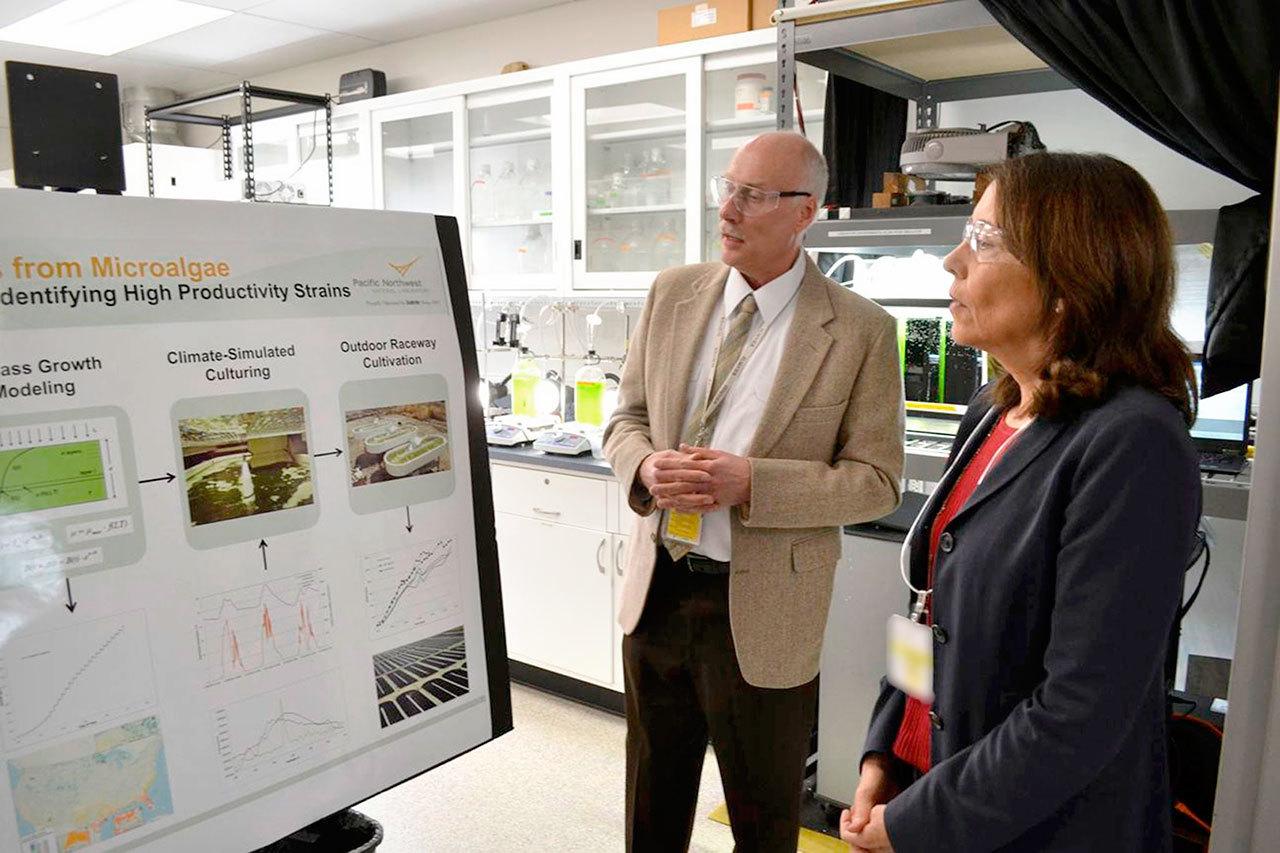
Dr. Michael Huesemann, lead researcher for the algae biofuel program in Sequim’s Pacific Northwest National Laboratory, meets with U.S. Sen. Maria Cantwell briefly in July 2016 about algae and its potential. His current project looks to find the best growing conditions for algae to harvest biofuel quickly. (Matthew Nash/Olympic Peninsula News Group)                                Dr. Michael Huesemann, lead researcher for the algae biofuel program in Sequim’s Pacific Northwest National Laboratory, meets with U.S. Sen. Maria Cantwell, D-Mountlake Terrace, briefly in July 2016 about algae and its potential. His current project looks to find the best growing conditions for algae to harvest biofuel quickly. (Matthew Nash/Olympic Peninsula News Group)

Dr. Michael Huesemann, lead researcher for the algae biofuel program in Sequim’s Pacific Northwest National Laboratory, meets with U.S. Sen. Maria Cantwell briefly in July 2016 about algae and its potential. His current project looks to find the best growing conditions for algae to harvest biofuel quickly. (Matthew Nash/Olympic Peninsula News Group) Dr. Michael Huesemann, lead researcher for the algae biofuel program in Sequim’s Pacific Northwest National Laboratory, meets with U.S. Sen. Maria Cantwell, D-Mountlake Terrace, briefly in July 2016 about algae and its potential. His current project looks to find the best growing conditions for algae to harvest biofuel quickly. (Matthew Nash/Olympic Peninsula News Group)

Sequim lab looks to find the best biofuel in algae

SEQUIM — Scientists at the Pacific Northwest National Laboratory’s Marine Sciences Laboratory are turning algae inside out to find the best biofuel possible.

Dr. Michael Huesemann, a lead researcher, said algae is a promising clean energy but expensive to harness effectively.

“The price of biofuel is largely tied to growth rates,” he said. “Our method could help developers find the most productive algae strains more quickly and efficiently.”

Huesemann, who has worked with algae for 16 years, started on the $6 million, three-year algae DISCOVR project (Development of Integrated Screening, Cultivar Optimization and Validation Research) in October 2016 with a small team of senior and junior scientists in Sequim.

“What we’re really interested in are carbon-neutral biofuels that can be grown in the United States,” he said.

“We haven’t found any algae that grows fast enough or provides enough biofuel, so we’re trying to find microalgae that grows fast to make biofuels.”

Huesemann said there are millions of strains in nature to sort through, so rather than a “shotgun approach and randomly screening” they are “doing an organized, rational screening.”

Finding the best algae is broken into a process of five tiers among labs in Sequim, three other Department of Energy labs — Los Alamos National Laboratory, National Renewable Energy Laboratory, Sandia National Laboratories and Arizona State University’s Arizona Center for Algae Technology and Innovation.

Previously, researchers tried to evaluate algae in test tubes but find lab results don’t always mirror outdoor ponds, laboratory officials said.

In Tier I, scientists in Sequim and New Mexico test up to 30 different algae strains to see how weather-tolerant they are, and the top third will go to Tier II, Huesemann said.

In Tier II, Sequim houses a unique climate-simulating system called LEAPS (Laboratory Environmental Algae Pond Simulator) that simulates climates and seasons around the world inside glass cylinder photobioreactors.

Two other labs will evaluate the algae to see if there is any value in its compounds that could be used for products like food dye phycocyanin, which could make algae biofuel production more cost-effective, Huesemann said.

Scientists also will research how resilient certain algae strains are to predators, like protozoans, and other competing algae.

Huesemann anticipates Tier I and II being conducted this year, he said.

For Tier III, researchers in New Mexico will further test top-performing algae strains, Huesemann said, which includes “forcing cells to grow faster or generate more oils, using state-of-the-art laboratory techniques such as directed evolution and fluorescence-assisted cell sorting.”

Afterward, strains will travel to outdoor ponds in Arizona for study as part of Tier IV to compare biomass output with earlier steps. Lastly, scientists will study the algae strains that performed the best in different lighting and temperature conditions for Tier V.

Data will go into the Pacific Northwest National Laboratories’ Biomass Assessment Tool to help researchers generate maps that illustrate the expected biomass productivity of each algae species grown in outdoor ponds “all over the U.S. in different seasons on any day of the year,” Huesemann said.

Once the study is complete, research will be made public for companies and other researchers.

Laboratory officials said work that could stem from this project includes converting harvested algae into biofuels, examining operational changes such as crop rotation to further increase biomass growth and assessing the technical feasibility and economic costs of making biofuel from algae selected through this process.

For more on the experiment, visit www.pnnl.gov/news or marine.pnnl.gov.

________

Matthew Nash is a reporter with the Olympic Peninsula News Group, which is composed of Sound Publishing newspapers PeninsulaDaily News, Sequim Gazette and Forks Forum. Reach him at mnash@sequimgazette.com.
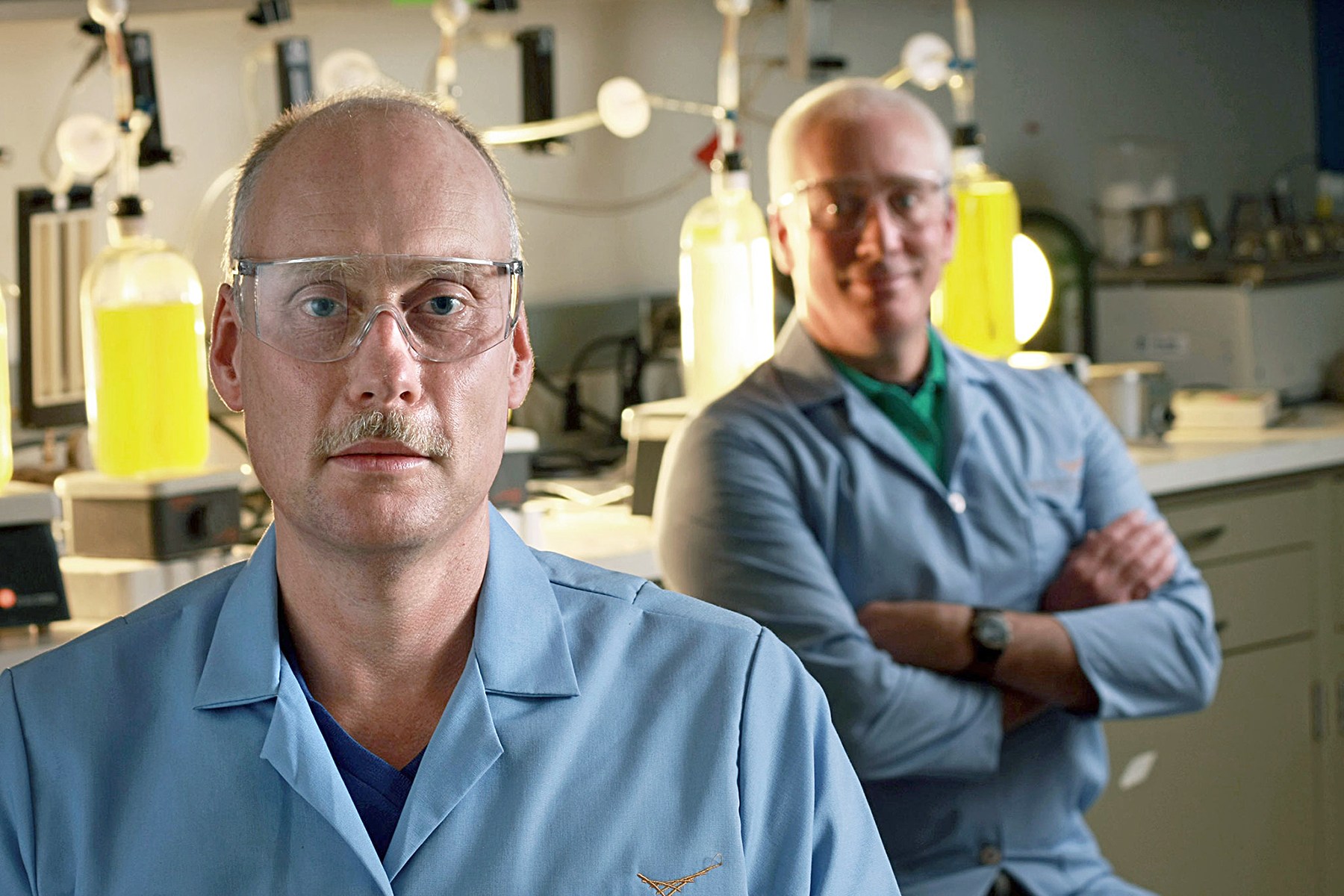
Scientists Michael Huesemann, in front, and Tom Hausmann continue work on finding the best strains of algae for biofuel production. (Pacific Northwest National Laboratory)

Scientists Michael Huesemann, in front, and Tom Hausmann continue work on finding the best strains of algae for biofuel production. (Pacific Northwest National Laboratory)

More in News

Art Director Aviela Maynard quality checks a mushroom glow puzzle. (Beckett Pintair)
Port Townsend puzzle-maker produces wide range

Christmas, art-history and niche puzzles all made from wood

Food programs updating services

Report: Peninsula sees need more than those statewide

U.S. Rep. Emily Randall, D-Port Orchard.
Randall bill to support military families passes both chambers

ANCHOR legislation would require 45-day relocation notification

x
Home Fund supports rent, utility assistance

St. Vincent de Paul helps more than 1,220 Sequim families

EYE ON THE PENINSULA: Peninsula boards set to meet on Monday

Meetings across the North Olympic Peninsula

Hill Street in Port Angeles is closed due to a landslide. (Dave Logan/for Peninsula Daily News)
Hill Street closed due to landslide

Hill Street is closed due to an active landslide.… Continue reading

Tippy Munger, an employee at Olympic Stationers on East Front Street in Port Angeles, puts out a welcoming display for holiday shoppers just outside the business’ door every day. She said several men have sat there waiting while their wives shop inside. (Dave Logan/for Peninsula Daily News)
Holiday hijinks

Tippy Munger, an employee at Olympic Stationers on East Front Street in… Continue reading

Hospital begins recorded meetings

Board elects new officers for 2026

From left to right, Frank Hill, holding his dog Stoli, Joseph D. Jackson, Arnold Lee Warren, Executive Director Julia Cochrane, monitor Janet Dizick, holding dog Angel, Amanda Littlejohn, Fox and Scott Clark. (Elijah Sussman/Peninsula Daily News)
Winter Welcoming Center has expanded hours

Building provides respite from November through April

Wastewater bypass prompted no-contact advisory

The city of Port Angeles has clarified Monday’s wastewater… Continue reading

A crew from the Mason County PUD, in support of the Jefferson County PUD, works to replace a power pole and reconnect the power lines after a tree fell onto the wires and damaged the pole at the corner of Discovery Road and Cape George Road, near the Discovery Bay Golf Course. Powerful winds on Tuesday and early Wednesday morning knocked out power across the Peninsula. The majority had been restored by Wednesday. (Steve Mullensky/for Peninsula Daily News)
Reconnecting power

A crew from the Mason County PUD, in support of the Jefferson… Continue reading

Port Angeles council passes comp plan update

Officials debate ecological goals, tribal treaty rights