
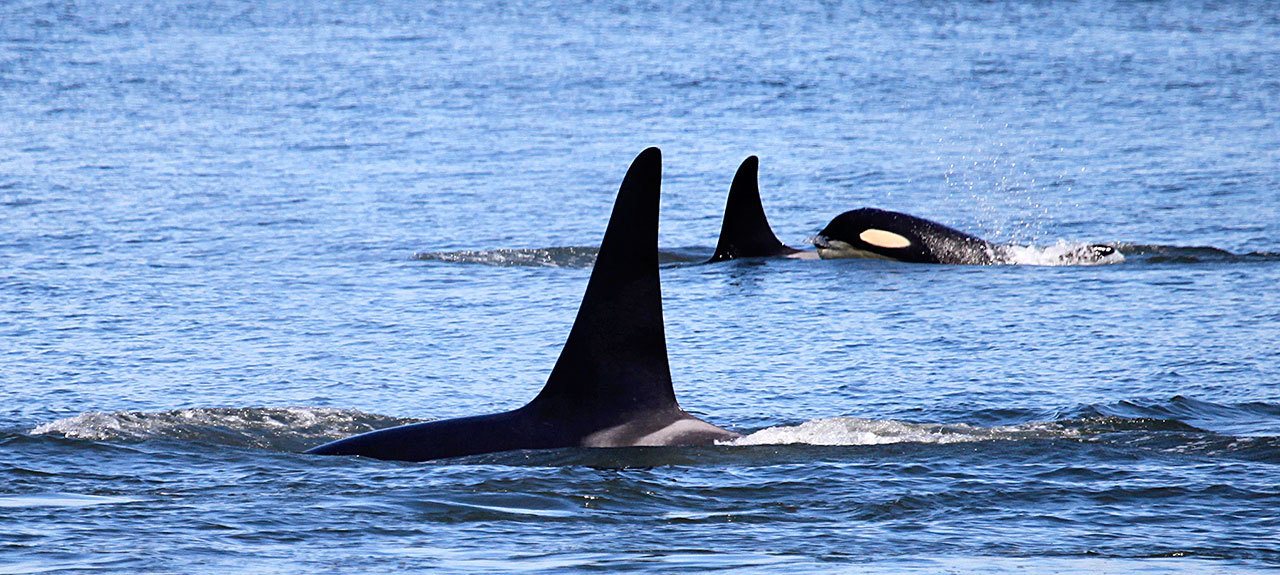
Environmental activists from the United States and Canada are expressing concerns over a newly approved expansion of a Canadian oil pipeline, saying it could threaten the Puget Sound’s southern resident orcas.
Canadian Prime Minister Justin Trudeau in November approved the Kinder Morgan Trans Mountain pipeline expansion, which would drastically increase the amount of oil being transported from the oil sands in Alberta to Burnaby, B.C., a city just east of Vancouver.
“It definitely will be a Canadian Standing Rock,” said Paul Magid, a member of the Jefferson County Stand with Standing Rock caravan, which recently returned from protests of the Dakota Access Pipeline on the Standing Rock Sioux reservation in North Dakota.
“All of us down here who are gearing up for Standing Rock are watching what’s happening up there. You can expect a lot of people getting involved to try and stop that.”
The pipeline itself isn’t the main concern, according to Shari Tarantino, president of the board for the Orca Conservancy.
“Our largest concern is the traffic coming through the Georgia Strait and Puget Sound,” Tarantino said.
Currently, the Trans Mountain pipeline, in operation since 1953, moves about 300,000 barrels per day between Edmonton, Alberta and Burnaby, according to Kinder Morgan on its website at www.kindermorgan.com. The newly approved expansion, expected to cost $6.8 billion in Canadian dollars, would nearly triple that, moving 890,000 barrels per day.
According to the Kinder Morgan outline of its Puget Sound systems, once the oil reaches the coast, it is pumped on to tankers, which sail through the Georgia Strait, San Juan Islands and Puget Sound to reach Washington oil refineries in Anacortes, Cherry Point and Ferndale.
More oil means more tankers sailing through the already critical habitat of the south resident orcas, which are listed as endangered under the Endangered Species Act and under the Canadian Species At Risk Act, according to the National Oceanic and Atmospheric Administration (NOAA).
“Any increase in shipping traffic will hurt the acoustic ability of the southern resident whales,” said Jenny Atkinson, the executive director of the Whale Museum in Friday Harbor.
“The whales use sound to find food, map their environment and communicate. With more shipping noise, they’ll have a harder time doing what they need to do.”
Aside from shipping noise, more oil tankers come with an increased possibility of oil spills.
“One oil spill and we’d likely lose the population,” Tarantino said. “Statistically we can expect a major spill every seven years.”
Tarantino estimated that tanker traffic in the Puget Sound will go from roughly 60 tankers sailing per year to more than 420.
The southern resident killer whales are the only resident population in the U.S., according to NOAA. There are three pods of southern residents: J, K and L.
As a species, the whales have been listed as critically endangered since 2003 and their habitat — including the Strait of Juan de Fuca, Georgia Strait, the San Juan Islands and inland Puget Sound — was designated a critical habitat in 2006, according to NOAA.
“It’s definitely a critically endangered population with 81 members,” Tarantino sad. “The population has shown time and time again that they’re up against incredible odds. If we keep throwing obstacles in their way, one of these days, they’re not going to recover.”
________
Jefferson County Editor/Reporter Cydney McFarland can be reached at 360-385-2335, ext. 55052, or at cmcfarland@peninsuladailynews.com.
