
By Phuong Le
The Associated Press
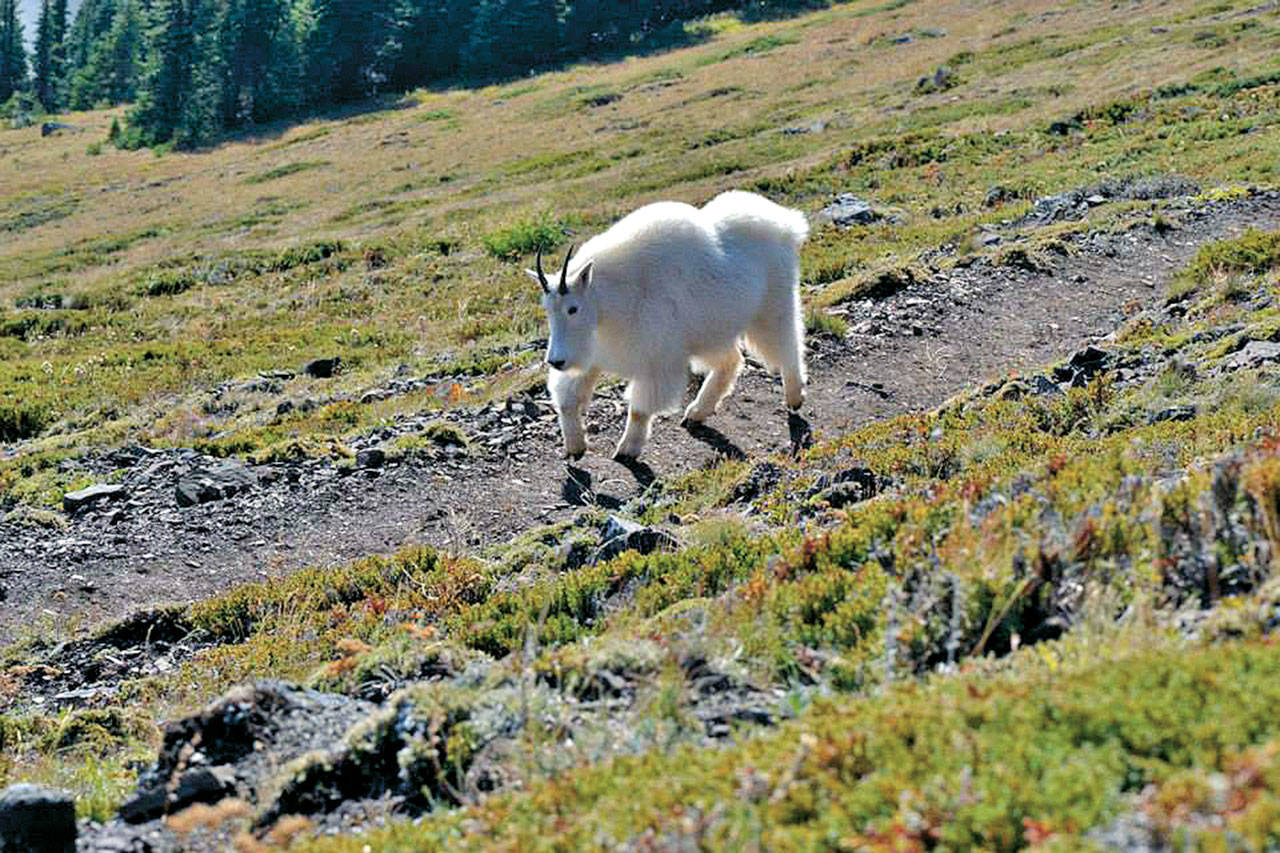
OLYMPIC NATIONAL PARK — Olympic National Park officials are weighing several options to remove or kill mountain goats in the park, including a plan to capture and relocate as many of the animals as possible and shooting others.
Public comment will be accepted until Sept. 26 on the options in the draft environmental review that was released Monday.
A public meeting — the only one on the North Olympic Peninsula — is planned from 6 p.m. to 8 p.m. Aug. 15 at the Olympic National Park Visitor Center, 3002 Mount Angeles Road. A 15-minute presentation will be followed by an open house in which staff will answer questions.
Park officials said the plan will allow them to reduce environmental impacts and protect public safety.
Mountain goats, which are not native to the Olympic Peninsula, have long posed an environmental problem for the park. The fatal goring of Bob Boardman, a Port Angeles man, on Klahhane Ridge in October 2010 raised new concerns.
The park’s preferred alternative calls for capturing and relocating goats to national forests in the North Cascade Mountains, where mountain goats are native, and then switching to lethal removal when capturing isn’t possible.
Three other options include killing the goats using shotguns and high-powered rifles from helicopters, relocating them or taking no action.
“It’s a real plus to be able to move them from the Olympics, where they’re not native, to areas of the North Cascades,” said Louise Johnson, the park’s chief of resources management.
Taking no action means the park would rely on its current plan, which focuses on hazing or killing individual goats that are dangerous.
The park began studying ways to manage the increasing goat population in 2014, four years after Boardman, a 63-year-old hiker, was fatally attacked by a mountain goat. Boardman was trying to protect his wife and a friend when the goat gored him, severing arteries in his thigh.
Park officials say they want to reduce safety risks as the potential for interactions between humans and goats increase.
Goats can be a nuisance along heavily used trails and around wilderness campsites because they seek out salt and minerals from human urine, backpacks and sweat on clothing, according to the park.
Nearly a dozen goats were introduced to the Olympic Mountains in the 1920s in an apparent effort to establish a hunting population. Hunting was prohibited after the park was established in 1938. By 1983, however, the population numbers grew to more than 1,100.
In the 1980s, park officials used helicopters to capture and remove goats, but that program ended over safety concerns to staff. More than 500 goats were removed during that decade.
In 1995, the park considered eliminating the goat population by shooting the animals from helicopters. That plan was later tabled.
A survey last year found that the goat population had more than doubled between 2004 and 2016. More than 600 goats now graze the park’s alpine meadows and roam its rocky peaks.
The plan alternatives include actions proposed to occur within Olympic National Park and Olympic National Forest.
“We are pleased and grateful for our close collaboration with the Forest Service and the Washington State Department of Fish and Wildlife in developing the draft plan,” said acting Olympic National Park Superintendent Lee Taylor.
“Mountain goats are not native to the Olympic Peninsula and cause impacts to park resources and create safety risks for park visitors.”
Johnson said the park has been working closely with the U.S. Forest Service and state Department of Fish and Wildlife on the proposal to capture and relocate goats to Mount Baker-Snoqualmie and Okanogan-Wenatchee national forests in the North Cascades.
“There’s been ongoing conversation,” she said. “Everybody is on board.”
Some have expressed concerns to the park about stress and other injuries to goats that are relocated. Some have objected to killing the animals.
Tim McNulty with the conservation group Olympic Park Associates favors the goats’ removal. He said there’s overwhelming evidence that the goats are harming the natural landscape and plant habitat.
“They’re clearly non-native, and restoring the integrity of the alpine areas and protecting other animals is much more important than maintaining a non-native goat population,” he said.
The draft plan can be reviewed at parkplanning.nps.gov/OLYMgoat or at public libraries including those in Port Angeles and Port Townsend.
Comments will be accepted during the scheduled public meetings or can be mailed or hand-delivered to Superintendent, Olympic National Park, 600 E. Park Ave., Port Angeles, WA 98362. Comments will not be accepted by fax or email.
Other public meetings scheduled are Aug. 14 at the Olympic National Forest Supervisor’s Office, 1835 Black Lake Blvd. SW, Olympia; Aug. 16 at the Everett Public Library auditorium, 2702 Hoyt Ave., Everett; and Aug. 17, Seattle Public Library, 2300 Yesler Way, Seattle. All these meetings will be from 5 p.m. to 7 p.m.
________
Peninsula Daily News Executive Editor Leah Leach contributed to this report.
