
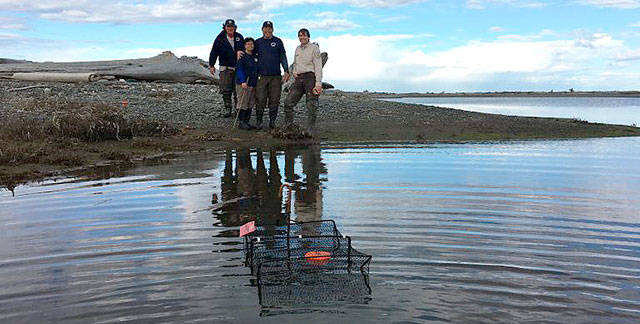
SEQUIM — As crabbing season reaches its midpoint in the area, state and federal resource managers report they’ve caught 87 of the invasive European green crabs on the Dungeness Spit.
The most recent totals from July 6 show they’ve trapped 51 males and 36 females, said Allen Pleus, Aquatic Invasive Species coordinator for the state Department of Fish and Wildlife, and that their sizes indicate they came from the same larvae group.
Dr. Emily Grason, Crab Team project coordinator through Washington Sea Grant, said in a recent blog post that the crabs’ sizes show they are a new population and likely floated to Sequim in 2016 but where they are coming from is still not determined.
“The most likely explanation for how green crab arrived there is that they floated in as larvae from another infested area,” she said.
That may be Sooke Basin, British Columbia, Grason said, but it’s also possible the crabs came from another part of Canada, Washington, Oregon, California or someplace else.
Resource managers continue to retrieve crabs for genetic analysis to determine their source, Grason said, and expect to have an answer in a few months.
Scientists across the globe regard the European green crab, which is identifiable by its five spines on each side of its eyes, as one of the worst invasive species on Earth. It’s been blamed by industry officials in the northeastern U.S. for severely damaging shellfish harvests and seagrass beds.
Lorenz Sollmann, deputy project leader at the Washington Maritime National Wildlife Refuge, said they’ve been trapping, depending on tides and staffing levels, 3 to 5 days a week.
Grason estimates resource managers have placed more than 2,400 traps since the first trappings.
All but one of the crabs was trapped in Graveyard Spit’s 550-meter channel.
Sollmann said the lone male crab was found in the eastern portion of Graveyard Spit’s east lagoon in late June.
“Every week we have continued to prospect in other areas or revisit sites that we’ve trapped at before but no (green crab) were caught earlier,” he said.
This week, they’ve placed 40 traps in the Graveyard Spit channel and 14 in the base lagoons. More than 100 crab traps were placed on various days in early May.
Grason said this time of year is “critical” because green crabs focus on reproducing rather than going after food in traps.
Fish and Wildlife staff have performed monthly early detection monitoring since 2001 in the refuge, and with Crab Team staff members’ help to realign traps, they found the crabs’ location in April.
Dungeness’ invasive green crab population is the third sighting since small populations were spotted at Westcott Bay on San Juan Island and Padilla Bay near Anacortes last summer.
Grason said those green crabs were scattered over large distances and with Dungeness’ concentration of green crabs, it likely means there are more hiding in the mud.
However, she maintains that “the population hasn’t yet reached the numbers that are seen in areas of greatest infestation, and they are, as far as we know, still confined to a relatively small location.”
Grason said on June 14-16, staff with the Crab Team and Neil Harrington, natural resources biologist for Jamestown S’Klallam Tribe, placed 75 traps near the mouth of the Dungeness River.
While no crabs were found, Harrington will continue to conduct trappings there and in Sequim Bay in suitable habitat locations, she said.
Resource managers also are making plans to work with the Lower Elwha Klallam to add one or two monitoring sites west of Dungeness Spit.
Grason said the potential for habitat in those areas is low but those shorelines could have received more larvae from up north.
In Dungeness, Pleus said “current plans call for continued intensive trapping throughout the summer.”
If you spot a European green crab, here’s what Washington Sea Grant and the Crab Team recommend you do:
• Take several pictures from different angles and distances for identification with a common object next to it for scale.
• Leave the crab in place because it’s illegal to possess one without a special permit.
• Email photos to crabteam@uw.edu and wait for a response.
For more resources on the green crab, visit https://wsg.washington.edu/crabteam/about/blog/.
________
Matthew Nash is a reporter with the Olympic Peninsula News Group, which is composed of Sound Publishing newspapers Peninsula Daily News, Sequim Gazette and Forks Forum. Reach him at mnash@sequimgazette.com.
