
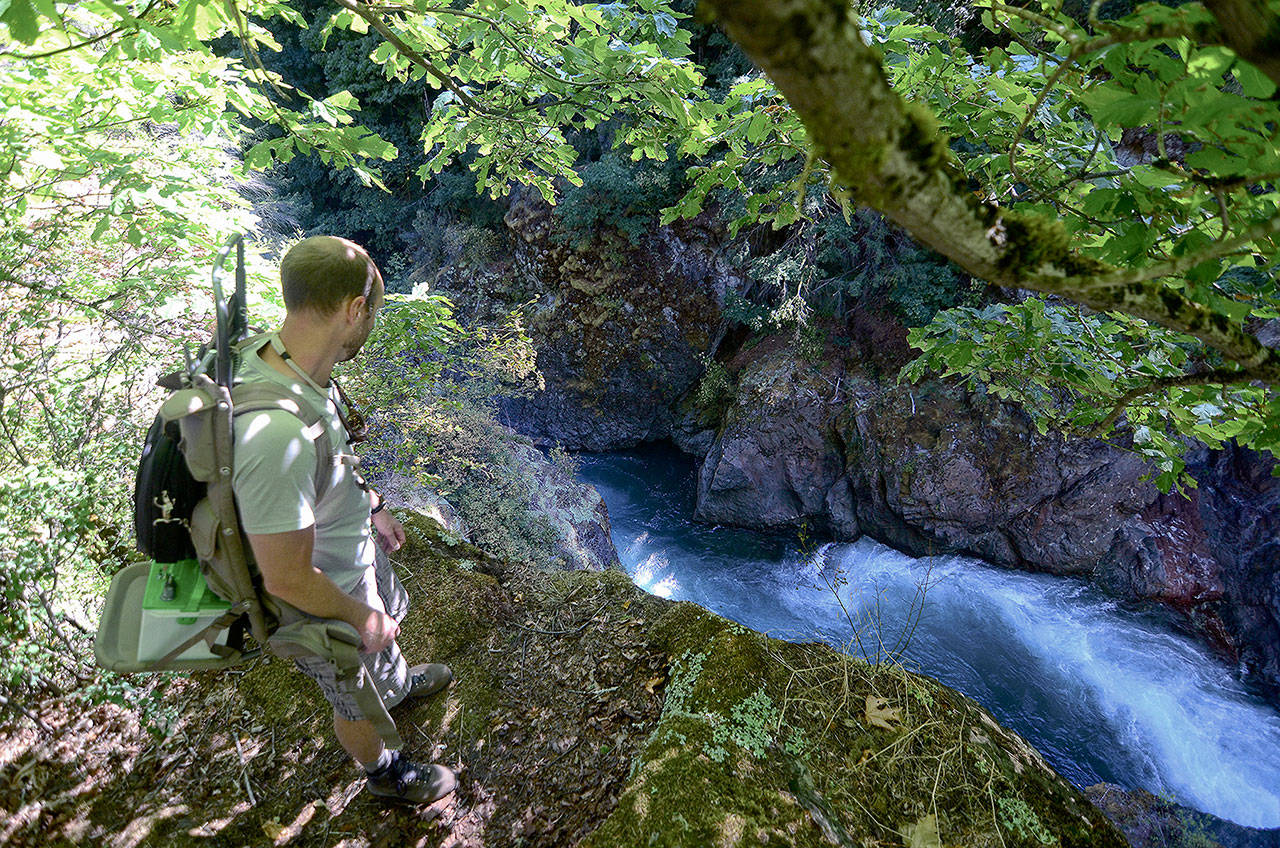
OLYMPIC NATIONAL PARK — Josh Geffre has watched with awe as salmon return to the uppermost reaches of the Elwha River.
Geffre, a fisheries technician for Olympic National Park, started monitoring the fish for the park in 2014 and has marveled as he’s seen most species swim upstream of the former Glines Canyon Dam.
“It’s very satisfying to know the fish are recolonizing into areas upriver of the former dam sites,” he said during a recent trip to collect data on the fish. “It’s exciting to watch them.”
The National Park Service led a $325 million effort to restore the Elwha River to its natural state with the removal of the Elwha and Glines Canyon dams. The fish-blocking dams were gone by 2014.
Ahead of schedule
In some ways the fish restoration effort is ahead of schedule, Pat Crain, a biologist for the park, said Wednesday.
Crain said populations are about what they are expected to be, but fish have moved farther into the headwaters earlier than scientists predicted.
“In that way, we’re ahead of things,” he said. “We’ve seen fish farther up the river than we had thought. We didn’t have a feel for how quickly fish would move way up in the headwaters.”
Crain said the restoration effort has been thought of in four phases: protection, recolonization, local adaptation and full restoration. Each phase is expected to last two cycles, which are typically about four years.
The populations are what were expected in the protection phase, but fish are behaving like they are in the recolonization phase, he said.
Populations returning to the river over the next couple years will still have been affected by the dam removal, but Crain anticipates spikes in fish population to begin within the next few years.
“Fish that spawned last year, their offspring and eggs incubated in ideal conditions and went out to sea in ideal conditions,” Crain said. “My hope in the case of the chinook is in three or four years we’ll see a good return off the fish that spawned.”
Fishing in the Elwha River and its tributaries is closed until June 1, 2019. Fishing in the river has been closed since 2011 to protect depleted native salmonid populations.
Crain said it’s too early in the restoration for the Elwha’s current runs to be compared to other rivers in the region, but it’s believed the Elwha runs one day will exceed those in nearby rivers.
Fish are monitored
As fish populations return to one of the most heavily-monitored watersheds in the state, Crain said crews use a number of different strategies to track how many fish are entering the river, their behavior in the river and the number of fish heading out to sea.
Geffre is often in the field tracking their behavior in the Elwha River and frequently uses telemetry receivers to track the locations of tagged fish. He travels to several fixed sites each week to download information from receivers in the field.
While traveling to each site, he carries a mobile receiver to track the locations of fish in real-time. If he hears a “chirp” over the radio, he knows there’s a fish within about one-third of a mile.
When there’s a hit, the receiver shows information about a specific fish that was tagged and Geffre records its location.
On July 31, he recorded the first chinook of this year making it over the former Elwha Dam site.
About once a month, Geffre takes a Rite Brothers Aviation plane to track fish in the uppermost parts of the river. Using aerial telemetry the park has found that bull trout have been the ones to use the headwaters more than any other species since the project began, Geffre said.
“They have been the champion of this project,” he said. “They have given us the most information, I would say, on spacial distribution.”
Telemetry is just one of the strategies.
Others include SONAR surveys to document the number of returning adult chinook salmon and steelhead trout, smolt trapping to determine the number of juvenile fish that are going to sea, snorkel and redd surveys to assess distribution of juvenile and adult fish, DNA sampling to assess distribution, biological sampling to determine contribution of hatchery and natural origin fish and monitoring of key habitat indicators.
Monitoring ecosystem recovery in the Elwha is a cooperative effort by Olympic National Park, Lower Elwha Klallam Tribe, U.S. Fish and Wildlife Service, U.S. Geological Survey, National Oceanic and Atmospheric Administration Fisheries, and Washington Department of Fish and Wildlife.
“This work — the monitoring and tracking — is really a unique collaborative effort,” Crain said. “One agency wouldn’t have been able to pull off all this.”
According to the Environmental Impact Statement for the dam removal, once the fisheries are restored the river could see more than 31,000 chinook per year, more than 34,000 coho per year and more than 10,000 steelhead per year.
It was predicted nearly 275,000 pink salmon would be produced in the Elwha River annually.
Crain said timelines and population peaks identified in the EIS for restoration are within reach. When the fish runs hit those numbers is when scientists will know the restoration is complete, Crain said.
“Then we will have done the job,” he said. “Everything is to the point where the river is taking care of itself.”
________
Reporter Jesse Major can be reached at 360-452-2345, ext. 56250, or at jmajor@peninsuladailynews.com.
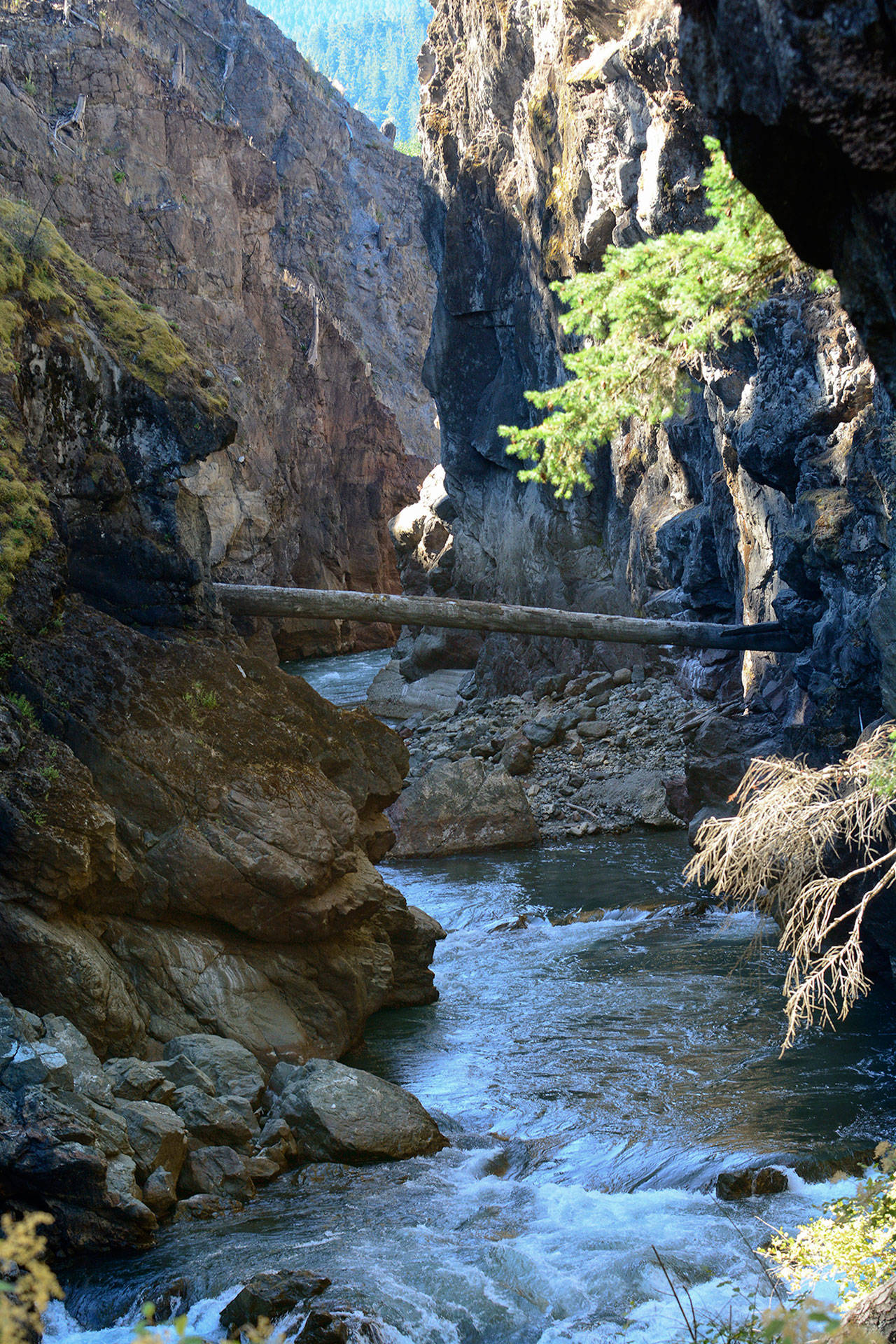
The Elwha River rushes through Glines Canyon, a site that had been difficult for fish to navigate past until officials blasted boulders that blocked the river. (Jesse Major/Peninsula Daily News)
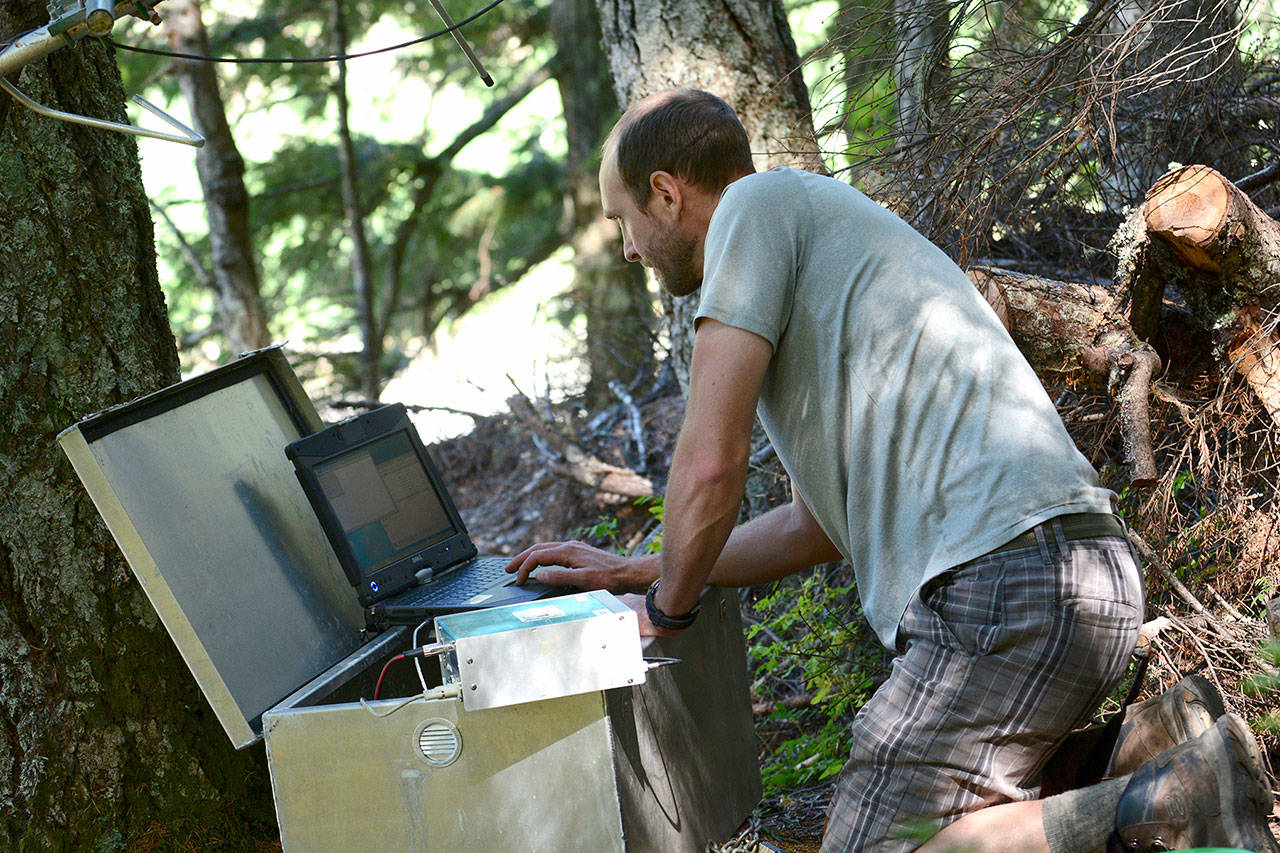
Olympic National Park fisheries technician Josh Geffre downloads fish tracking data from one of several fixed sites on the Elwha River on July 31. (Jesse Major/Peninsula Daily News)
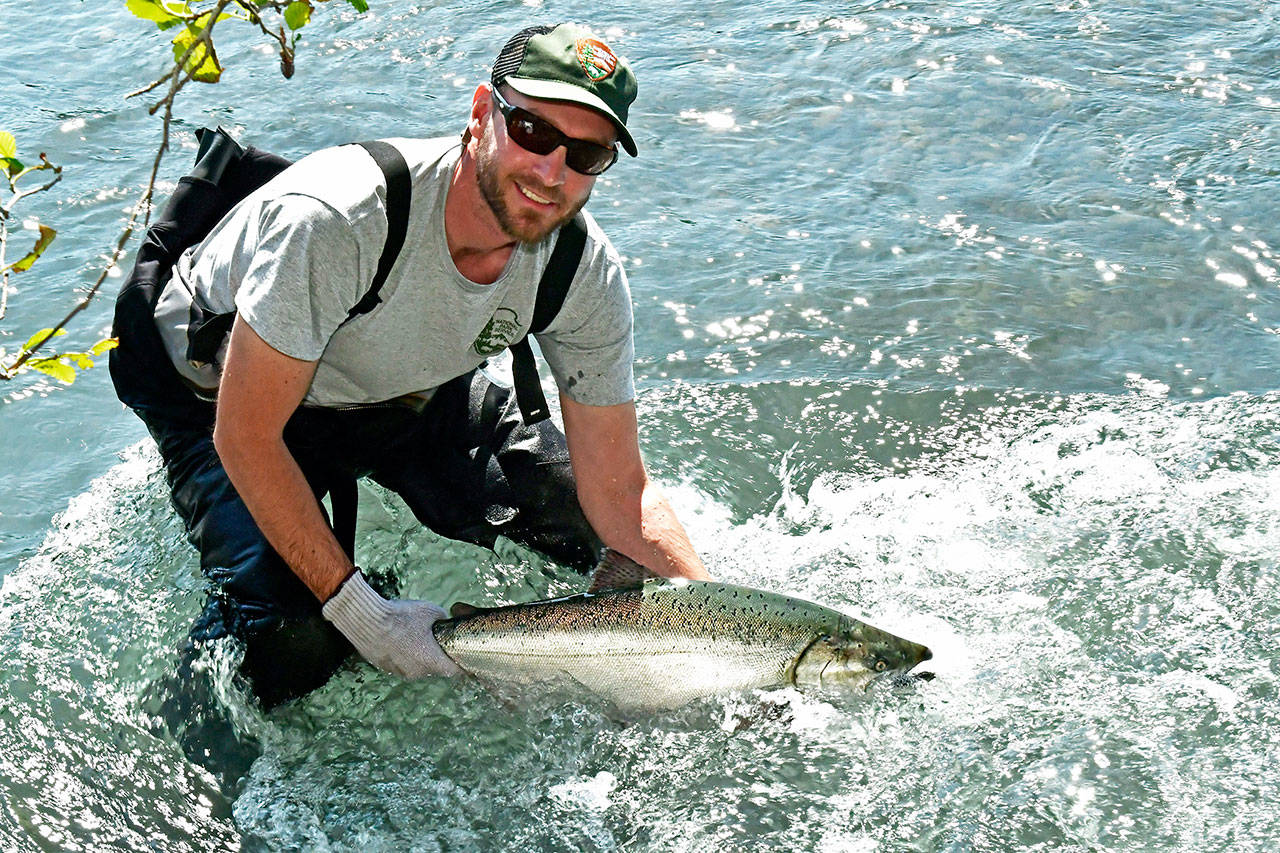
John Chao/National Park Service (top); Jesse Major/Peninsula Daily News (above) Josh Geffre, at top, a fisheries technician for Olympic National Park, holds a chinook salmon from the Elwha River. Above, the river rushes through Glines Canyon, a site that had been difficult for fish to navigate past until crews blasted boulders that blocked it.
