
PORT TOWNSEND — A collaborative project on dry land aims to help keep pollutants out of Port Townsend Bay.
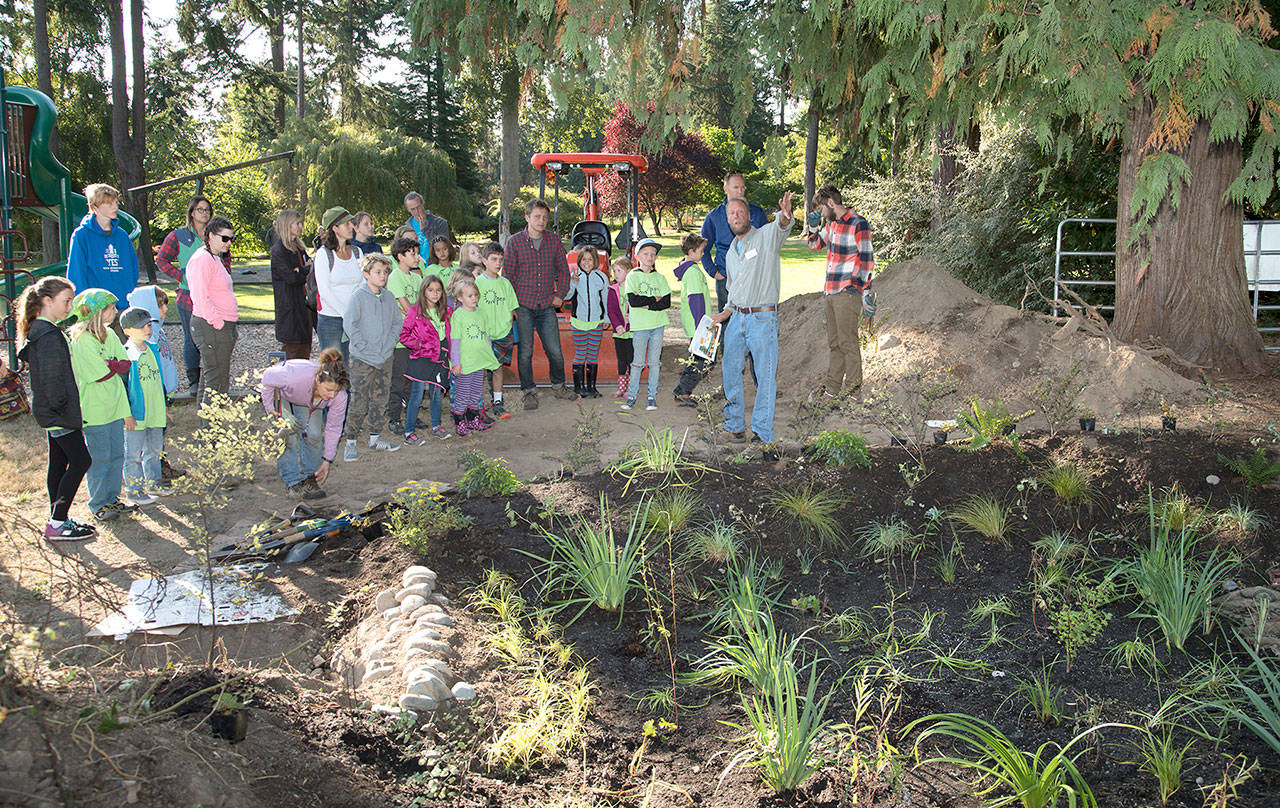
Work from several parties, including by some 45 students, on a 25-foot-by-25-foot rain garden in Chetzemoka Park was finished Friday.
“It took the partnership,” said Bob Simmons, associate professor with Washington State University Extension, who designed the garden.
“The Jefferson County Marine Resources Committee had the funding, WSU had the expertise and the city of Port Townsend gave us permission and labor and machinery,” Simmons said. “Then volunteers came out and did the planting.
“It really takes a village to make these things happen if you don’t have a big budget,” he said, adding that the rain garden cost about $12,000 when one takes into account staff time, plants and volunteers.
“Nobody [state or federal authorities] said we have to do it,” Simmons said.
“We’re taking care of ourselves right here.”
The rain garden on the northeast corner of the park at Roosevelt and Hudson streets will filter out contaminants in stormwater before they reach the water.
“The rain garden acts like a big sponge,” Simmons said.
A gully from a storm drain outfall was deepened and filled up to about 18 inches with a special soil mix of 40 percent compost and 60 percent sand. That left about 6 inches for the water to pond up and sink in.
“The compost and sand mixture is good for taking out contaminants,” Simmons said.
Students from Port Townsend School District OPEPO (Optional Educational Program) planted plants — which also help to break down contaminants — and spread mulch, he said.
The plants are a mixture of a native and non-native varieties, he said.
“We were careful to pick ones that are deer-tolerant,” Simmons said. “We have a lot of deer here.”
The plants also were chosen for shade tolerance and hardiness, an ability to withstand wet conditions as well as drought.
The program to create rain gardens is in its fourth year, Simmons said.
Rain gardens have been created near the Jefferson County Courthouse, on Garfield Street and near the Port Townsend Community Center.
Last week, another rain garden was completed in the parking lot of First Security Bank in Port Hadlock with the help of about eight volunteers, Simmons said.
That rain garden, which is about 21 feet by 14 feet, is in an island in the parking lot. Bank personnel will help with maintenance and watering of the new fixture.
Simmons said he and the marine resources committee have been working with the city of Port Townsend to identify areas in town that are hot spots for pollution.
Plans are to create two more in the coming year. The sites have not been set yet, Simmons said.
A lot of stormwater runoff comes through Chetzemoka Park, he said.
“Our streets turn into streams when it rains,” he said.
It washes such contaminants as pet waste, fertilizers, petroleum products and heavy metals from brake pads from lawns and roadways.
Those pollutants then find their way into the bay, where they can affect wildlife.
Heavy metals from brake pads and tires are neurotoxic to salmon and other fish, according to WSU studies, Simmons said.
“It ruins their brains. They can no longer swim straight,” he said.
If in the path of stormwater, “they can die within an hour.”
Fertilizers tend to increase algae blooms, and pet waste brings bacteria into the bay.
“Our shellfish are filter feeders,” Simmons pointed out.
“It can make it so you can’t eat oysters and clams without getting sick.”
To learn more about rain gardens, see http://tinyurl.com/PDN-simmonsraingardens.
________
Executive Editor Leah Leach can be reached at 360-417-3530 or at lleach@peninsuladailynews.com.
