
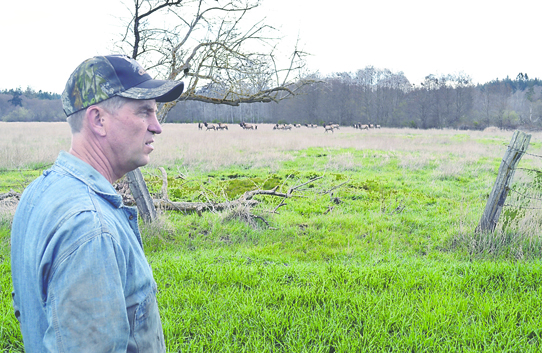
SEQUIM –– Between 15 and 20 elk were killed during a six-month season for special hunts to thin the Dungeness herd and reduce its damage to local farms.
The season for the special hunts ended Sunday, said Sgt. Eric Anderson, an agent with the state Department of Fish and Wildlife.
Anderson said the hunts were authorized to keep the herd at a more manageable number of 20 to 25 animals to minimize the damage they do to an estimated 50 Dungeness Valley farms.
“Twenty animals do half the damage of 40 animals,” Sgt. Anderson said.
The Dungeness herd of cows, calves and yearlings now totals about 23 animals. A herd of 12 bulls stays in Happy Valley until the summer mating season.
Local fans of the elk have criticized the department’s decision to allow the special hunts.
“The elk are important to the citizens of Sequim and the tourism of the area,” Anderson said.
“What we’re simply trying to do is manage a herd in an area where it has no natural predators and they have some of the best feed available.”
Since leaving their ancestral homelands in the hills around Happy Valley south of Sequim for the irrigated farm fields of the Dungeness Valley north of U.S. Highway 101 about 10 years ago, the herd has taken a hefty toll on farmers, Anderson said.
Troy Smith, a farmer who said his family has lost tens of thousands of dollars in crops to the elk over the past decade, agreed.
“They’re pretty to look at when they’re not in your fields eating money out of your pocket,” Smith said.
Fom October through February, Fish and Wildlife has allowed master hunters and landowners on special elk hunts, Anderson said.
A few animals were harvested in the most recent hunts in February, he added.
All the hunts are coordinated by the department, including three special hunts that called for youth shooters, two of which ended in the removal of elk.
“There hasn’t been any hunts down there that haven’t been supervised,” Anderson said.
In the middle of past decade, the herd reached almost 100 elk, almost too many for even the lush Dungeness farm fields to support, he said.
That population boom resulted in hunts that harvested some 50 elk in one year.
Smith’s family has run Maple View Farms in the valley above Washington Harbor since 1933, planting spinach, corn, cauliflower, barley, grass and alfalfa on fields throughout the Dungeness plain. Up until about 10 years ago, they had practically no interactions with the elk herd.
“We were in the lowlands; they were in the highlands,” Smith said. “Now, they’re down in the lowlands, and we’re losing our crops.”
Tim Cullinan, wildlife biologist for the Point No Point Treaty Council, said the elk historically have stayed in the Olympic Mountain foothills.
“These elks have been here since the glaciers left,” he said.
But when farms got subdivided in Happy Valley and housing boomed on Sequim’s Bell Hill, the herd’s food supply started to shrink, he said.
Anderson added that bans on clearcutting in the 1980s replaced the natural grasses and forbs and blackberries that grew in clearcut meadows with thick “doghair” — young Douglas firs and western hemlock shoots.
In search of more food, the herd crossed north of Highway 101 in 1992, Cullinan said.
“They moved north of the highway and found — well, they found heaven,” Anderson said.
This year, they decided to stay in the Smiths’ “heaven” all year.
Last year, the elk ate and trampled 25 acres of corn, Smith said, adding that the field typically would yield 750 tons of corn worth almost $25,000.
The elk roam through the field, Smith said, eating just the tops of ears of ripening corn and trampling other stalks by rolling in the field or when males spar in the summer mating season.
A field of cauliflower also was destroyed, he said, wiping out not only $25,000 of the farm’s potential gross revenue but also more than $12,000 worth of seed, field preparation and fertilizer put into the crop.
Crop insurance, guaranteed by the federal government, will reimburse farmers for the cost of damage inflicted by weather but will not cover losses because of wild animals, Smith said.
“It’s a huge impact on our livelihood.”
Some damages are paid to the farmers from a special deer and elk damage fund.
Fish and Wildlife also provides farmers like the Smiths with hunting tags they can use to take elk or sell to master hunters.
In the 1990s, Fish and Wildlife hired herders and hazers to chase elk from north to south into the hills, Anderson said.
But the animals would always come back.
“They’re just like people. And they found out where the good life is,” Cullinan said.
Also, the Holiday Inn Express and Black Bear Diner have now been built in what was the herding path.
Smith’s family has erected some fences, but Anderson said fences will only push the elk to housing developments and nearby golf courses.
“If you want to see damage in the hundreds of thousands of dollars, see what a herd of elk will do to all those greens,” Anderson said.
Smith even has tried applying a chemical deterrent to his crops but said it did no good and lessened their quality.
Sequim-Dungeness Valley Editor Joe Smillie can be reached at 360-681-2390, ext. 5052, or at jsmillie@peninsuladailynews.com.
