
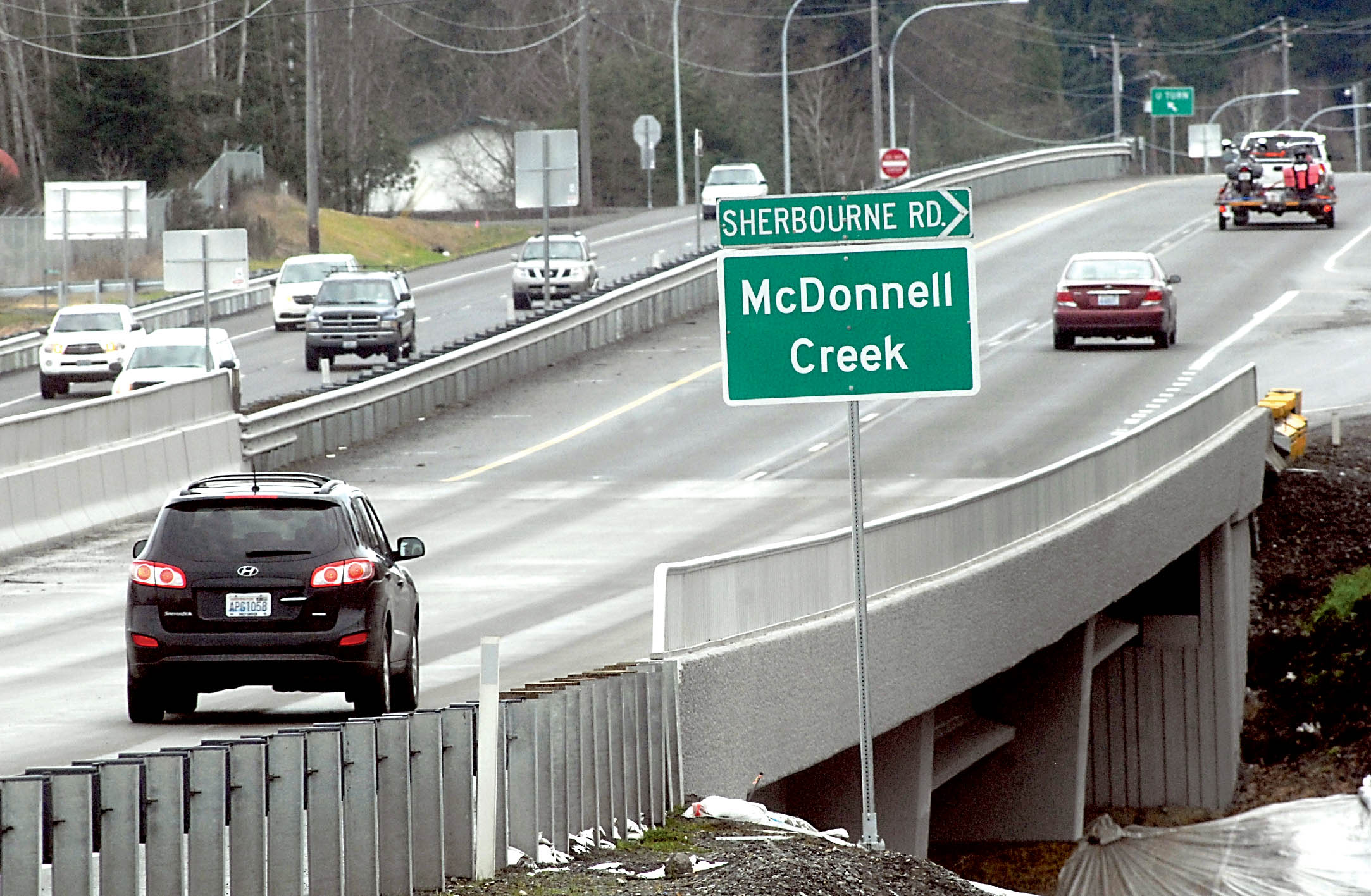
Old McDonald had a creek.
Ee-aye-ee-aye-oh.
It gave McDonnell’s nose a tweak
That it should be spelled so.
Or so the ditty might say were it about the names tied to creeks, rivers, campgrounds, prairies and other geographic features on the North Olympic Peninsula.
Motorists once crossed a watercourse marked “McDonald Creek” on U.S. Highway 101 between Port Angeles and Sequim before the widening project there.
But if they crossed the very same stream on Old Olympic Highway, the sign read “McDonnell Creek.”
Then there’s Sol Duc, the river, the creek and the hot springs — but Soleduck, the prairie, trails and campground nearby.
In Jefferson County, Squamish Harbor 6 miles south of Port Ludlow almost became Suquamish, and Point Hudson was for a brief time Hudson Point.
And while we have the Quillayute River, school district, airport and Quillayute Needles Wildlife Refuge, we have the Quileute tribe and its namesake language.
Even the latter has varieties in pronunciation: KWILL-yoot, kwill-AY-oot and kwill-EE-ute.
As Juan de Fuca (FOO-ka or FEW-ka?) might have asked, “¿Quien sabé?” (Actually, de Fuca’s real name was Ionnas Phokas, but that’s a whole different tale.)
Some of the pied spellings and pronunciations result from white explorers’ and settlers’ attempts to reproduce Native American sounds of the Salish, Quileute and Nootka languages.
Some origins are still more convoluted. La Poel, the campground at the west end of Lake Crescent, is from the Chinook trade jargon that Natives used for intertribal communication.
It in turn comes from the French words la poele, which mean “frying pan.” Indeed, some old maps of the area call it Pancake Point.
Speaking of — or in — Chinook, Kalakala, the name bestowed on the art deco streamlined ferry that once plied the waters between Port Angeles and Victoria, means “flying bird.”
The good ship’s name sounds similar to Kulakula, the name of the point that traditionalists say should be spelled Kula Kula.
But in one word or two, it means “travel,” according to Edmond S. Meany’s landmark 1913 book, Origin of Washington Geographic Names.
McDonald vs. McDonnell is an even more complex case.
McDonald was the Washington Board of Geographic Names’ choice based on land patent records that show McDonalds settling in the Joyce area.
Even though there is no link to a McDonald family in eastern Clallam County, the board specifically rejected McDonnell as the name in 1993, and the U.S. Board of Geographic Names reaffirmed McDonald three years later.
According to Bob Redling of the Department of Natural Resources, which inherited the task of umpiring name changes, “Local residents petitioned the Washington Board on Geographic Names to change the name to McDonnell Creek.
“The board received several letters of support from local citizens claiming that the original name was McDonnell, but they could not provide any maps or publications to prove this.
“The name McDonald had been in use for over 72 years at that time, and appeared on numerous maps and publications, so the board denied the name change, as local common current usage usually trumps historic spelling.
“The U.S. Board on Geographic Names did as well, and the name remains McDonald Creek officially.”
Well, almost.
“The [Clallam] County Highway and Washington State Department of Transportation erected signs with the McDonnell spelling in 1993,” Redling told the Peninsula Daily News, “before the Washington Board on Geographic Names and the U.S. Board on Geographic Names made their decisions.”
The county based its contrarian choice on the historical accounts of Richard John McDonnell, who brought his wife and family to settle near the mouth of the creek around 1860.
The obituary of his son Joseph — who died at the age of 80 in 1940 — notes that the creek “was named for the McDonnell family, although an error in recent years’ maps and highway markers have called it McDonald Creek.”
McDonald, McDonnell and similar-sounding variants are derived from the Gaelic Mac Dhamhnuill, which means “son of Domhnall,” an ancient Scottish warrior.
Even that surname sometimes is spelled Domhnaill (the second “L” also seems to be optional) and is sometimes preceded by an O’ in place of a Mc. Or a Mac.
Confused yet?
You should be. The spelling Soleduck was accepted until 1991, when the state geographic names panel changed it to Sol Duc.
Again, Redling of DNR weighs in:
“The official name is Sol Duc (Falls, Hot Springs, Lake, Park [in this case, ‘park’ refers to a clearing, or flat], and River).
“The Washington Board on Geographic Names voted to make the Sol Duc spelling official in 1991, with the support of the Clallam County commissioners.
“The U.S. Forest Service was opposed to the action, as they used (and still use) the Soleduck spelling. While the U.S. Board on Geographic Names made the spelling of Sol Duc official for geographic [Redling’s emphasis] features, the Forest Service still uses Soleduck for administrative features (i.e., trails, campgrounds, etc.).
“So, for various reasons — old signs in one case and a federal agency’s preferences in another — some confusion about these geographic names continues.
“The value of having state and federal systems for approving ‘official’ geographic names is that this situation would be happening a lot more often.”
In French, Sol Duc means “sun duke,” but both Soleduck and Sol Duc — which at least are pronounced alike — derive from a Quileute term that means “sparkling waters.”
Not so the nearby Bogachiel, which while it has a single spelling comes from the Quileute words that are pronounced bo qwa tcheel, meaning “turbid,” “roiled” or “muddy” water.
The Quileute language, incidentally, is unique and separate from the Salish dialects spoken by most neighboring tribes except for the Makah, whose language stems from the Nootka tongue common among Canadian First Nations of Vancouver Island.
In Jefferson County, folks got squeamish about renaming Squamish Harbor 6 miles south of Port Ludlow to Suquamish, the name of the tribe that calls that region of Hood Canal home.
The tribe had prevailed upon the state now-Committee on Geographic Names to restore the name to three syllables in 2012 with the blessings of Jefferson County commissioners.
Objections from the Jamestown S’Klallam and Port Gamble S’Klallam tribes led the committee to reverse itself about a year later and restore Squamish.
The S’Klallam had alleged political motives and fishing rights were behind the short-lived change.
Ironically, Suquamish had been the name given to the harbor by U.S. Navy explorer Lt. Charles Wilkes on his map-making expedition of 1841. The name Squamish arose about a decade later.
Short-lived, certainly, was the history of Hudson Point, so named for a couple of years by Port of Port Townsend commissioners who in 2008 changed it back to Point Hudson.
Although it was named by British Navy Capt. George Vancouver, it wasn’t clear for which Hudson it was named, although English explorer Henry Hudson would be a good bet. Vancouver, by the way, named Jefferson County’s largest city for the Marquess of Townshend, but the town lost its “H” somewhere along the way.
Meanwhile, back on Old McDonald’s — or McDonnell’s — or McDomhnaill’s — Farm:
And on that farm he had a fowl
Ee-aye-ee-aye-oh.
It went Soleduck here and Sol Duc there
The spelling? Who’s to know?
________
Reporter James Casey can be reached at 360-452-2345, ext. 5074, or at jcasey@peninsuladailynews.com.
