
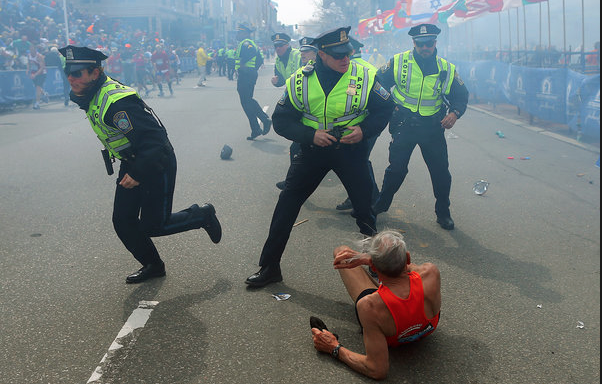
By Tim Rohan The New York Times
To follow events in Boston and other stories as they are updated today — and to get other national-international news — go to the “Nation/World” button at the top of this page (www.peninsuladailynews.com).
Then go to “AP News” and click.
There are also still photos and video at the AP News site. The Associated Press, a nonprofit cooperative owned by U.S. newspapers, is the largest newsgathering agency in the world.
BOSTON — About 100 feet from the end of the 26.2-mile Boston Marathon, explosions shook the street and sent runners frantically racing for cover.
The marathon finish line, normally a festive area of celebration and exhaustion, was suddenly like a war zone.
“These runners just finished and they don’t have legs now,” said Roupen Bastajian, 35, a Rhode Island state trooper and former Marine.
“So many of them. There are so many people without legs. It’s all blood. There’s blood everywhere. You got bones, fragments. It’s disgusting.”
Had Bastajian run a few strides slower, as he did in 2011, he might have been among the dozens of victims wounded in Monday’s bomb blasts.
Instead, he was among the runners treating other runners, a makeshift emergency medical service of exhausted athletes.
“We put tourniquets on,” Bastajian said. “I tied at least five, six legs with tourniquets.”
The Boston Marathon, held every year on Patriots’ Day, a state holiday, is usually an opportunity for the city to cheer with a collective roar.
But the explosions turned an uplifting day into a nightmarish swirl of bloodied streets and torn-apart limbs as runners were toppled, children on the sidelines were maimed, and a panicked city watched its iconic athletic spectacle destroyed.
The timing of the explosions — around 2:50 p.m. — was especially devastating because they happened when a high concentration of runners in the main field were arriving at the finish line on Boylston Street.
In last year’s Boston Marathon, for example, more than 9,100 crossed the finish line — 42 percent of all finishers — in the 30 minutes before and after the time of the explosions.
This year, more than 23,000 people started the race in near-perfect conditions. Only about 17,580 finished.
Three people were killed and more than 100 were injured, officials said.
Deirdre Hatfield, 27, was steps away from the finish line when she heard a blast. She saw bodies flying out into the street. She saw a couple of children who appeared lifeless.
She saw people without legs.
“When the bodies landed around me I thought: Am I burning? Maybe I’m burning and I don’t feel it,” Ms. Hatfield said. “If I blow up, I just hope I won’t feel it.”
She looked inside a Starbucks to her left, where she thought a blast might have occurred.
“What was so eerie, you looked in you knew there had to be 100 people in there, but there was no sign of movement,” she said.
Ms. Hatfield wondered where another explosion might occur. She turned down a side street and ran to the hotel where she had agreed to meet her boyfriend and family after the race.
Amid the chaos, the authorities directed runners and onlookers to the area designated for family members meeting runners at the end of the race. It was traditionally a place of panting pride, sweaty hugs and exhausted relief.
But on Monday, it became a place of dread, as news of the attack spread through the crowd and people awaited word. One woman screamed over the din toward the streets roped off for runners: “Lisa! Lisa!”
Some saw the explosions as clouds of white smoke.
To others, they looked orange — a fireball that nearly reached the top of a nearby traffic light.
Groups of runners, including a row of women in pink and neon tank tops and a man in a red windbreaker — kept going a few paces at least, as if unsure of what they were seeing.
Some runners stopped in the middle of the street, confused and frightened. Others turned around and started running back the way they came.
“It is kind of ironic that you just finished running a marathon and you want to keep running away,” said Sarah Joyce, 21, who had just finished her first marathon when she heard the blast.
Bruce Mendelsohn, 44, was at a party in a third-floor office above where the bombs went off. His brother, Aaron, had finished the race earlier.
“There was a very loud boom, and three to five seconds later there was another one,” said Mr. Mendelsohn, an Army veteran who works in public relations. He ran outside. “There was blood smeared in the streets and on the sidewalk,” he said.
Mendelsohn could not be sure how many people had been killed or wounded, but among the bodies he said he saw women, children and runners. The wounds, he said, appeared to be “lower torso.”
As Melissa Fryback, 42, was heading into the home stretch, she realized she was on pace for one of her best times ever.
She steeled herself for the last three miles and finished in 3 hours 44 minutes. She met up with her boyfriend, and the two had made it about two blocks from the finish line when they heard the blasts.
“I can’t help but wonder that if I hadn’t pushed like that, it could have been me,” she said.
Boston hospitals struggled to keep up with the flow of patients. Massachusetts General Hospital admitted 29 patients, 8 of them in critical condition; several of them needed amputations, a spokesman said.
Late Monday night, Brigham and Women’s Hospital said it had seen 31 patients who were wounded in the explosions, ranging from a 3-year-old to patients in their 60s.
As many as 10 were listed in serious condition, and 2 were in critical condition.
The Rev. Brian Jordan, a Franciscan priest based in Brooklyn, said he was in Boston to say a pre-race Mass near the starting line for a group of about 100 friends who were running.
The group included Boston firefighters, Massachusetts State Police officers and several Army soldiers recently returned from Iraq.
Father Jordan, a veteran runner of 21 Boston Marathons himself, was about a block away from the blasts when they occurred, heading toward the course to watch his friends finish the race.
“I never heard that type of sound before,” he said by telephone. “It was like cannons.”
He said he made his way through the fleeing crowd toward the explosions. “I saw some blood,” he said.
He realized he could be more effective wearing his Franciscan habit, so he returned to the firehouse and donned the brown robe of his order, and then headed back out into the streets.
“All I could do was try to calm people down,” Father Jordan said. “Marathons are supposed to bring people together.”
Jeff Constantine, 46, ended his first marathon a mile from the finish. It took 10 minutes to find out why.
He was planning to finish the race at almost exactly the time that the bomb went off.
“If I didn’t freeze up, if I hadn’t been slow, I would have been right there,” he said.
His family had traffic to thank. They were running late after watching Constantine run up Heartbreak Hill, the race’s most challenging stretch, and never made it to the finish line.
