
By Felician Fonseca
and Ted Warren
The Associated Press
The Jamestown S’Klallam Tribe is among the tribes nationwide that eventually will receive funds from a settlement agreement with drug companies over opioids distribution.
Tribes settled with drugmaker Johnson & Johnson and the three largest U.S. drug distribution companies last week for $590 million. Lawyers representing tribes hope to reach settlements with others in the pharmaceutical industry, including remaining manufacturers and pharmacies.
Last year, the four companies announced a $26 billion settlement with state and local governments to end all suits. An overwhelming majority of governments have signed on; the companies are to decide this month whether it constitutes enough acceptance to move ahead. The agreement with tribes is to be subtracted from those deals.
Each of the 574 federally recognized tribes are eligible for a share of the settlement money made public Tuesday.
It’s unclear how quickly the money would flow to tribes, but it won’t be much and not until 95 percent of tribes and tribal organizations that sued agree to the settlement.
A 2015 study found Native Americans had the highest per capita rate of opioid overdose deaths of any population group.
Cheryl Andrews-Maltais, who leads the Wampanoag Tribe of Gay Head Aquinnah in Massachusetts — which was among hundreds of Native American tribes that sued drug manufacturers and distributors over the role they played in the epidemic — said she could think of 15 deaths among her tribe of about 500 alone.
“Obviously [the settlement] should have been more,” Andrews-Maltais said.
“The ongoing, cumulative effects are generational, and this money is not going to be generational.”
She said she takes note of the heart-wrenching dates that remind Wampanoag families that they’re still in the midst of the opioid drug crisis — birthdays of loved ones lost, anniversaries of their passing. Then she reaches out with a phone call to the grieving.
“And then you’re on the other side of it, and you’re bracing for another holiday or event you can’t share because of this,” she said.
A 236-page court document filed in the case laid out staggering statistics for tribes related to drug-related crimes and deaths, and noted a long history — including the federal government’s attempts to assimilate Native Americans into white society — that has contributed to generations of trauma.
Most tribes have struggled financially to address the opioid crisis through law enforcement, courts, social services and health care.
Tribal police agencies said in the court filing that they’ve had to train more officers on how to deal with prescription and synthetic drugs, and arm them with tools to treat overdoses.
Tribes have turned to wellness or healing centers to treat those with opioid addictions, their families and the larger community.
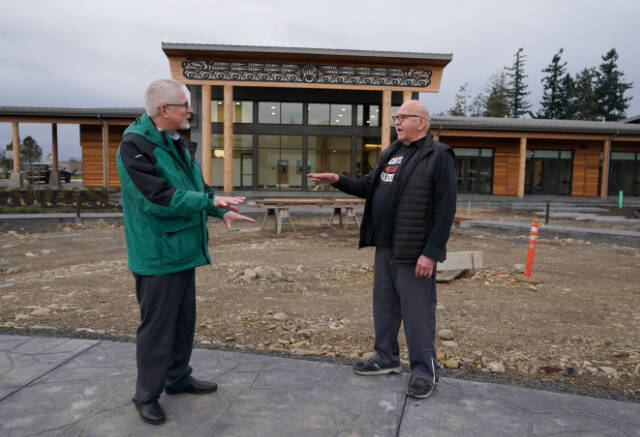
In Sequim, the Jamestown S’Klallam Tribe is building a holistic health center in the shadow of the Olympic Mountains that is expected to open in March.
It will serve both tribal members and non-tribal residents in Clallam and Jefferson counties.
Clallam County had the highest rate of opioid prescriptions among all counties in the state in 2012. That has declined since but opioid death rate remained high according to latest figures.
The University of Washington found that the opioid-related death rate in Clallam County was 14.48 per 100,000 from 2018 to 2020, an increase of 68.7 percent from the rate of 8.25 per 100,000 in 2002-2004.
Jefferson County was reported to have had an increase of 114.8 percent, from 7.30 per 100,000 in 2002-2004 to 15.68 per 100,000 in 2018-2020.
The Jamestown Healing Clinic eventually will serve up to about 200-250 per day, providing wraparound services to who are struggling with addiction and have volunteered for treatment, the tribe has said.
Shuttle services will be available for anyone who needs a ride and child care, the tribe has said.
The plans call for a water feature in the front that will reinforce a traditional story about the ability to change the path of a river by moving one rock.
The tribe also has funded a full-time social services worker who will be embedded in the police department to address concerns in the larger community about patients and any drug-related crimes.
The medication-assisted treatment clinic was hotly debated for abut two years, as a group called Save Our Sequim opposed it.
“Sometimes people, optically, think that these kind of treatment centers become a magnet to drug dealers and the underbelly of that industry,” said Jamestown S’Klallam Chairman W. Ron Allen.
“And that’s not what it is. It’s a reverse of that. They’re designed to be highly secure, highly safe, highly monitored and totally focused on helping those individuals become healthy.”
Joshua Carver, who received services from the tribe to overcome a heroin addiction, helped install some of the center’s artwork as part of his tribal construction job.
His mother, Shawna Priest, saw it as an evolution from taking oxycodone for back issues, moving on to heroin, being hospitalized on the brink of an overdose and detoxing at home for six months before recovering four years ago.
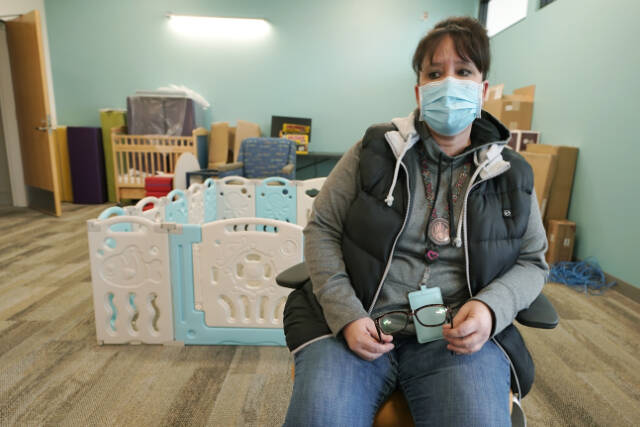
Shawna Priest, a member of the Jamestown S’Klallam Tribe, sits in the child-care area of the Jamestown Healing Clinic where she works as a medical assistant, Wednesday, Feb. 2, 2022, in Sequim, Wash., as she talks about the battles her son and daughter have had with opioid addiction. The tribe is building a full-service health center to treat both tribal members and other community residents for opioid addictions. Earlier in the week, Native American tribes across the U.S. settled a lawsuit against drug maker Johnson & Johnson and the largest three drug distribution companies in the U.S. for $590 million. The money won’t be distributed quickly, but tribal leaders say it will play a part in healing their communities from an epidemic that has disproportionately killed Native Americans. (AP Photo/Ted S. Warren)
Priest herself was terrified to take medication after having ankle surgery last April, questioning whether it would cause her to become addicted.
She tells her family’s story to instill hope in others.
“You can get through this. You can be successful,” she said. “It’s not the end of the world.”
Leonard Forsman, chairman of the Suquamish Tribe on the North Kitsap Peninsula in Washington state, said he is glad major drug manufacturers and distributors are being held responsible for the opioid epidemic, though none acknowledged wrongdoing in the settlement.
The tribe plans to use the money to support cultural resurgence, which he said “has been the most effective pathway for preventing addiction and promoting recovery.”
The Cherokee Nation in Oklahoma said it will use the funding to expand mental health treatment and related services.
A special court master and the judge who oversaw the case must develop a formula for allocating the money from the settlement.
Three enrolled tribal members who are well-known in Indian Country will be responsible for administering the funds: former U.S. Bureau of Indian Affairs Secretary Kevin Washburn, former Indian Health Service acting director Mary Smith, and Kathy Hannan, chair of the National Museum of the American Indian’s Board of Trustees.
Tribal leaders say they hope the funding will consider not only population but geographic diversity, access to health care, land mass and tribes’ needs.
“One measuring stick that does apply, unfortunately to the vast majority of tribes, is that they are disproportionately impacted by opioids, alcohol and other chemical-generating problems that they had a very difficult history dealing with,” said Geoffrey Strommer, whose firm represented some tribes in the settlement.
Kristopher Peters, a former police officer for the Squaxin Island Tribe in Mason County in Washington state, said he has seen good people lose their jobs, destroy their families, hurt others and die because of opioid addictions. Incarceration is not the answer, and many times, treatment doesn’t work the first time, he said.
“We’re not expecting the awarded funds to solve our issues or buy our way out of this epidemic,” said Peters, now the tribe’s chairman. “That in itself is not going to heal anyone.”
Cultural gatherings like the canoe journey shared among tribes at Puget Sound and potlatches — ceremonial feasts that involve gift giving — are part of the equation, he said.
“I’ve seen people who are absolute addicts struggling with crime on that canoe journey, and they are totally different people,” he said. “Connecting with their traditional ways. It’s healing.”
________
Executive Editor Leah Leach contributed to this version of the Associated Press story.
