
Strong fish counts seen in Elwha
Published 1:30 am Friday, July 14, 2023
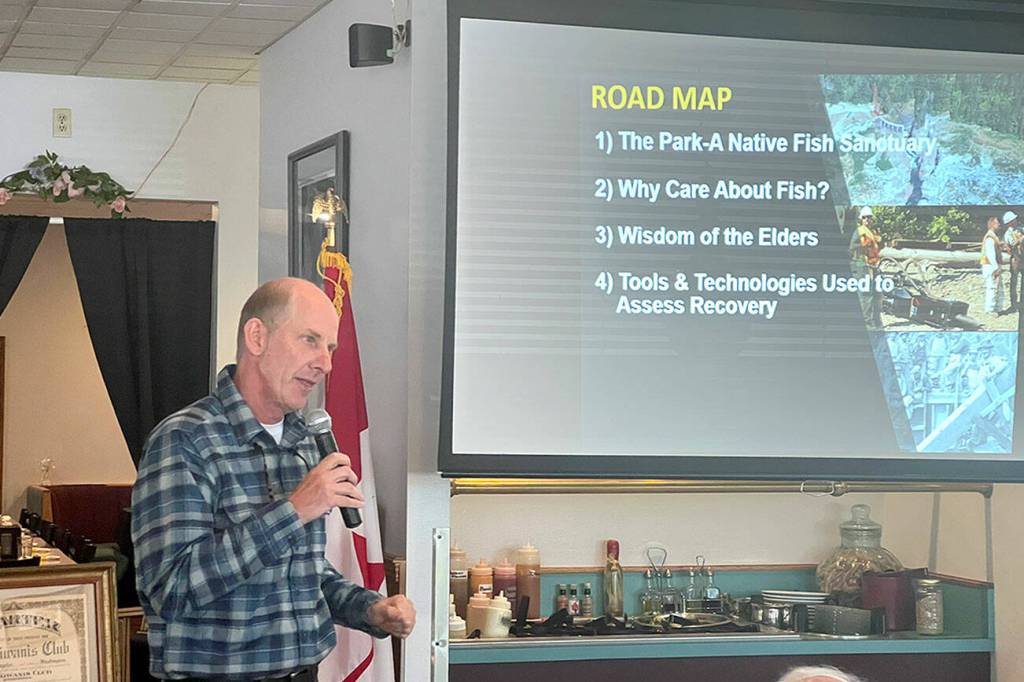



PORT ANGELES — Fish species on the Elwha River are coming back now that dams that once blocked the river have been removed, but river restoration is still in its infancy, according to Sam Brenkman, chief fisheries biologist with Olympic National Park.
More than 4,000 Chinook salmon had returned to the river by 2022, and more than 25,000 trout were surveyed in 2019, up from the roughly 3,000 in 2007, but the moratorium on most fishing remains in effect.
Specialists from the national park, the State of Washington and local tribes work together to look at metrics like number of fish returning and how far upriver they go before making decisions about when fishing might return. Brenkman said he hoped sport fishing might return to the park as early as next summer, but fishing on other parts of the river are determined by the state or tribes.
There are more than 4,000 linear miles of riverway just inside Olympic National Park, Brenkman said Thursday during a talk to the Kiwanis Club of Port Angeles, making it the largest protected area for wild Pacific salmon in the northwest outside of Alaska.
For a century, the Elwha River was blocked by two dams and the local fish population was unable to migrate between the fresh headwaters inside the park and the ocean, leading to steep declines in the number of fish.
“When the dams were in place, it was estimated that about 90 percent of the salmon habitat was lost,” Brenkman said. “We saw an estimated about a 98 percent decline in fish populations collectively.”
But fish surveys on the river show that several species are making a strong comeback now that the dams have been removed, Brenkman said.
The Elwha River dam removal began in 2011 with the tearing down of the Elwha Dam followed by the Glines Canyon Dam in 2014. Since then, the outflowing of sentiment stored behind the dams has recreated the once moon-scape mouth of the Elwha into a huge beach with abundant wildlife while also changing the course of the river in places along its way from the Olympic mountains to the Strait of Juan de Fuca.
The removal of the Elwha Dam and Glines Canyon Dam was the largest such project in U.S. history, but Brenkman said it will soon lose that honor when the Klamath River dams in Northern California come down by 2026.
The U.S. Army Corps of Engineers has counted more than 90,000 dams across the country — many of them quite small — and dam removal has increased in the past 20 years.
Asked about calls to remove the four Snake River Dams in the Columbia Basin, Brenkman said there were many differences between those dams and the Elwha River, making the issue of their removal more complicated.
Brenkman said scientists use a range of survey techniques to estimate the number of fish. Some of them are low-tech, like snorkeling the river and counting fish — others are high-tech, such as environmental DNA, where water samples are tested for genetic evidence of which fish are in the river.
Soon after the dams were removed, some species of fish were observed above the old dam sites, and by 2017, some had even reached the river’s headwaters.
Some fish populations have seen a more than 200 percent increase, Brenkman said, and because they were now able to reach the ocean to feed, they were coming back larger. Some trout species are returning eight times larger than when the dams were in place.
“They’re getting out to the ocean, which is basically their refrigerator, and they’re eating a lot,” Brenkman said.
The removal of the dams also led to the restoration of natural wood debris in the river, which provides shelter for fish species as they make their way upriver.
“The large woody debris, I call it like fish condominiums,” Brenkman said. “When the dams were in place, the natural transport of that wood was obviously changed.”
Though the return of fish to the river has been strong, there’s been a moratorium on fishing on the Elwha since 2011. In October, the Lower Elwha Kallam Tribe will have a limited ceremonial and subsistence fishery for coho salmon on the lower river, taking up to 400 fish.
“The agencies have aligned to support this because we think we have the numbers,” Brenkman said. “These are mostly hatchery coho salmon.”
Brenkman said it takes a long time for salmon populations to rebound, and since 2014, when the dams were finally removed, it’s only been about two or three generations of salmon.
Olympic National Park was a “savings account of regional significance” when it comes to fish, Brenkman said, and proper management of the fish populations is important for the future of fish populations.
“National park boundaries do not protect rivers; people do,” Brenkman said. “Can we collectively — as humans, society, biologists — collectively manage this system?”
________
Reporter Peter Segall can be reached at peter.segall@peninsuladailynews.com.