
By Phuong Le
The Associated Press
SEATTLE — State regulators Monday tentatively denied a request by Willapa Bay oyster growers to use a pesticide to control shrimp that burrow in oyster and clam beds and make it hard for the shellfish to grow.
In denying a permit, the state Department of Ecology said that new scientific research and data show the pesticide imidacloprid would have too great an impact on other marine organisms, wildlife and the environment.
It’s a reversal from 2015 when the agency issued a similar permit to the Willapa-Grays Harbor Oyster Growers Association after finding the pesticide was unlikely to result in significant harm to the environment.
Ecology officials said they evaluated new research and analyses that were not available during the previous review.
“The science around imidacloprid is rapidly evolving and we can’t ignore it,” Ecology Director Maia Bellon said in a prepared statement. “New findings make it clear that this pesticide is simply too risky and harmful to be used in Washington’s waters and estuaries.”
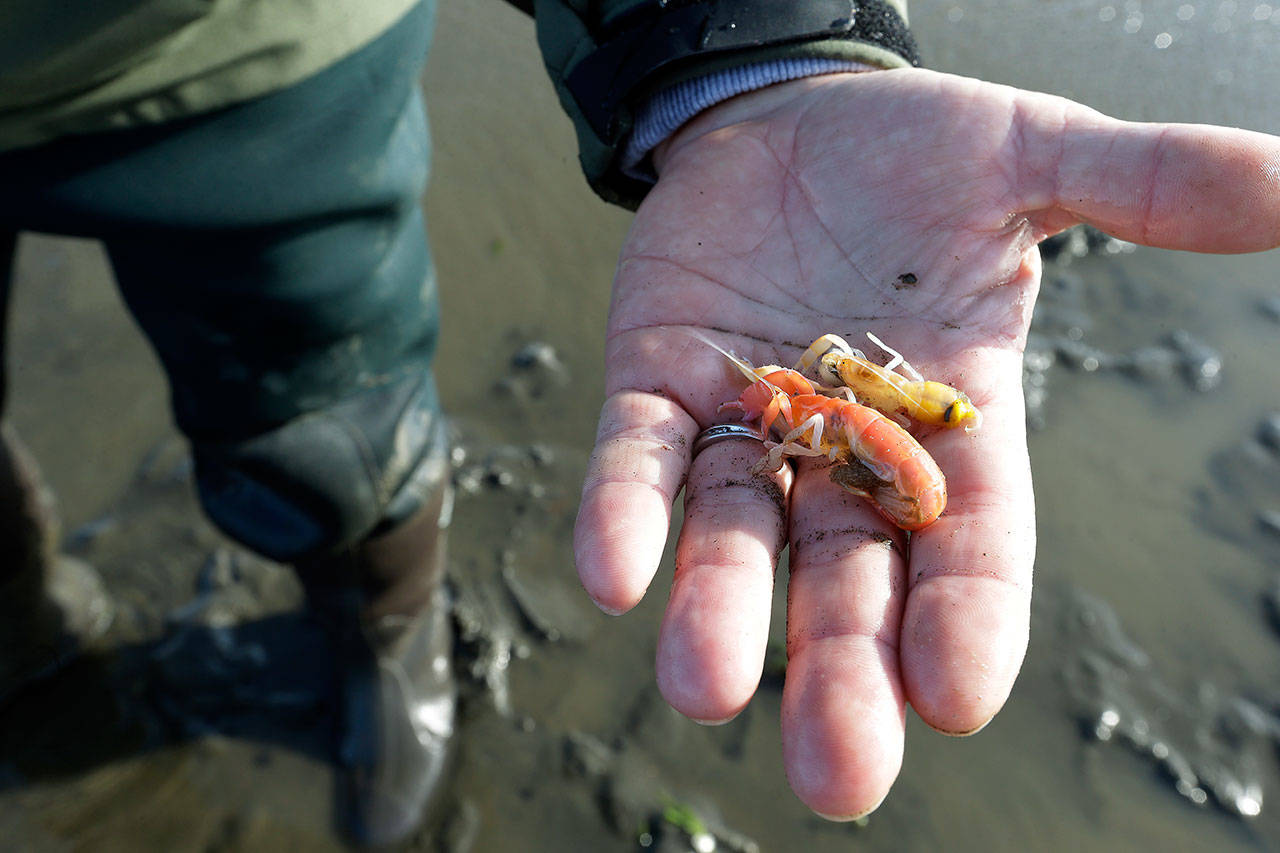
Oyster growers have tried for decades to control native shrimp — ghost and mud shrimp — that churn up mudflats, making the ground too soft for oysters, causing them to sink into the mud and suffocate.
Growers said the burrowing shrimp, left unchecked, threaten the shellfish industry in Willapa Bay and Grays Harbor, which contributes more than $102 million to the region.
Willapa Bay is the largest producer of farmed oysters in the U.S., growing mostly nonnative Pacific oysters.
“We believe the decision is based on politics and not on sound science,” Ken Wiegardt, president of the Willapa-Grays Harbor Oyster Growers Association, said in a statement Monday.
“If this political, non-scientific decision stands, burrowing shrimp will continue to destroy our oyster beds, severely damaging our industry, our estuary and our entire rural economy,” he added.
Weeks after receiving approval to use imidacloprid and amid public outcry, the oyster growers group asked the state in 2015 to withdraw the permit. The state’s largest shellfish grower, Taylor Shellfish Farms, also backed away from the plan to spray about 2,000 acres in Willapa Bay and Grays Harbor.
In 2016, a smaller group of about a dozen oyster growers applied to the state to be allowed to use the pesticide in waters, triggering additional environmental review.
Ecology denied the request saying it found significant impacts to sediment and invertebrates that live in that sediment, as well as negative impacts to fish and birds when food sources are disrupted. It also said there was increased uncertainty about long-term, cumulative impacts.
Imidacloprid is a neonicotinoid, a class of commonly used insecticides. Studies have shown that neonicotinoids harm bees.
Several environmental and others groups applauded the decision, saying neonicotinoids should not be used in the water.
The group sought to apply the pesticide to about 500 acres of commercial shellfish beds, mostly in Willapa Bay, using boats and ground equipment.
The proposed area is much smaller than the 2015 plan to spray about 2,000 acres using helicopters.
Ecology will make a final decision following a public comment period that ends May 14. The decision can be appealed.
For more information on Ecology’s decision, and to submit a comment online, see www.ecology.wa.gov/burrowingshrimp.
Comments also can be emailed to burrowing.shrimp@ecy.wa.gov or sent by U.S. Postal Service to Rich Doenges, Ecology Southwest Regional Office, P.O. Box 47775, Olympia, WA 98504-7775.
In comments to the state last fall, the National Marine Fisheries Service said it had concerns about the unintended harm to other species.
Officials with the U.S. Fish and Wildlife Service also told the state last fall it did not support a proposal to use the pesticide, saying that the use would have “acute adverse impacts” to sediments, marine organisms that live in that sediment, free-swimming crustaceans and zooplankton, both on and off areas that would be treated.
The growers group said Monday that it had proposed that the permit allow them to use the pesticide only to conduct scientific monitoring and that approval for use would depend on results of that monitoring.
Ecology told the group in a letter Monday that the issues would be the same whether it is experimental or for commercial purposes.
Learn more about this proposal, Ecology’s environmental review, and the decision at www.ecology.wa.gov/burrowingshrimp.
