
Peninsula Daily News
news services
EDITOR’S NOTE — Starwatch is published on the first Friday of every month in the print edition of the Peninsula Daily News.
NASA has released a video with information about the upcoming supermoon lunar eclipse. It is embedded BELOW the story for your viewing:
THE AUTUMN STARS are moving into the North Olympic Peninsula’s sky, and so is autumn itself.
But September has only one big story this year: the first “supermoon” lunar eclipse in more than three decades.
Let’s hope the night isn’t cloudy.
The eclipse, which occurs Sunday, Sept. 27, features a full moon that will look significantly larger and brighter than usual.
It will be the first supermoon eclipse since 1982 — and the last until 2033.
A supermoon occurs when a full moon happens when it is at the closest point in its elliptical orbit around Earth, making the full moon appear up to 14 percent larger and 30 percent brighter than usual.
A lunar eclipse occurs when the moon passes into Earth’s shadow.
Supermoon eclipses have occurred just five times since 1900 (in 1910, 1928, 1946, 1964 and 1982).
“Normal” lunar eclipses are much more common.
In fact, an observer at any particular location around the globe can expect to see a total lunar eclipse about once every 2.5 years on average.
Sept. 10 show
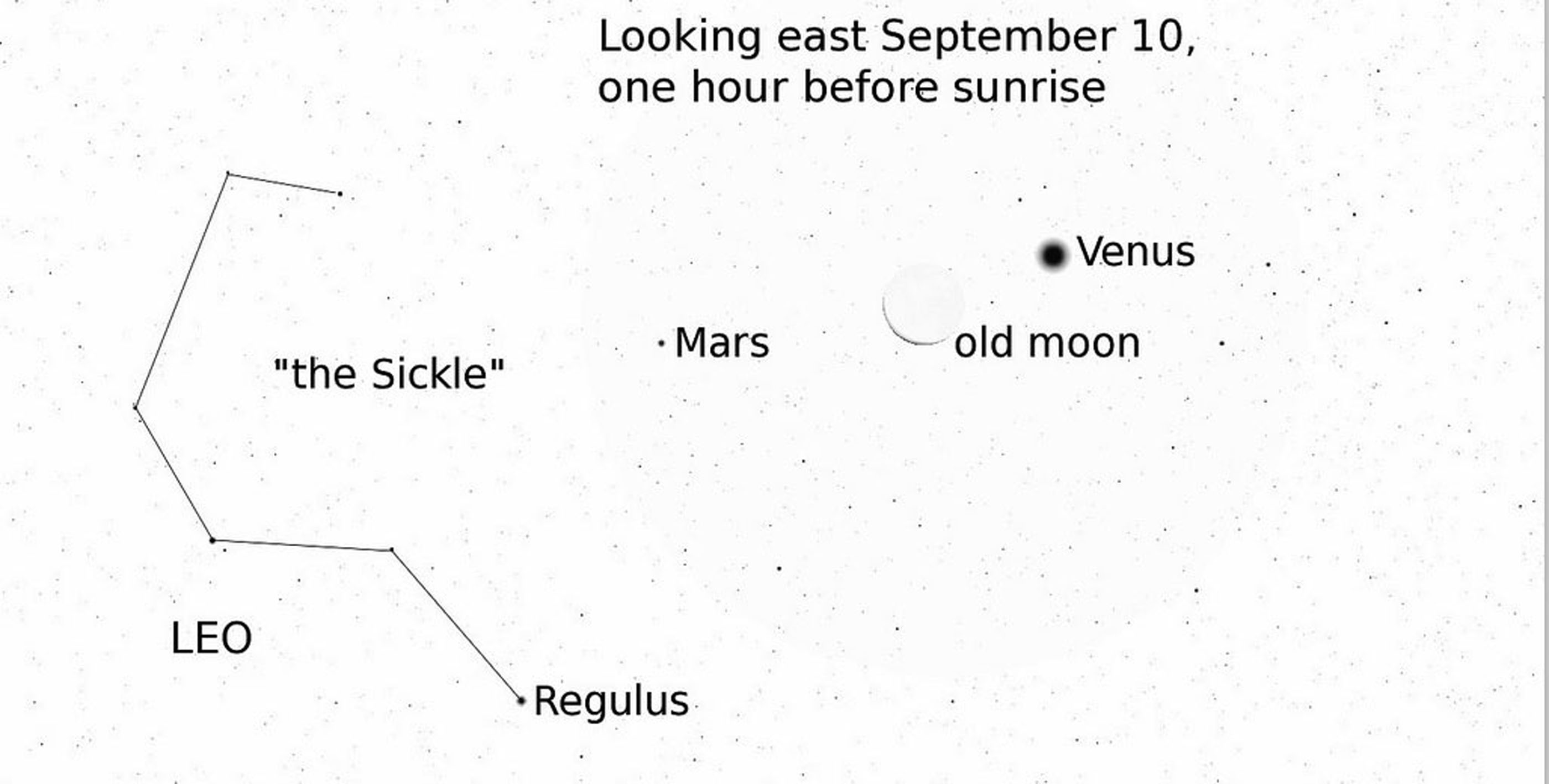
A warm-up to the eclipse happens with a sky show the morning of the 10th, when a waning crescent moon appears in the east between bright Venus and subdued Mars.
Look about an hour before sunrise; with sharp eyes or binoculars, you may also find Regulus, the brightest star in the constellation of Leo the Lion, rising below Mars.
And speaking of Regulus, look to the east about an hour before sunrise on the 25th.
Venus will be fairly high, Jupiter fairly low, and midway between them, you’ll see Mars (left) and Regulus, only 0.8 degrees apart.
Binoculars will make it easier to compare Mars’ soft red glow with the blue-white of Regulus.
September’s full moon, traditionally known as the Harvest Moon, happens just four days after the autumn equinox.
Much closer to Earth
Totality for the supermoon’s eclipse on the 27th will last from 7:11 p.m. to 8:23 p.m.
The Harvest Moon reaches perigee, the closest approach to the Earth in its orbit, at 6:46 p.m., when it will be about 221,750 miles away — more than 17,000 miles closer than its average distance.
It becomes full at 7:50 p.m., but by then, it will be engulfed in Earth’s shadow, deep into totality.
If we’re lucky, Earth’s sunrises and sunsets will refract lots of red light onto the moon’s face and turn it into a celestial pumpkin.
For this reason, total lunar eclipses are often referred to as “blood moons.”
Autumn arrives
Fall finally comes — though our patio thermometers already reflect that certain nip in the air — with the autumn equinox at 1:20 a.m. on the 23rd.
At that moment, the sun crosses the equator into the southern sky, and the Earth is lighted from pole to pole.
Saturn in the evening
Gold-hued Saturn, in the constellation Libra the Scales, now is the only planet visible to the unaided eye in the evening.
It is the brightest object visible in the southwest sky as twilight deepens, and sets in the west-southwest at about 10:50 p.m.
Because each evening the time that Saturn sets occurs about 4 minutes earlier than the setting time of the previous night, the ringed planet will soon be lost to view in the early evening.
Stars and planets at Hurricane Ridge
John Goar is finishing up this summer’s free astronomy programs with telescopes at Hurricane Ridge, one of the best light-restricted “dark sky” sites on the Peninsula 17 miles up a paved road from Port Angeles in Olympic National Park.
Known as the park’s volunteer “astro-VIP,” Goar is a math and science teacher in Kingston and a member of the Bremerton-based Olympic Astronomical Society.
His programs last about an hour.
Using the telescopes, he shows Saturn and its moons, other planets and stars, globular star cluster M13, the Ring Nebula and the Andromeda Galaxy.
Meet Goar at the Hurricane Ridge Visitor Center tonight (Saturday night, Sept. 5) and Sunday night (Sept. 6), then Friday and Saturday nights, Sept. 11-12. The viewings begin at 9 p.m.
The Sept. 12 session includes a “star party” by Olympic Astronomical Society members “who will be happy for the public to look through their telescopes,” Goar says.
If skies are cloudy, Goar’s program is canceled.
For program status, phone the recorded Hurricane Ridge Road hotline at 360-565-3131 after 4 p.m. the day of the program.
“Dress warmly,” says Goar, noting that the visitor center is situated at 5,242 feet.
While the programs are free, there is a $20-per-carload entrance fee to Olympic National Park (good for seven days) for those who do not already have a $40 annual park pass.
For more information, visit www.olympictelescope.com.
ISS’ morning fly-bys
Beginning the morning of the 8th, the International Space Station, now carrying the six crew members of Expedition 44, including two U.S. astronauts on a one-year assignment, will make appearances in our early morning sky through much of the month.
The ISS is easy to see with the naked eye — it is the third-brightest object in the sky and looks like a fast-moving plane — but it’s dozens of times higher than any airplane and travels thousands of miles per hour faster.
For exact times and locations in our sky, visit the ISS section of the NASA website, http://tinyurl.com/pdn-spacestation, and click on “Spot the Station.”
You can also sign up there for email alerts on local ISS fly-bys.
Spaceflight anniversary
Astronauts Frederick Hauck, Richard Covey, John Lounge, George Nelson and David Hilmers flew into orbit aboard the space shuttle Discovery on Sept. 29, 1988.
It was the first U.S. manned space flight after a hiatus of nearly 1,000 days that followed the destruction of the shuttle Challenger.
It exploded Jan. 28, 1986, killing all seven members of its crew, including teacher Christa McAuliffe.
Discovery also was the first shuttle to fly after 2003’s Columbia disaster.
