
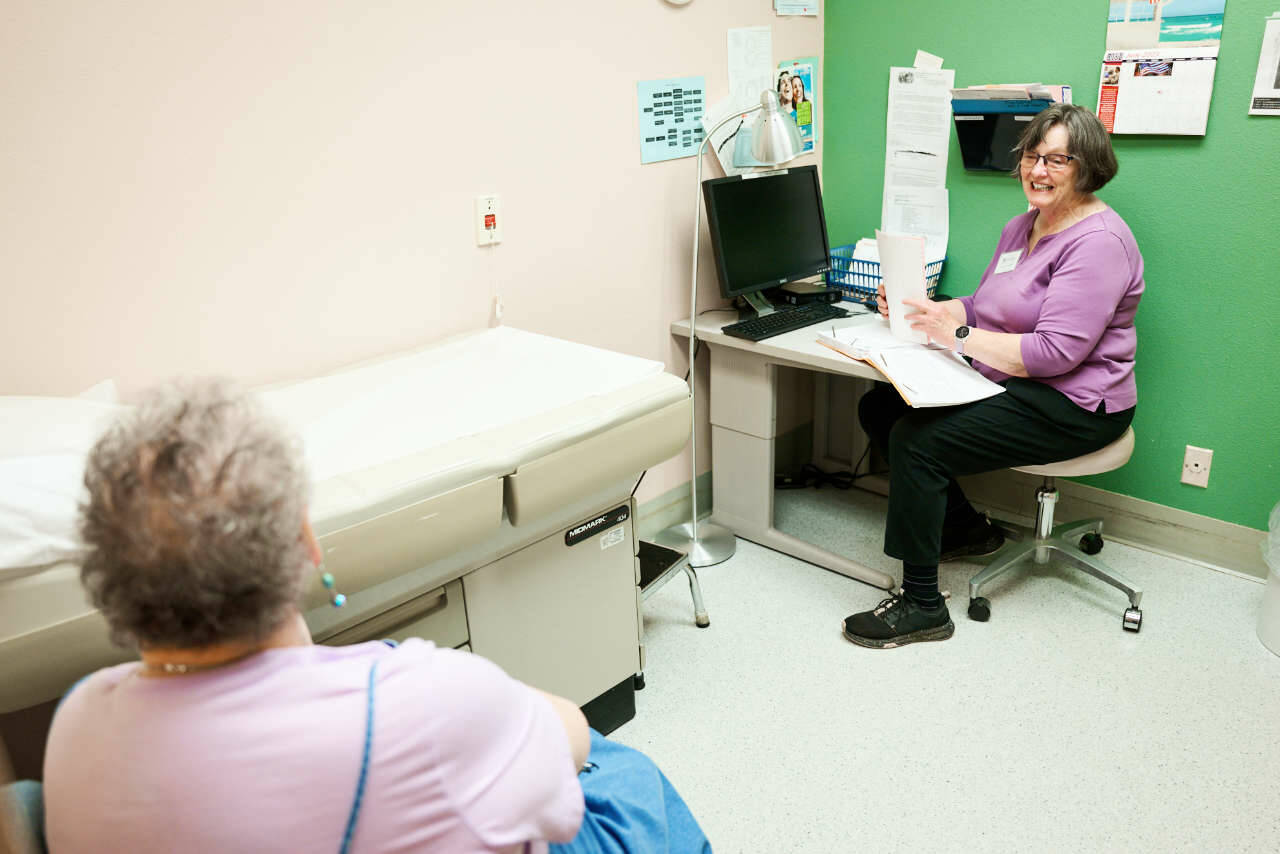
SEQUIM — Soon after the doors open at 4:30 p.m. every Monday and Thursday, the waiting room at the Dungeness Valley Health and Wellness Clinic — also known as the Sequim Free Clinic — begins to fill.
Some patients come with aching shoulders or a nagging, lingering cough. Others arrive worried about blood pressure they have not checked in years, diabetes they can’t afford to manage, or medications they ran out of weeks ago but don’t have the money to refill their prescriptions.
At many other doctors’ offices, patients might wait weeks or even months for an appointment. But at the Sequim Free Clinic, they are seen quickly and patients say the volunteer medical professionals spend more time with them.
Since it opened in 2001, the Dungeness Valley Health and Wellness Clinic (DVHWC) has provided almost 27,000 free patient visits to under-insured and uninsured community members, including Jefferson County residents.
The clinic, located at 777 N. Fifth Ave. #109, at the back of the Sequim Medical Center complex, offers walk-in urgent care, chronic disease management by appointment, assistance with prescription costs, and referrals for dental, vision, laboratory, imaging and specialty services.
It does so without billing, without insurance requirements, and without turning patients away based on income, housing status or employment.
“This is a safety net, but it’s also a bridge,” said Executive Director Sara Nicholls, who has led the clinic since 2016. “People come to us when they can’t access care elsewhere, and sometimes that’s temporary. Sometimes it’s long-term. Either way, we’re here.”
They have been in Sequim for a quarter century now. The clinic will turn 25 this fall. Its silver anniversary will be celebrated with a volunteer and donor appreciation event, the details of which will be announced in the coming months.
One person with an idea
The roots of the clinic stretch back to a single individual and a simple observation. In her role as parish nurse at Dungeness Valley Lutheran Church, registered nurse Mary Griffith began receiving calls from retired church members who were too young for Medicare and unable to afford healthcare.
“She realized there were people doing everything right — working their whole lives — who suddenly had nowhere to turn,” said Clinic Director Rose Gibbs, who has worked at the clinic for 16 years.
In February 2000, Griffith began researching how to start a free clinic. By June, she had filed articles of incorporation. A project team formed within the church, physicians and nurse practitioners volunteered their services, and more than $3,000 was raised through private donations.
After two years of paperwork, planning and persistence, the clinic received nonprofit status and officially opened on Oct. 15, 2001, operating one evening a week out of the church’s parish house.
The community supported the initiative with an open house event netting $11,000 in donations. Within a month, the Virginia Mason Clinic in Sequim began providing free lab work. When that clinic closed the following year, Olympic Medical Center stepped in, pledging annual financial assistance for laboratory and X-ray services — a partnership that continues today.
By the end of the first year, the clinic had provided 373 patient visits. During that time, something became clear: the need extended far beyond the retired parishioners Griffith initially set out to serve.
“We quickly learned that most of our patients were younger, working people without insurance — the working poor,” Gibbs said.
Growing with the community
As patient numbers grew, so did services. The clinic began participating in health fairs, emphasizing prevention and wellness. Recognizing the enormous unmet need for dental care, the clinic secured a grant from the Haller Foundation to address dental emergencies.
In 2004, the clinic added a second weekly clinic night, doubling patient visits. Specialists began accepting referrals. A community fundraiser — the Walk for Health, later known as the Clinic Fun Walk — was launched, raising both awareness and critical operating funds. Many businesses have supported the event.
The work caught regional attention. There was even coverage by a Seattle television station.
In 2005, after four years as the volunteer clinic director, Griffith stepped down but remained active on the board. With the clinic growing, the board hired its first paid director, registered nurse Jamie Goodwin. New standards were implemented, including CPR certification and the acquisition of an external defibrillator. Public health forums and wellness education became part of the clinic’s mission.
Significant grants followed and community donations poured in. Volunteer Spanish interpreters joined the team as the clinic began serving a growing Hispanic population.
Meeting chronic needs
By 2007, it became clear that walk-in urgent care alone was not enough.
“We were seeing people only when they were in crisis,” Gibbs said. “High blood pressure, diabetes, asthma — conditions that need consistent management.”
With funding from the Benjamin N. Phillips Memorial Fund, the clinic launched plans for a Chronic Healthcare Clinic. That vision became reality in 2008, when the chronic care clinic opened with nurse practitioner Larry Germain as its primary provider.
Later that year, the clinic moved from the church parish house into a larger former radiology building owned by Olympic Medical Center. The facility — leased to the clinic for $1 per year — allowed room to expand services and increase privacy.
That same year, Griffith was honored as Clallam County’s Public Health Hero.
A model of care
Today, the clinic operates walk-in urgent care on Monday and Thursday evenings, serving, on average, eight to 10 patients per night on a first-come, first-served basis. A Chronic Health Care Clinic also operates several times each month, by appointment only, with visits lasting up to 45 minutes.
“We don’t have a clock ticking,” Gibbs said. “We don’t have a computer between us and the patient. We listen.”
Providers include retired and active physicians, nurse practitioners, registered nurses and medical professionals with decades of experience. Many volunteer one shift per month. About 65 volunteers are on the roster, with more than 40 actively serving in clinics.
“The most common thing we hear from patients is, ‘This is the first time someone actually listened to me,’” Gibbs said.
The clinic maintains an internal electronic database for continuity and reporting, and all visits are documented by hand. That allows providers to focus on care rather than billing or electronic systems that some of them may not be familiar with, or might struggle to learn and remember if they volunteer once a month.
Chronic disease management is a particular focus, especially diabetes and hypertension. A major grant from the state Department of Health in 2010 expanded diabetes education, nutrition counseling and self-management programs.
“We emphasize medications people can actually afford,” Gibbs said. “There’s no point prescribing something that costs $1,000 a month.”
Serving the community
While many assume free clinics primarily serve elderly patients, the reality is different. About 64 percent of DVHWC patients are younger than 50, and more than 40 percent are employed.
“These are people working in service industries, self-employed or working part-time without benefits,” Nicholls said. “Many technically have insurance, but their deductibles are $7,000 or $8,000. That’s not accessible healthcare.”
The clinic also serves people in transition — new residents waiting months to establish primary care, workers between jobs or patients bridging gaps in coverage.
“We help keep people out of the emergency department for things that don’t belong there,” Gibbs said. “That benefits everyone.”
The clinic also provides health education — not just for patients, but for the community at large. It regularly hosts wellness forums aired on KSQM 91.5 FM featuring medical professionals. Videos of the presentations can be viewed on the clinic’s website, sequimfreeclinic.org.
In addition to this health education partnership and the clinic’s Prescription Assistance Program, the nonprofit’s outreach efforts include dental voucher programs.
Powered by volunteers, support
The clinic’s annual budget is supported primarily by community donations and fundraisers, which account for about 40 percent of funding. Grants supplement the remainder. Five part-time employees manage operations, coordination and outreach.
Donated food and clothing also are available at the clinic for patients who need them. The modest food pantry is maintained by Soroptimist International of Sequim.
“We’re incredibly fortunate,” Nicholls said. “This community shows up for us, year after year.”
Olympic Medical Center remains a cornerstone partner, providing lab and imaging services and specialist access through its financial assistance program.
In 2011, the clinic celebrated its 10th anniversary with 70 volunteers providing nearly $600,000 worth of healthcare services. In 2012 alone, the Prescription Assistance Program helped patients receive more than $221,000 in free medications, according to the clinic’s website.
Former patients sometimes give back as volunteers.
“People come full circle,” Gibbs said. “They receive care, and then they give back.”
Not all volunteers need to be trained medical professionals. Some work the reception desk or help with such things as fundraising events.
Looking ahead
As healthcare costs continue to rise, the clinic’s board and staff remain watchful and prepared.
“We haven’t seen a surge yet, but we know it could come,” Gibbs said. “If it does, we’re ready to expand hours.”
While the future of healthcare can seem precarious, those at the Sequim Free Clinic stay focused on their mission.
“We’re here,” Nicholls said. “And there should be no stigma, no embarrassment, no fear. This is a real medical clinic, staffed by professionals who care deeply about this community.”
________
Kathy Cruz is the editor of the Sequim Gazette of the Olympic Peninsula News Group, which also is composed of other Sound Publishing newspapers Peninsula Daily News and Forks Forum. She can be reached by email at kathy.cruz@soundpublishing.com.
