
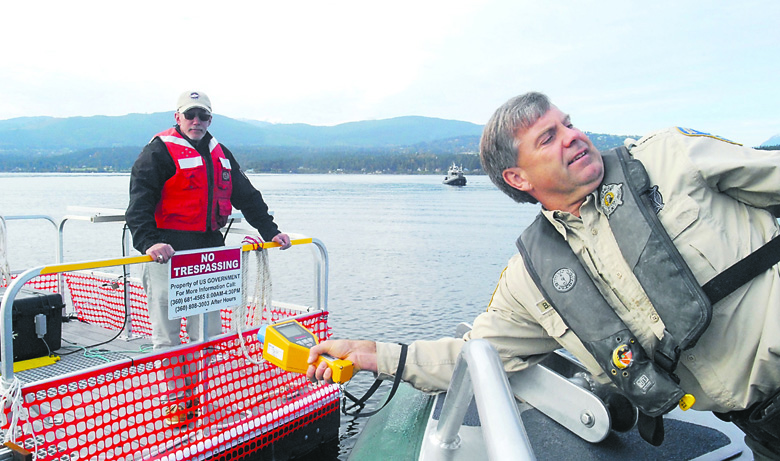
SEQUIM — Radiation detectors buzzed like vibrating cellphones as the Clallam County Sheriff’s Office Marine Unit approached a floating platform on Sequim Bay.
The platform was being used to simulate a radioactive Canadian vessel in a U.S. Department of Homeland Security training exercise Wednesday for first responders to detect nuclear materials entering the Puget Sound.
Deputy Bill Cortani leaned over the side of the 26-foot Protector and pointed a radioisotope identification device, or RIID, at a sealed radiation source at the base of the platform.
“They found it,” said Al Conklin, radiation health physicist with the state Department of Health.
“They just need to identify it now.”
Cortani and state Department of Fish and Wildlife officer Brian Fairbanks used the high-tech gizmos to collect separate readings of the nuclear isotope.
“What we’re doing is we’re saving this reading to a file,” Cortani said as the Protector idled near Travis Spit.
“And when we’re done here, we’ll go back to land and we’ll plug this into the computer, and then all this information will be sent to what we call JHOC [Joint Harbor Operations Center].”
In a real-life scenario, a federal lab would quickly determine whether the particular isotope is a terrorist threat.
“You find something, you suspect it’s illegal,” Conklin said.
Organized by lab
The quarterly training exercise was put on by the Pacific Northwest National Laboratory, which provides training and radiation-detection equipment for Homeland Security’s Domestic Nuclear Detection Office.
The “Small Vessel Standoff Detection” exercise was designed to train first responders to detect radiation on vessels of 300 tons or less.
“Those vessels don’t have to announce that they’re coming,” said Deputy Ralph Edgington.
“They just show up.”
While local, state and federal authorities were training aboard a dozen boats on the water, other officials were meeting at the Pacific Northwest National Laboratory facilities on Sequim Bay.
The Pacific Northwest National Laboratory, or PNNL, conducts quarterly nuclear-detection drills in Sequim, Everett, Bellingham and Seattle.
PNNL emergency operations manager Bill Peterson, a retired Coast Guard captain and former commander of Coast Guard Group/Air Station Port Angeles, said recurrent training is a must because radiation detection is a “perishable skill set.”
He said the federal government doesn’t have the assets to screen all of Puget Sound’s major choke points, or narrow gaps where vessels funnel through.
Homeland Security recognized that local, state and tribal agencies could help federal authorities sustain a 100 percent screening at the three major choke points in a “collaborative and cooperative effort,” Peterson said.
“We’ve standardized a concept of operations,” he added.
“We’ve standardized standard operating procedures for everybody. And then we went to standardize training and drills for everybody with respect to the detection equipment.”
New member
Peterson said the Clallam County Sheriff’s Office is one of the newest of the 21 member agencies.
The Jefferson County Sheriff’s Office, which has a marine unit of its own, did not participate in the Small Vessel Standoff Detection training.
Jefferson County Sheriff Tony Hernandez could not be reached for comment Friday.
Clallam County’s custom-made Protector vessel is used by deputies, Fish and Wildlife authorities, Border Patrol agents and others for safety patrols, fishing checks and border security operations, Edgington said.
It was built by Lee Shore Boats of Port Angeles and equipped with 3-D capability, a mobile data terminal and a radar tower.
Low-probability, high-risk
Clallam County Sheriff Bill Benedict, who attended last week’s meetings at the Battelle-operated PNNL, said he views a nuclear incident as “one of those extremely low-probability but high-risk events.”
“I equate that to a [magnitude-]9.0 earthquake,” Benedict said Friday.
While his office doesn’t have the financial resources to perform nuclear-detection operations on its own, Benedict said he is “more than willing” to deploy the federal radiation-detection equipment.
Back on the Protector, Conklin explained that every isotope gives off a unique energy that can be detected and measured by the RIID.
“It collects the whole gamma spectrum, and then they’re a key where they get to a particular isotope,” Conklin said.
“Then they email that to the feds at the labs, and they will look at it and they will say, ‘OK, this peak means it’s this isotope.’”
Conklin said the most likely hits on the pager-like personal radiation detectors are medical patients who have had radiation therapy injections or heart stress tests.
Cortani recalled a recent case in which an elderly woman on a mobility scooter triggered his partner’s personal radiation detector.
The officer was in a patrol car, and the woman, who had a stress test, was on a Port Angeles sidewalk.
“We detained her,” Cortani said.
“She didn’t have the medical paperwork that generally people are supposed to carry after they’ve had a radiation treatment of some sort.
“And so we were actually able to identify the isotopes coming off of her.”
He added: “She thought it was pretty cool.”
________
Reporter Rob Ollikainen can be reached at 360-452-2345, ext. 5072, or at rollikainen@peninsuladailynews.com.
