
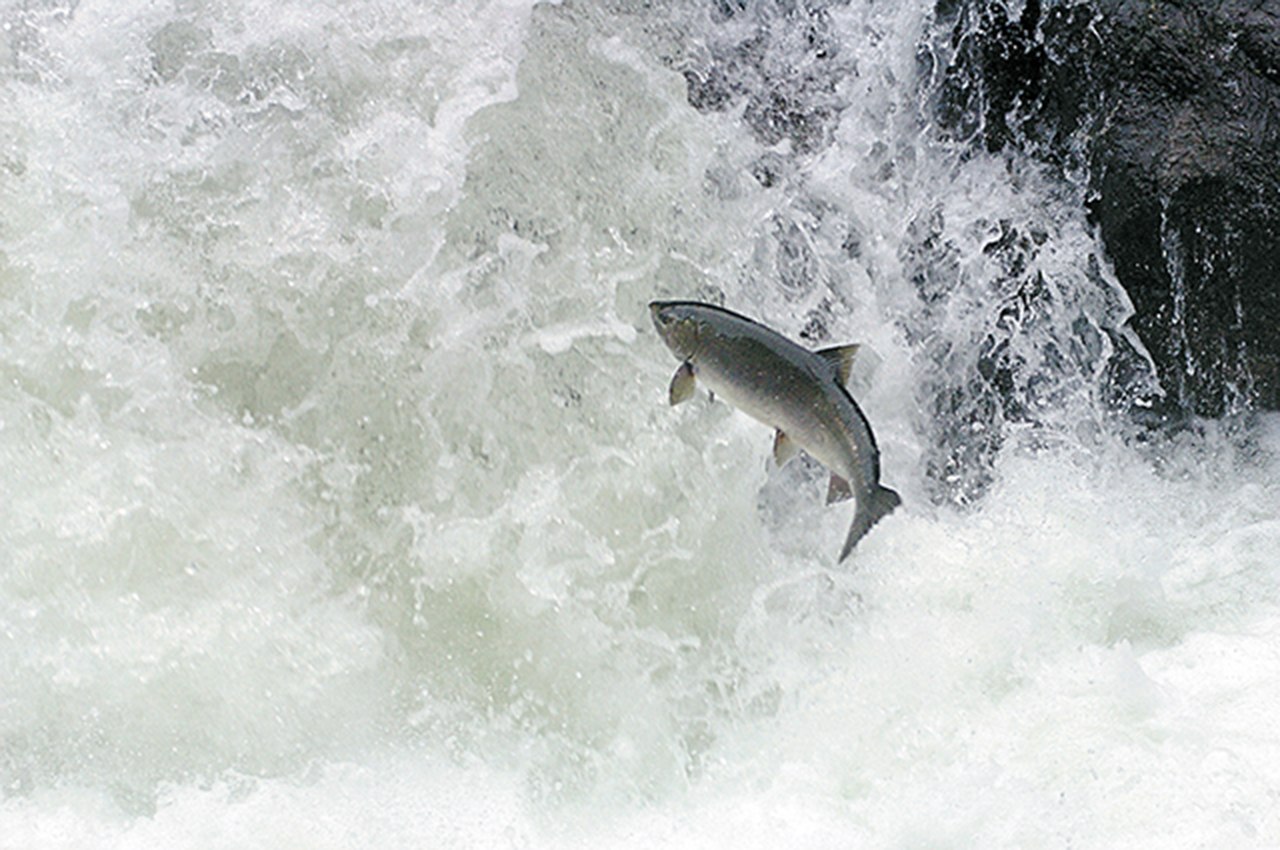
PORT ANGELES — Salmon throughout most of Washington state are in trouble, and will need continued investment by state, federal and local organizations if they are to be saved, according to a report released by the Governor’s Salmon Recovery Office.
In most of the state, salmon are below recovery goals set in federally approved recovery plans.
Washington is home to 33 genetically distinct populations of salmon and steelhead, 15 of which are classified as threatened or endangered under the federal Endangered Species Act.
Of the 15, seven are not making progress or are declining, six are showing signs of progress but still below recovery goals and two are approaching recovery goals.
Puget Sound chinook and steelhead, as well as sockeye, are of the main concern locally, said Mike McHenry, a habitat biologist with the Lower Elwha Klallam Tribe.
Chinook run in both the Elwha and the Dungeness rivers, he said.
“In the Elwha of course, we have a major restoration project underway,” he said. “The recovery is just beginning.”
This year about 60 chinook redds — salmon spawning nests — were counted above Glines Canyon, meaning at least 100 or more salmon made it past the former upper dam.
Last year 2,000 chinook returned to the Elwha River, McHenry said. In the two previous years, 4,000 returned. He said this is because of a high marine mortality rate due to warm water in the North Pacific Ocean, he said.
Commercial and recreational harvests have declined significantly because of fewer fish and limits on how many fish could be caught to protect wild salmon, according to the report.
Harvest of coho salmon has fallen from a high of nearly 3 million in 1976 to fewer than 600,000 in 2014, according to the state Department of Fish and Wildlife.
Chinook harvests have followed the same downward trend, with about 970,000 chinook caught in 1973 compared to 316,000 in 2014.
The newly created Fish Barrier Removal Board recently released a report indicating that despite two decades of investments, an estimated 35,000 to 45,000 barriers to fish passage remain.
The report also talks about progress made in habitat restoration and hatchery reform.
For the first time, more permits were obtained in 2014 to remove shoreline armoring (beach walls and bulkheads) than to build new ones in Puget Sound. Softer, more natural shorelines help increase food and shelter for salmon.
Statewide, an estimated 6,500 barriers to fish passage have been corrected with fish-friendly culverts and bridges in Washington streams, opening an estimated 6,400 miles of habitat to salmon since 2000.
The report also noted changes that need to be made to improve salmon recovery, including better integration of harvest, hatchery, hydropower and habitat actions; fully funding regional recovery organizations and increasing state agency resources to meet salmon recovery commitments; restoring access to spawning and rearing habitat; and increasing monitoring of fish and habitat to fill in data gaps.
________
Reporter Jesse Major can be reached at 360-452-2345, ext. 56250, or at jmajor@peninsuladailynews.com.
