
By Jeffrey P. Mayor Tacoma News Tribune
EDITOR’S NOTE — See related story today, “Chinook salmon seen in upper Elwha River for first time in 102 years,” https://www.peninsuladailynews.com/article/20140914/NEWS/309149941
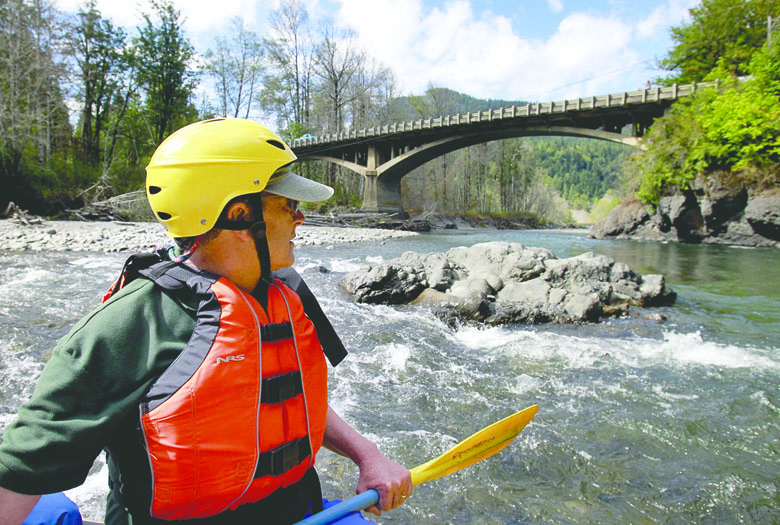
OLYMPIC NATIONAL PARK — As it winds through Olympic National Park, it doesn’t take long to discover that the character of the Elwha River is different, wilder.
There are gravel beaches at many of the river bends. Trees and root wads dot the shoreline and some of the beaches. There are far more rapids, made easier or more difficult by the fluctuating flows.
I first floated the Elwha in 2007, getting a firsthand glimpse of a river contained by two dams.
Then the river’s constant flow made for an easy trip from Altair Campground inside the park to the head of what was then Lake Aldwell.
My most recent trip was last month, just a week before the final section of the 210-foot Glines Canyon Dam was blasted into history.
The 108-foot Elwha Dam came down in July 2012.
The $325 million removal and restoration project allows the Elwha to flow unfettered 45 miles from its source in the Olympic Mountains to the Strait of Juan de Fuca.
Like any river trip, there is plenty to see.
Throughout our short journey, we scanned the emerald depths for salmon moving upstream to spawn.
Salmon spotted
It wasn’t until we reached the head of the former Lake Aldwell that Rob Smith called out “Salmon!”
Sure enough, the rest of us in the raft saw a bright red sockeye making its way through a pool. We also saw a fairly large chinook.
“I’m eager to see the salmon come up here,” Smith, Northwest regional director for the National Park Conservation Association, said after the trip.
“It’s great to hear about a woman the other night who saw five salmon jumping in the river.”
The river once was home to runs of all five Pacific salmon and five other species of anadromous fish.
Stories are told of chinook that weighed 100 pounds returning to the river, with runs of 300,000-400,000 salmon.
Recent runs have been just 1 percent of those historic counts.
Now that the river gives fish access to 70 miles of pristine habitat, 87 percent of which is protected within the park, restoration managers are hopeful the runs will someday approach pre-dam levels.
“It’s a really neat time to be out there,” said Morgan Colonel, owner of Olympic Raft & Kayak.
“I’ve seen an otter capture a coho salmon that was as big as the otter.”
Return of the river runs
Robert Elofson is eager to see the return of salmon, steelhead, bull trout, searun cutthroat trout and other species.
He is the director of the river restoration effort for the Lower Elwha Klallam tribe.
In addition to spending the last 13 years on the project, Elofson has spent parts of 30 years fishing the lower river.
Standing on the freshly created gravel bar, Elofson could not contain his excitement.
“This brings a smile to me, to watch it happening, the salmon coming back,” he said.
“The sediment coming down, the woody debris building up — it’s amazing to see the process taking place.”
David Morse is another longtime participant in the project. He was superintendent of Olympic National Park from 1994-2003.
During a stop in our journey, he said there was a sense of satisfaction at knowing the dams have finally come down.
There were times, however, when he thought it might not happen.
“The first one, two, three years in the mid-’90s, there was a fair amount of doubt,” the now-retired Morse said.
“The story is actually 25, 30 years old. This is the second chapter of a long story.”
There is more to this journey, and this story, than salmon.
Many forms of wildlife
The 7- to 8-mile float is a mini-biology class.
No sooner had we started our trip when we saw an American dipper, hopping from rock to rock, looking for a buggy meal under the river’s surface.
A short time later, we saw a Harlequin duck hen guiding her three chicks to calmer water.
We saw an osprey soar over the river, as well as a falcon and a red-tailed hawk.
There were piles of trees and stumps washed up on the banks and gravel bars.
They will serve as sanctuary for future generations of salmon fry as they grow before migrating downstream to the Strait and then to the Pacific Ocean.
There were many more rapids, the turbulence putting more oxygen in the water for all the life forms that live in the river.
The river itself is different.
The flows, once contained by the dams, will rise and fall with the season.
Where rock gardens now roiled the surface are smooth shallows.
“It’s more primitive; it’s more natural,” Colonel said.
“It’s not manmade anymore. It’s a much more wild experience.”
When we stopped at a new gravel bar, Colonel walked over with what at first appeared to be a rock.
The size of a small melon, it had the same white-gray look of all the other rocks on the bar. On closer inspection, you could see smaller rocks embedded in the large piece.
It was, Colonel pointed out, a chunk of Glines Canyon Dam that had been carried several miles downstream.
More chunks will come down now that the final section of the dam has been blasted.
Sediment from lakes
There also is more sediment from the two lakes to be washed downstream.
Forty percent of the lakebed silt expected to come down the river remains, said park spokeswoman Barb Maynes.
It is a recovery process that will likely take decades to be fully complete. But Mother Nature will get a helping hand.
Park staffers and volunteers later this fall will tackle the task of putting 400,000 native plants on land once covered by the reservoirs.
There is little doubt the river is different from that trip seven years ago.
“You’re seeing some things no one has ever seen before,” Colonel said, referencing the 100-year history of the dams.
“Seeing what is being uncovered that has been buried, that’s what I enjoy.”
David Graves, Northwest program manager for the conservation association, has watched the removal process unfold over the years and is anxious to see what the Elwha will become.
“The river changes month by month, week by week and sometimes day by day,” he said.
