
By Steve Benham
KATU-TV of Portland, Ore.
PORTLAND, Ore. — They’re back. A lot of them. And they’re reproducing.
The invasion of the pyrosomes, gelatinous, translucent tube-like creatures ranging in size from less than an inch to a foot or more, continues in force off the coast of Oregon for a second year, baffling scientists.
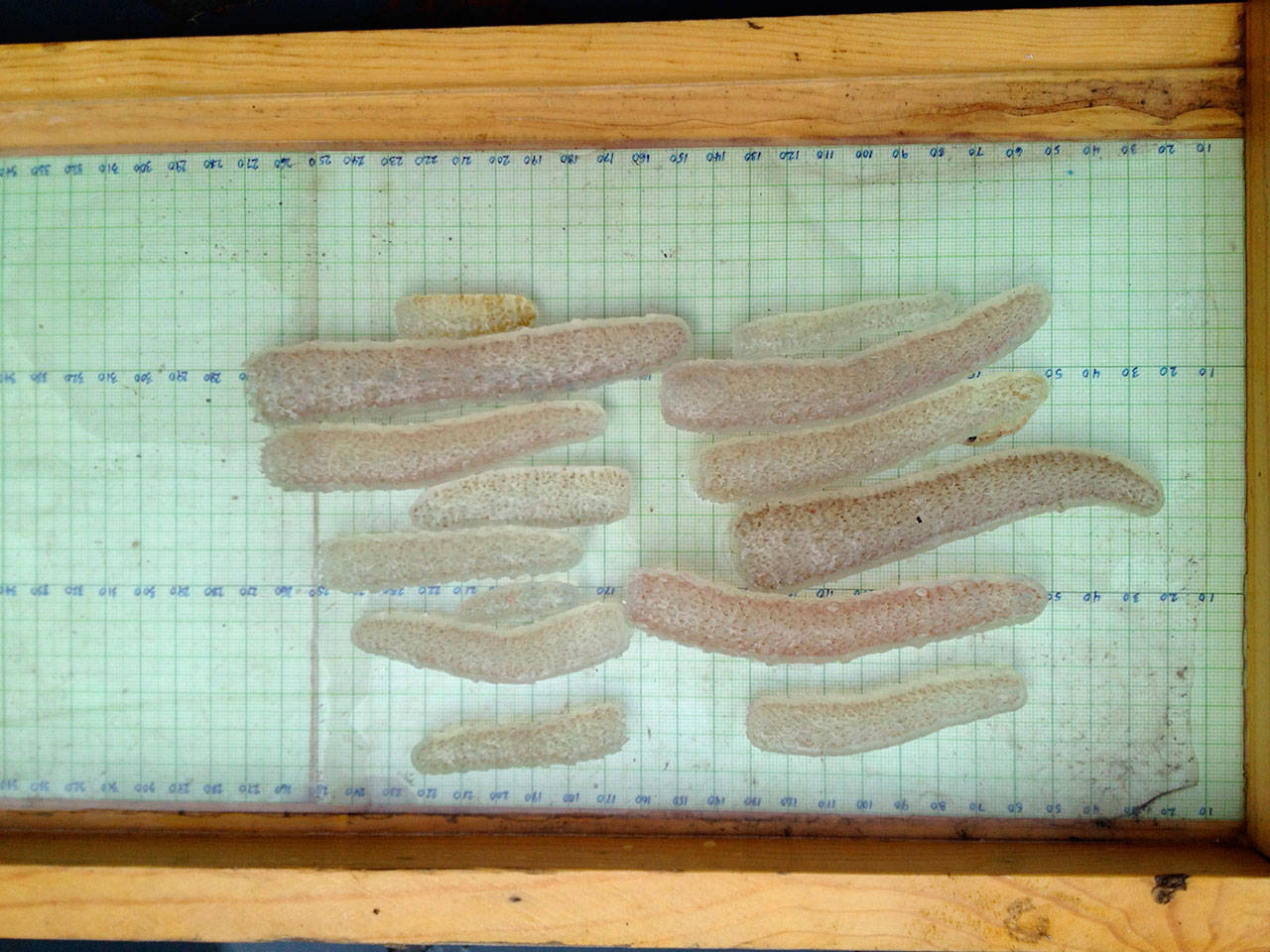
In this March 2018 photo provided NOAA Fisheries, pyrosomes, that marine scientists pulled out of the Pacific Ocean off the coasts of Oregon and Washington during a research cruise aboard NOAA’s Bell M. Shimada, sit in a tray. (Laurie Weitkamp/NOAA Fisheries via AP)
The creatures, made up of individual zooids — small, multicellular organisms — normally live in warmer waters, such as the tropics, and usually don’t travel farther north than the waters off southern California.
But last spring, scientists pulled pyrosomes out of the Pacific Ocean off the coasts of Oregon and Washington by the tens of thousands. The pyrosomes also wreaked havoc with the nets of commercial anglers, and they washed ashore by the millions, littering beaches.
Scientists just finished two research cruises aboard a National Oceanic and Atmospheric Administration fisheries survey vessel, Bell M. Shimada.
Oregon State University research assistant Jennifer Fisher was aboard a cruise in early March. She said in the seven or eight years she’s been sampling the seas off Oregon and California, she’s maybe seen the creatures twice.
But the past two years have been different.

In this March 2018 photo provided NOAA Fisheries, pyrosomes litter the deck of NOAA’s Bell M. Shimada research vessel during a cruise off the coasts of Oregon and Washington. (Laurie Weitkamp/NOAA Fisheries via AP)
“We saw a range of sizes, which to me indicates they are reproducing,” she said about last month’s sampling runs.
“To me that indicates whatever conditions they need, they’re doing well and they’re surviving, clearly, and they’re flourishing.”
NOAA research fisheries biologist Laurie Weitkamp, who went on a separate Shimada cruise about a week later, said researchers were pulling enough pyrosomes out of the sea to fill up buckets five gallons each.
Whatever caused these “pyrosome blooms” has so far stumped researchers, but “something happened,” said Weitkamp.
“We’re all kind of scratching our heads trying to figure out what it was that happened.”
Even though scientists haven’t confirmed it, they suspect that warmer water brought the creatures here.
Ric Brodeur, also a NOAA research fisheries biologist based in Oregon, raised two possibilities.
“[They] may have arrived during the unusual warm blob we had in 2015 or came north with the large El Nino in 2016 and seem to be sticking around even though the conditions appear to be close to normal,” he said.
Brodeur, as well as several other scientists, wrote a paper this winter on the pyrosome invasion that was published by the North Pacific Marine Science Organization.
In it the scientists said the pyrosome bloom of 2016-17 was expected to last into this year but noted that future climate change might also determine the presence of pyrosomes in the Northwest.
“Projected climate change in the coming decades may lead to anomalous events such as the pyrosome bloom becoming more common in the future, requiring continuing monitoring to assess its impacts,” they wrote.
Besides being a nuisance to commercial anglers, scientists are concerned about the impact the pyrosomes will have on the oceanic food web.
“They are so numerous and can consume a lot of plankton, so we are concerned about them competing with things like krill and copepods that are the normal base of the food web,” said Brodeur.
Tiny crustaceans such as copepods, which are also high consumers of phytoplankton, can make good meals for forage fish, which are then eaten by fish such as salmon.
The copepods that live off the coast of Oregon are good sources of fat in the food web.
But scientists have found that pyrosomes are likely not, which suggests that they won’t be a nutritious source of food for any fish that eat them.
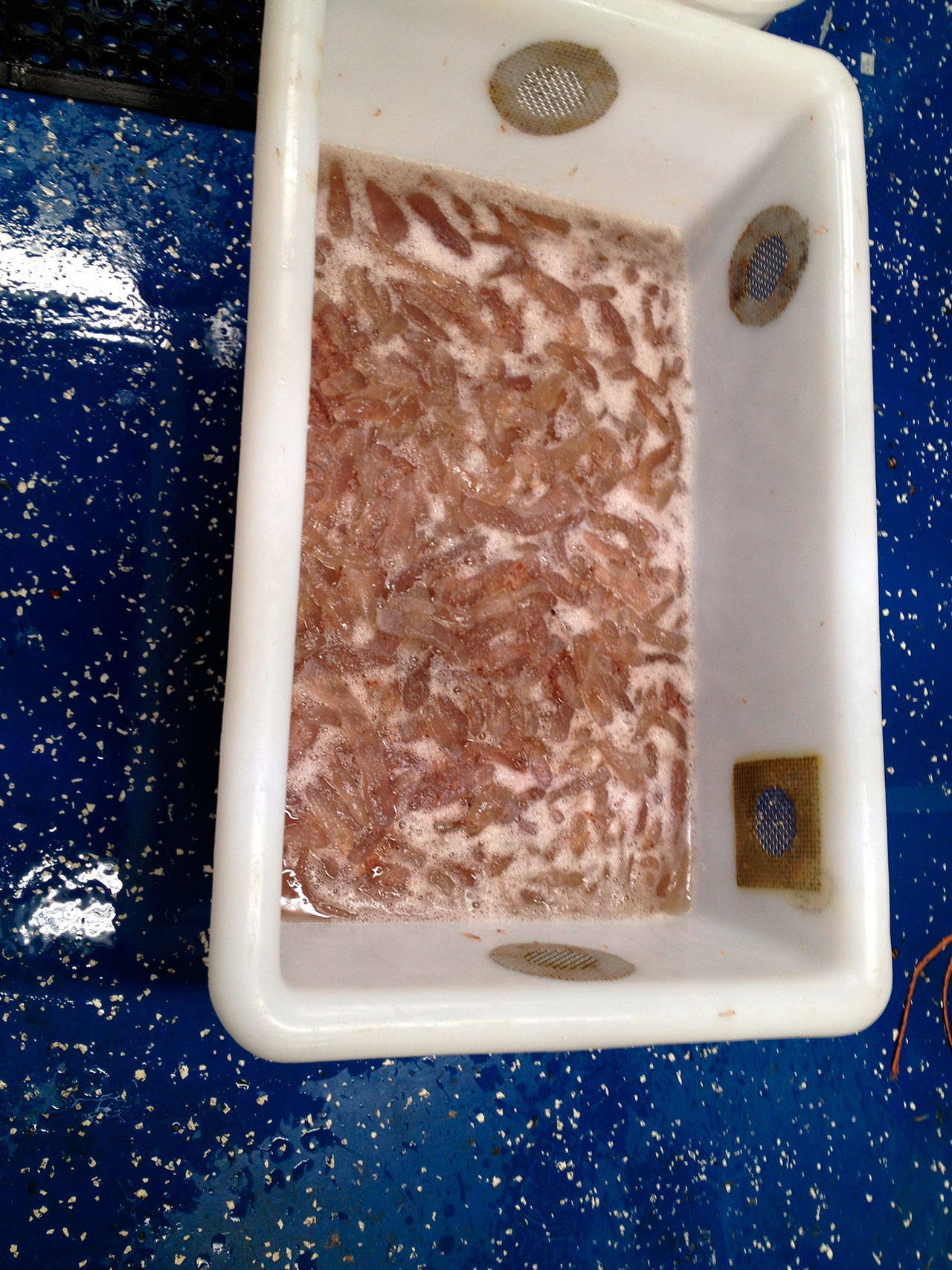
In this March 2018 photo provided NOAA Fisheries, pyrosomes sit in a container. (Laurie Weitkamp/NOAA Fisheries via AP)
For example, scientists are finding that fish such as rockfish are making meals out of pyrosomes instead of feasting on their normal diet of krill and shrimp.
“They’re thinking they’re eating hamburgers and instead, they’re eating celery — even worse than celery,” Weitkamp said.
While she doesn’t think the rockfish will die from eating the pyrosomes, Weitkamp said their growth will slow down.
That might mean, in the long run, less bounty for commercial anglers.
There is no shortage of questions about the pyrosomes’s impact on the ocean ecosystem.
“We really don’t understand what their role is in the food web in this area,” said Hilarie Sorensen, a graduate student at the University of Oregon who’s also studying the pyrosomes. “In such high numbers, could they potentially make a dent in the phytoplankton populations?”
The scientists, such as Sorensen, are observing that the pyrosomes are sticking close to high populations of phytoplankton and moving with them as they migrate from close to shore to farther out, which makes sense as the phytoplankton are a source of food.
Sorensen was on the Shimada late last May when a five-minute tow netted about 60,000 pyrosomes. She and other scientists at that time attached a GoPro camera to a net and dropped it in the water. Pyrosomes were everywhere.
In addition to helping scientists understand the impact to the food web, Sorensen said the research could also help commercial anglers navigate away from potential pyrosome hotspots if the creatures persist year after year.
“This information would be useful to let them know, OK, at this location during May, they were particularly abundant at these depths. So maybe these are areas you might want to avoid so you don’t waste your time or get your equipment broken,” Sorensen said.
With ocean temperatures returning to average, one of the big questions is whether these creatures will bloom this summer.
Oregon scientists will be watching.
________
This story from a Portland, Ore., television station was distributed by The Associated Press.
