
Peninsula Daily News and news sources
The number of oil tankers sailing along the Strait of Juan de Fuca bringing cargos of crude from Alaska has diminished dramatically in the past few years, according to oil and ship-movement records, but a plan for Alberta tar sands crude could increase the number of tankers in the Strait if it comes to pass.
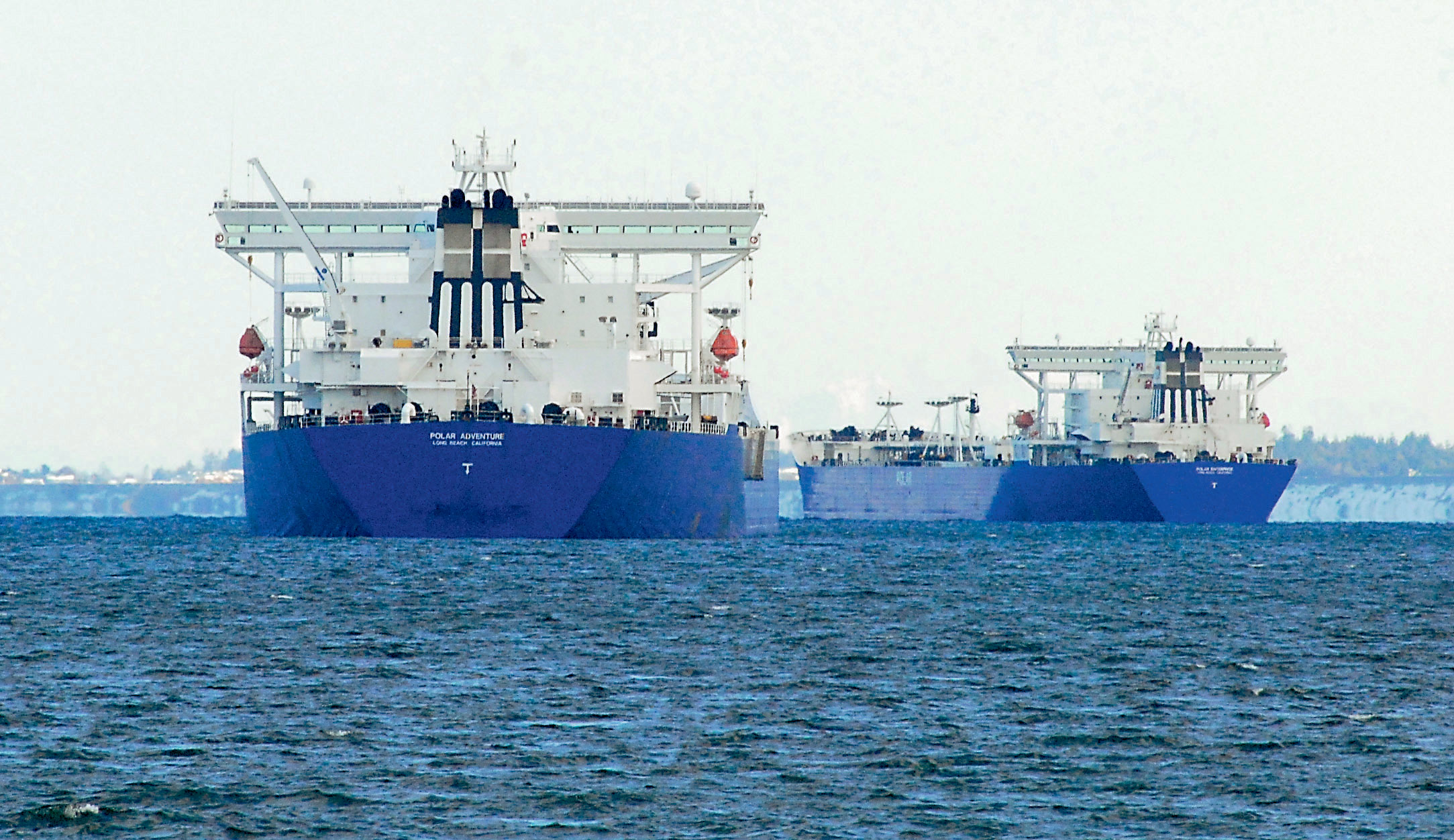
Many of the ships that currently head for Ferndale, Anacortes, Tacoma and other refinery points on Puget Sound often anchor in Port Angeles Harbor.
Many of those anchored that sit “low in the water” with full cargos await clearance to proceed to their refineries.
Others that have already offloaded their cargos will anchor in Port Angeles Harbor to take on fuel for their journey back to the Pacific.
And a few will tie up at a Port of Port Angeles pier to undergo topside repair and annual maritime inspections.
TAPS route
But the numbers of ship transits are dramatically lower from the heyday of the TAPS — Trans Alaska Pipeline System — route as fewer shipments of crude leave the terminal at Valdez, Alaska.
Crude sent through the Trans Alaska Pipeline has dropped from 2 million barrels a day in the 1990s and early 2000s to just above 500,000 daily now, according to a report in The Seattle Times.
“There used to be three or four tankers in Valdez a day,” said Steve Rothchild, spokesman for the Prince William Sound (Alaska) Regional Citizens’ Advisory Council.
“Now we get maybe 20 a month.”
The number of those tankers passing along the Strait to Puget Sound’s five refineries dropped from 285 in 1992 — the earliest records readily available — to 123 in 2013.
Other tankers head directly to refineries in the San Francisco Bay and Los Angeles areas.
More tankers?
The number of oil tankers on the Strait of Juan de Fuca in the next two to three years could increase beyond the totals of the TAPS route heyday if a pipeline expansion proposal carrying crude from Alberta’s tar sands to a ship terminal near Vancouver, B.C., reaches fruition.
The outbound Canadian tanker traffic to Asian ports would travel north of the international border that splits the Strait.
The loaded tankers also would travel through 3-mile-wide Haro Strait that splits the U.S.’s San Juan Island with British Columbia’s Sidney Island and the Vancouver Island coast east of Victoria.
“People who are paying attention are rightfully nervous about all of this,” said Martha Kongsgaard, chairwoman of the leadership council for the Puget Sound Partnership, the state agency overseeing cleanup of the Sound and parts of the Strait of Juan de Fuca.
“It’s just scarier than heck. It makes you want to put your hands over your ears.”
Keystone XL limbo
With planned expansion in production from Canada’s massive oil sands and the proposed 1,700-mile Keystone XL pipeline through the American Midwest still in limbo, energy giant Kinder Morgan Inc. in December sought permission to expand its pipeline from Alberta to Vancouver.
That would increase the pipeline’s capacity by one-third, to 890,000 barrels a day.
In turn, that would increase tanker traffic from its pipeline terminal in Burnaby, B.C., out the straits of Georgia, Haro and Juan de Fuca from about 60 tanker trips a year to more than 400, essentially doubling the total tanker traffic in Juan de Fuca maritime lanes.
At some points, those lanes are fewer than 5 miles from North Olympic Peninsula shores.
The presence of that much more oil puts the waters collectively known as the Salish Sea at a “very high” risk of spills, according to one study by Canadian authorities.
Another study showed that in six of seven simulated spill-response drills by B.C. officials, more than half the oil during a major spill would remain in the water five days after a hypothetical accident.
“We haven’t felt that in the past the standards and capability across the border were as strong as they are on the U.S. side,” said Dale Jensen, with the Washington State Department of Ecology’s spills program.
In addition, oil-sands petroleum has in previous accidents proved more difficult to clean up than North Slope crude brought down from Alaska.
A former National Oceanic and Atmospheric Administration chemist has argued that oil from Alberta could sink if left on the surface too long, making cleanup virtually impossible.
Frank Holmes, with the Western States Petroleum Association, acknowledged that more traffic could add more risk.
But he said the companies, the state and federal agencies on both sides of the border are coordinating right now to make sure spill-responders would be thoroughly prepared before any pipeline expansion is completed.
He also pointed out that Canadian bitumen — some of which currently is piped to Puget Sound refineries — often is mixed with other petroleum products, making it less likely to sink.
More escort tugs
And Kinder Morgan has recommended “additional risk-reducing measures in its facilities application, including increasing the use of escort tugs to cover the entire tanker route and the implementation of moving exclusion zones to safeguard tankers from other traffic,” Bikramjit Kanjilal, who oversees the marine development side of the company’s expansion proposal, said in a statement.
Many applaud the arrival of the new North American oil resources.
“This is a really good thing — it’s true energy independence,” said state Sen. Doug Ericksen, R-Ferndale, who authored one of several failed state legislative bills this year to tackle oil-spill issues.
“We’re creating some unique safety challenges . . . but I think [new sources are] great.”
Oil-industry officials said government and industry are moving to adjust to the challenges.
“The re-emphasis on more crude oil has definitely raised some concerns, and we need to take care of those,” said Holmes, with the Western States Petroleum group.
“But I think there’s a lot of effort, not only on our part but across the nation, to address those concerns.”
________
McClatchy News Service contributed to this report.
