
By Tom Vogt The Columbian
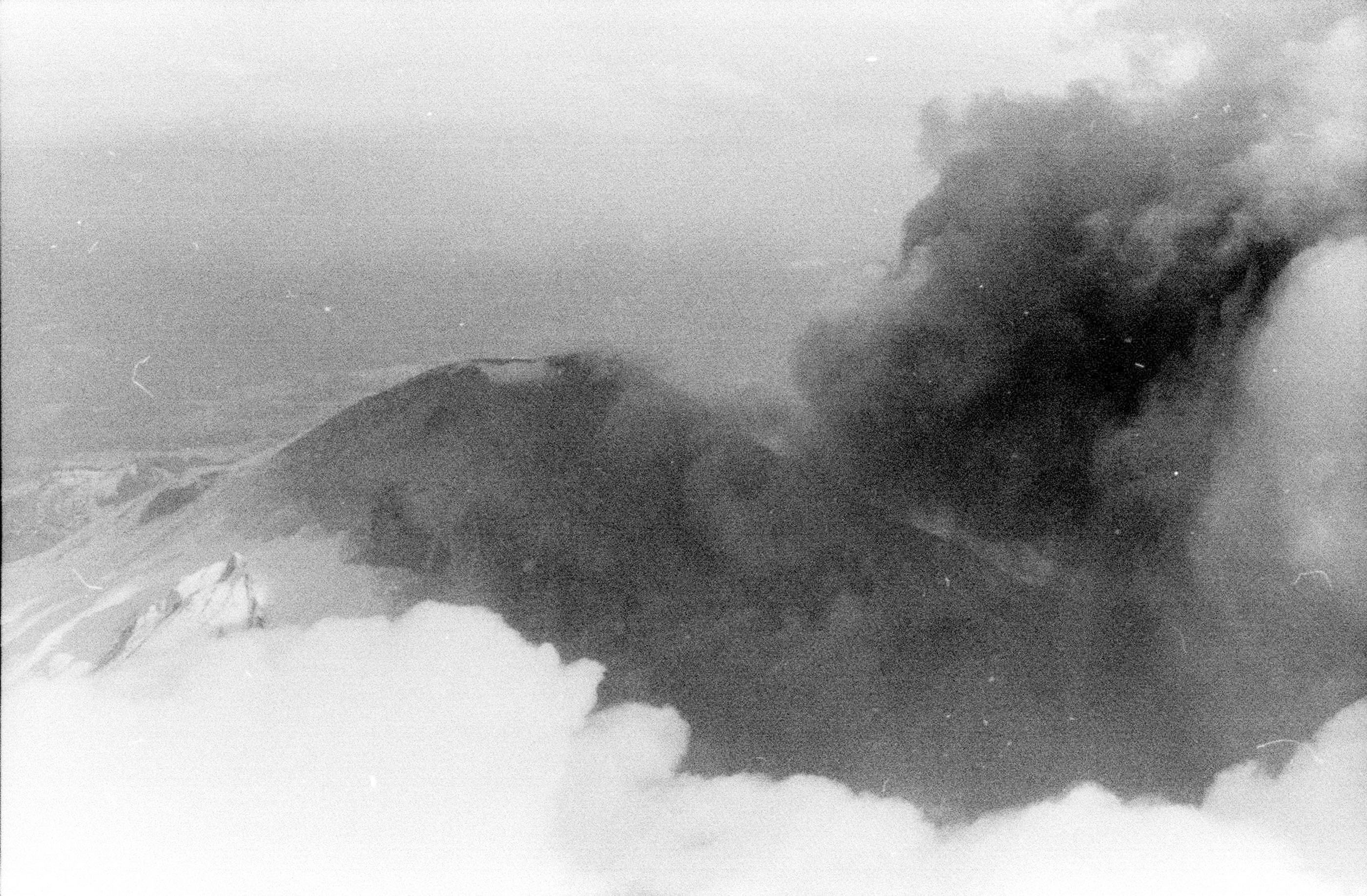
VANCOUVER, Wash. — They’re brand new images of a Northwest icon that disappeared more than 33 years ago — the conical summit of Mount St. Helens.
Reid Blackburn took the photographs in April 1980 during a flight over the simmering volcano.
When he got back to The Columbian studio, Blackburn set that roll of film aside. It was never developed.
On May 18, 1980 — about five weeks later — Blackburn died in the volcanic blast that obliterated the mountain peak.
Those unprocessed black-and-white images spent the next three decades coiled inside that film canister.
The Columbian’s photo assistant Linda Lutes recently discovered the roll in a studio storage box, and it was finally developed.
When Fay Blackburn had a chance to see new examples of her husband’s work, she recalled how he was feeling left out during all that volcano excitement.
“He did express his frustration. He was on a night rotation,” said Fay Blackburn, The Columbian’s editorial page assistant.
While other staffers were booking flights to photograph Mount St. Helens, “He was shooting high school sports.”
When his shift rotated around, “He was excited to get into the air,” Fay Blackburn said.
Columbian microfilm shows Reid Blackburn was credited with aerial photos of Mount St. Helens that ran April 7 and April 10.
He would have shot that undeveloped roll on one of those assignments. Maybe he didn’t feel the images were up to his standards. Maybe he didn’t trust the camera; it was the only roll he shot with that camera on the flight.
But he would have had more than one camera, said former Columbian photographer Jerry Coughlan, who worked with Blackburn at the newspaper.
“We all had two or three cameras” set up for a variety of possibilities. Riding in a small plane, “You didn’t want to be fumbling for lenses,” Coughlan said.
Former Columbian reporter Bill Dietrich teamed up with Blackburn during one of those early April flights over the volcano.
“Reid was a remarkable gentleman, with the emphasis on gentle,” Dietrich said. “He was an interested human being, with a great eye. He saw stuff.
“As a reporter, that’s a great thing about working with photographers. They see things,” Dietrich said.
“The newsroom was so electrified when the volcano first awoke. It was an international story in the backyard of a regional newspaper,” said Dietrich, who now writes historical fiction and Northwest environmental nonfiction. “We were all pumped up and fascinated.”
The May 18, 1980, eruption still is a historical landmark, as well as a huge scientific event: That’s why the roll of film was discovered a few weeks ago.
A photo editor working on a geology book contacted Lutes.
She’d come across a Columbian photo of a logjam on the Cowlitz River, taken on the day of the eruption, on a website and wanted the image.
Lutes sorted through a couple of boxes labeled “Mount St. Helens” and tried — unsuccessfully — to find that film.
She did find a ripped paper bag, with Blackburn’s negatives spilling out.
“I thought I’d better put it in a nice envelope so it wouldn’t be ruined,” Lutes said. “Then I found that roll. I thought, ‘Wouldn’t it be cool if we found what was on it?’”
Troy Wayrynen, The Columbian’s photo editor, agreed.
But with the switch to digital imagery, “I wasn’t sure if anyone even processed black-and-white film anymore,” Wayrynen said.
He took it to a Portland, Ore., photo supply company, which outsources black-and-white film to a freelancer.
When he got it back and saw the film-sized images, “I was astonished to see how well the film showed up,” Wayrynen said.
And then there was the content. Blackburn could have photographed anything on that roll, Wayrynen said.
“When I saw aerials of Mount St. Helens — a long-gone landscape — It was beyond my expectations,” he said.
This is the second time people have tried to coax images from film that Blackburn left behind.
The first occasion was shortly after his death.
Columbian colleagues, including Coughlan and Dave Kern, now assistant metro editor, visited the blast zone and recovered some of the personal gear from the car where Blackburn was sitting when the volcano erupted.
One of the items was a camera, loaded with a roll of film. But the film was too damaged to yield anything.
