
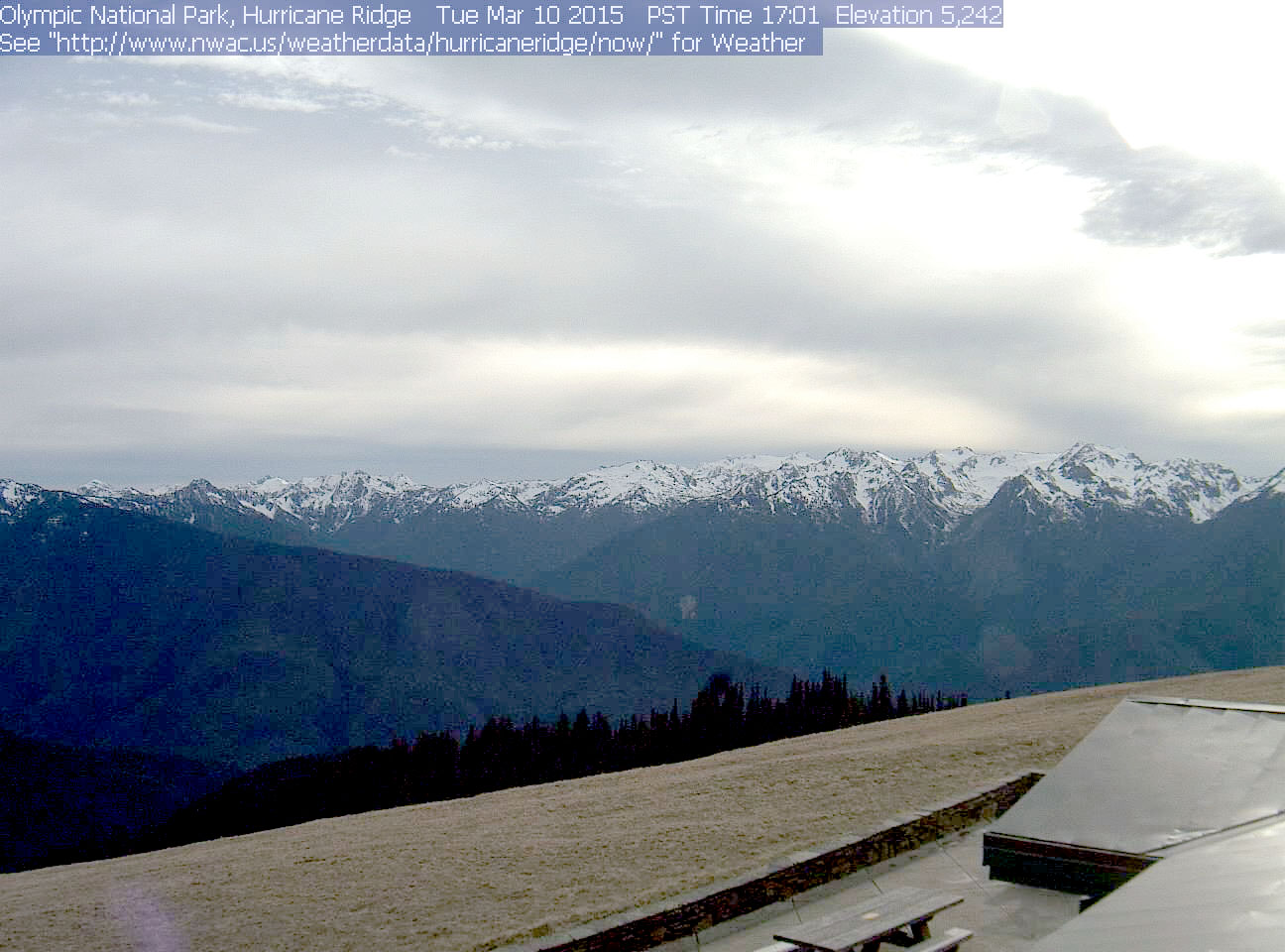
A stubbornly warm winter is still providing the Olympic Mountains with little snowpack, and the mountain range has been declared to officially be in a state of drought.
After a short-lived storm restored about a foot of snow last week, the meager, melting snowpack in the Olympics is back to single-digit percentages of where it should be.
The snow level is above the tops of most of the Olympics peaks, meaning that today’s rains are just that — rain — and not snow.
Both the short- and long-range forecasts are for above-normal temperatures, according to the National Weather Service.
“It is too late at this point that we will recover the snowpack to anything near normal,” said Doug McDonnal, forecaster for the Weather Service in Seattle.
On Tuesday afternoon, the SNOTEL sites that measure snow water content across the range showed the snowpack to be at 8 percent.
That compares with just 3 percent measured in mid-February.
On Feb. 24, the U.S. Drought Monitor first listed the higher elevations of the Olympics entering the D-1 — or “moderate drought” — stage, while lower elevations were designated as D-0, or “abnormally dry, used for areas showing dryness but not yet in drought.”
A March 3 report on conditions in the U.S. West focused on extremely dry conditions and a lack of snowpack in California’s Sierra Nevada mountains.
But it added that the drought has expanded to the Northwest.
“In the Pacific Northwest, snowpack conditions are equally poor — ranging from 9 percent to 47 percent of normal in the Cascades of Oregon and Washington,” the drought report said.
All of Washington state was included in an area designated as “drought development likely.”
A new drought report for the state is expected to be available Thursday at www.tinyurl.com/PDN-drought.
“We are a bit behind on rainfall,” McDonnal said.
There are two storms expected in the next week, and both were expected to bring warm rains to the mountains, he said.
While the Weather Service’s current rain year — measured from Oct. 1 through Sept. 30 — began with average to above-average rainfall, the past three months have been drier than average.
McDonnal said Weather Service long-term forecast models indicate that April, May and June will be warmer than average, but there are equal chances for a wet, average or dry spring.
However, the amount of rain or snow that typically falls during the season is low compared with winter and is not expected to make a significant impact, he said.
According to the U.S. Department of Agriculture’s Natural Resources Conservation Service, which measures water content of snowpacks using a laser system, Tuesday’s snowpack was at 8 percent using measurements from four sites in the Olympics.
On Tuesday at Waterhole, located near Hurricane Ridge at 5,010 feet elevation south of Port Angeles, the snowpack was 7 inches, 10 percent of the typical 70 inches of snowpack expected on a March 10, while the water contained in that snow was only 3.3 inches.
Typically, Waterhole’s peak snowpack — the date on which the snowpack typically stops growing and begins melting — is April 11.
Most of Hurricane Ridge’s open alpine meadows were covered only in brown, dead grass Tuesday, with the little remaining snow nestled in drainages and shadowed areas protected from the sunlight.
SNOTEL’s Dungeness site, in the mountains above Sequim at 4,010 feet, had no snow, while the site’s usual peak snowpack date would be this Thursday, according to Conservation Service data.
Buckinghorse, at an elevation of 4,870 feet in Jefferson County, had only 6 inches of snow, while Mount Crag, also in Jefferson County at 3,960 feet, had 3 inches of snow Tuesday, with a peak snowpack date of March 27.
The percentage of median for Buckinghorse and Mount Crag was not available, and peak snowpack was not available for Buckinghorse.
Many rivers leading from the Olympic Mountains are already running low, according to the U.S. Geological Survey streamflow monitoring website.
Three rivers were listed as having very low stream flows Tuesday:
■ Hoh River, at 813 cubic feet per second, 34 percent of the median, was in the first percentile for stream flow.
■ Calawah River, at 265 cubic feet per second, 22 percent of median, in the second percentile.
■ Hoko River, at 82 cubic feet per second, 21 percent of median, in the first percentile.
■ Elwha River was also running low at 805 cubic feet per second, 73 percent of median, and in the second percentile for the date.
■ Dungeness and Big Quilcene rivers each measured near-normal stream flows.
_________
Reporter Arwyn Rice can be reached at 360-452-2345, ext. 5070, or at arice@peninsuladailynews.com.
