
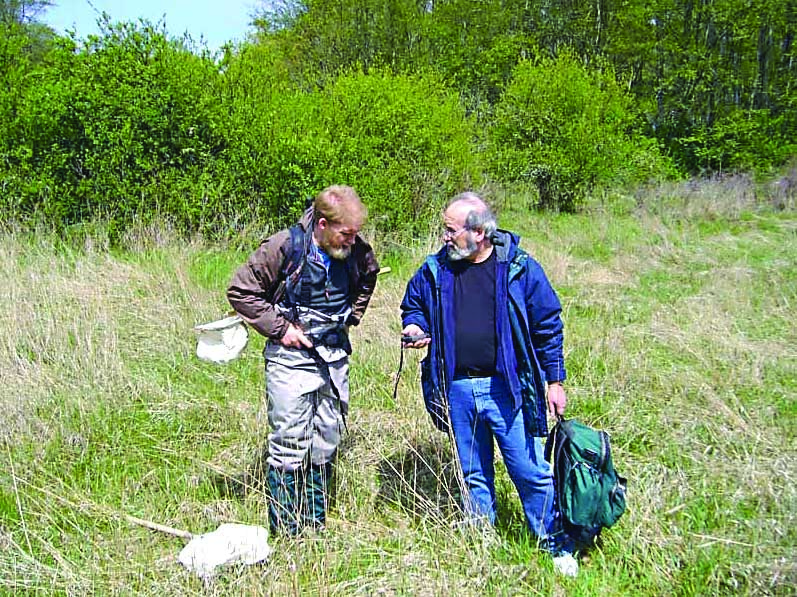
They’ve been snatched from the air with hand-held nets and scooped from the waters of the Elwha River.
Now, between 600,000 and
2 million individual insects and certain plants collected from the Elwha River Valley before dam removal are being processed and cataloged by students of Washington State University.
The goal of the collection is to establish a baseline of the types and populations of insects that lived in the river valley during the last century, when lakes were formed by dams, said Jerry Freilich, research coordinator for Olympic National Park.
That would set the stage for future researchers to take similar collections from the river valley after it has had time to recover and see what has changed, Freilich explained.
“It’s a before and after experiment,” Freilich said.
Removal of the Elwha Dam was finished in March 2011; the Glines Canyon Dam has been chopped down to a fraction of its original 210 feet and is expected to be fully removed next year.
The $325 million Elwha River Restoration Project, the largest in the nation, included removal of the dams, which were built without fish ladders and blocked salmon passage.
Contractors with the National Park Service began work on removing the dams in September 2011. The Elwha Dam was built in 1913. The Glines Canyon Dam, built in 1927 upriver from its older cousin, is expected to be completely gone by September.
Packed in alcohol and taken by van the roughly 400 miles to the WSU entomology department in Pullman, the beetles, flies and bugs were collected between 2008 and 2009 by students and staff from the University of Washington and researchers from the National Park, Freilich said.
“I work with enigmatic microfauna,” said Freilich, whose specific background is in aquatic entomology, or insects that live in water, “the little tiny ones that are puzzling or unknown to most people.”
Though tiny, the insects Freilich is interested in have a big impact on the river ecosystem.
“You’re really changing everything, from the little tiny stuff to the big stuff,” Freilich said.
“The little tiny stuff is like the underpinning. It’s the heart of the ecosystem.”
Freilich said he knows of no sampling planned for the time after the dams are demolished.
Such work likely would depend on funding and researcher interest and availability, he said.
Freilich said some changes future researchers might see include insects dependent upon slow-moving water, such as that found in lakes, for their breeding cycles no longer colonizing the Elwha valley.
“I think the more important change [is] associated with the return of the salmon and the predation the salmon produce,” Freilich said.
“They’re the chief [animals] that are feeding on the things we’re talking about.”
Richard Zack, the WSU entomology professor leading the initial insect organizing efforts, said undergraduates students Noah Austin and Laura Hamada have worked for the past two months removing individual insects from small vials filled with alcohol, which are in turn are packed in jars.
“There are literally hundreds of these jars and little vials,” Zack said.
The students will go through the specimens jar by jar and vial by vial, grouping them by type and securing many to pieces of Styrofoam, creating a database cataloging the specimens along the way.
“We’re looking at 1½ to 2 years,” he said, describing how long the sorting work will likely take.
Though not directly involved in this work, Freilich said just the sorting the students are doing representatives an immense time commitment.
“A jar of insects, that’s about 40 hours of work right there,” Freilich said.
And there are a lot of jars.
“Picture a large [Ford] Econoline van, and picture that pretty well filled up with boxes [of jars],” Freilich said.
“It’s a lot of stuff.”
The initial sorting is only the beginning of the project, as most of the specimens will likely have to be sent to experts specializing in specific species for identification, Freilich said.
This would involve specialists from universities across the country, Freilich said, such as experts in tiny aquatic flies from Colorado State University and Brigham Young University in Utah.
“And it’s going to be five years [or so] before some of this stuff even gets identified,” Freilich said.
The project might not have moved forward at all had Freilich not teamed up with Zack to beginning sorting the massive insect collection.
Between 2008 and 2009, the collection work, lead by UW professor Ted Pietsch, was funded by a $200,000 National Science Foundation grant and a $70,000 grant from the National Park Service’s biological resource management division, Freilich said.
The grants funded the collection and some early processing of the samples, Freilich said, but ran out before the vast majority of the specimens could even be removed from their protective alcohol baths.
So the collection sat in limbo, stored at the UW campus until Freilich got in touch with Zack about the WSU entomology department taking over the cataloging work, since UW does not have such a department.
Zack said a $30,000, two-year grant from a private foundation was secured to fund the work.
Next spring, Zack said he intends to meet with biologists, entomologists and other researchers on the Elwha dam removal and restoration project to discuss how the collection can best be used to study impacts on the Elwha ecosystem.
“That’s the beautiful comparison you’re going to be able to make, when you do take that reservoir system and turn it back,” Zack said.
The collection also will provide researchers of projects not yet considered access to an immense catalog of the Elwha River Valley creatures.
“This material should have tremendous biological value for people doing all sorts of study,” Zack said.
“For this Olympic material, this constitutes an immediate need because this resource doesn’t exist anywhere else.”
________
Reporter Jeremy Schwartz can be reached at 360-452-2345, ext. 5074, or at jschwartz@peninsuladailynews.com.