
By Carla K. Johnson and Nicky Forster | AP Medical Writers
SEATTLE — With her due date fast approaching, Kelly McCarty packed a bag with nursing tops, a robe, slippers and granola bars. Last week’s ultrasound, she said, showed “this baby is head down and ready to go.”
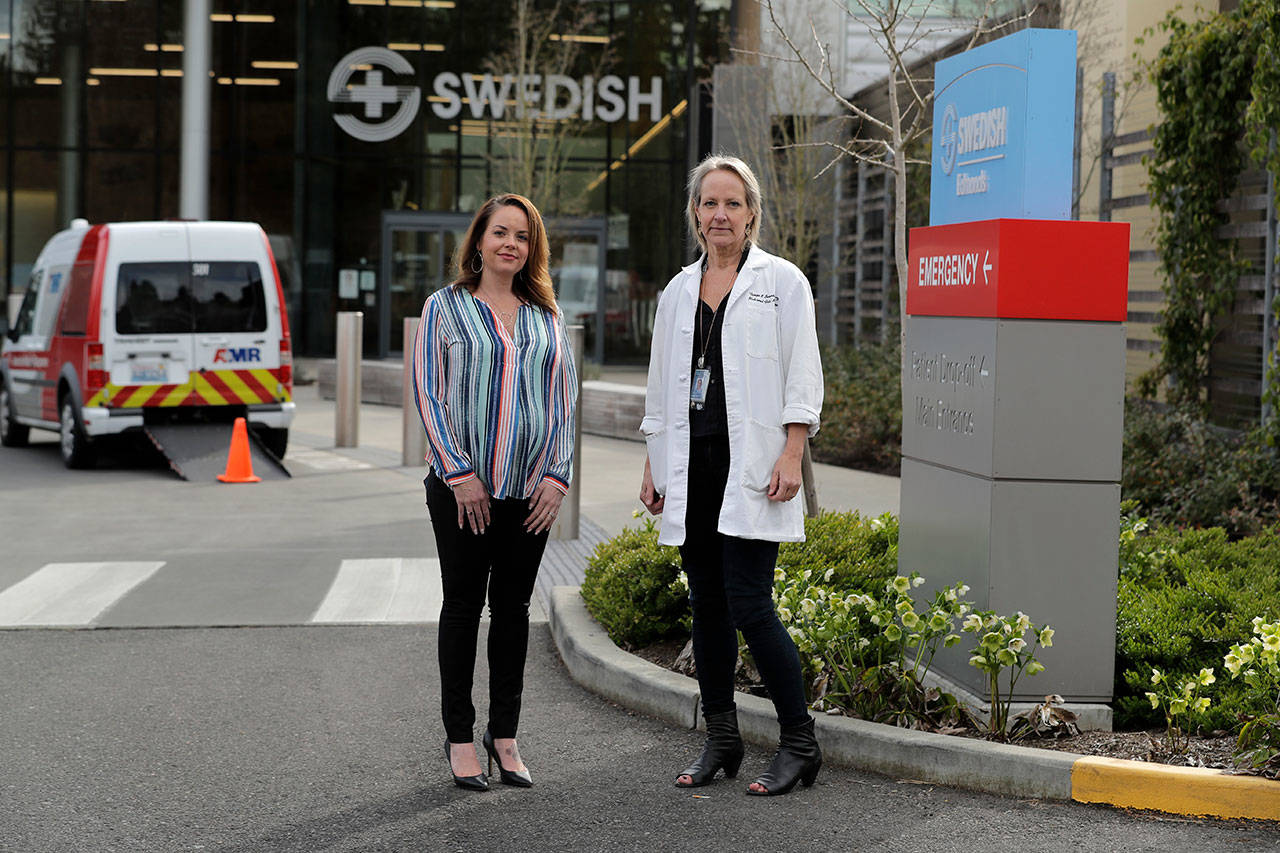
But the new coronavirus has thrown her a curveball, bouncing her and about 140 other expectant moms from their first-choice hospital to another 30 minutes away. The birth unit at the Edmonds hospital is needed for COVID-19.
With capacity stretched thin, U.S. hospitals are rushing to find beds for a coming flood of patients, opening older closed hospitals, turning single rooms into doubles and re-purposing other medical buildings.
Louisiana is making deals with hotels to provide additional hospital beds and has converted three state parks into isolation sites for patients who can’t go home. Illinois is reopening a 314-bed suburban Chicago hospital that closed in September.
In Seattle, Harborview Medical Center is turning a homeless shelter into a 45-bed coronavirus recovery center.
In New York, the city’s convention center is being turned into a temporary hospital. At Mount Sinai Morningside hospital, heart surgeons, cardiologists and cardiovascular nurses now care for coronavirus patients in a converted cardiac unit.
Floating hospitals from the U.S. Navy are heading to Los Angeles and, eventually, New York.
Military mobile hospitals are promised to Washington state.
Simple math is spurring hospital leaders to prepare. With total U.S. cases doubling every three days, empty intensive care unit beds, needed by an estimated 5 percent of the sick, will rapidly fill.
U.S. hospitals reported operating 74,000 ICU beds in 2018, with 64 percent filled by patients on a typical day. But available ICU beds are not evenly distributed, according to an Associated Press analysis of federal data on hospitals that provided a cost report to Medicare in fiscal year 2018.
The AP found more than 7 million people age 60 and older — those most at risk of severe COVID-19 illness — live in counties without ICU beds. AP included ICU beds in coronary units, surgical units and burn units in the count.
“Better to be over-prepared than react in the moment,” said Melissa Short, who directs women’s health for Seattle’s Swedish Medical Center, which is using data from China and Italy as it attempts to double its capacity to 2,000 beds.
In South Korea, some died at home waiting for a hospital bed. In northern Italy, an explosion of cases swamped the hospital system. Video and photos from two Spanish hospitals showed patients, many hooked to oxygen tanks, crowding corridors and emergency rooms.
About 10 days ago, Dr. Tanya Sorensen got a call from the doctor leading the response to the virus at Washington state’s Swedish Medical Center. How could the system consolidate its birth services to keep healthy delivering moms away from the sick?
“It took me aback,” said Sorensen, medical director for the hospital system’s women’s services. “It brought home the fact that we are going to be facing a huge surge of cases of COVID very soon.”
Edmonds facility
Swedish’s Edmonds facility — where McCarty had planned to deliver — announced Saturday it is closing its seventh floor birth center temporarily, gaining 35 beds for the expected influx. McCarty will go instead to an affiliated hospital in Everett.
“They need more beds. If they can open up a whole floor, I understand,” said McCarty, a public school teacher who is busy coaching colleagues about online learning during the state’s lockdown.
For most people, the coronavirus causes mild or moderate symptoms, such as fever and cough that clear up in two to three weeks. For some, especially older adults and people with existing health problems, it can cause more severe illness, including pneumonia, and death.
If other countries have the same experience as China, 15 percent to 20 percent of COVID-19 patients will have severe illness. About 5 percent could become sick enough to require intensive care.
Equipment is a challenge. About 20 percent of U.S. hospitals said they didn’t have enough breathing machines for patients and 97 percent were reusing or otherwise conserving N95 masks, according to a survey conducted last week by hospital group purchasing organization Premier.
Who will staff the needed ICU beds is keeping U.S. hospital leaders awake at night.
In western Massachusetts, Nancy Shendell-Falik, a nurse turned hospital executive, is planning Baystate Health’s response. The system’s community hospitals and flagship hospital in Springfield are finding space for 500 additional beds, including 140 ICU beds.
She asks herself: Will cross-training staff and working in teams help the ICU nurses handle a surge of patients needing breathing machines? Will there be enough masks, gowns and face shields? She also worries about exhaustion, burnout and nurses falling sick.
“Beds don’t take care of patients. We need the staff to do so,” she said.
During 9/11, she worked as a chief nurse at a hospital eight miles from the twin towers. She also worked at a Boston hospital that took in casualties of the 2013 marathon bombing.
“Those things changed our world forever, but they were very time-limited activities. What’s scary about this,” she said, is “we don’t know the duration.”
Making adjustments
This weekend, McCarty and her husband plan to drive to the Everett hospital, a trial run for when she goes into labor. When her contractions start, they’ll call her dad to come stay with their 4-year-old daughter. McCarty is taking it in stride, knowing the depth of the need.
“If it was my first child, I think it would be a little harder,” McCarty said of adjusting her birth plan for COVID-19. “I know what it’s like and I’ve been through it before. Where I deliver isn’t necessarily that big of a deal. I’m happy to oblige.”
