
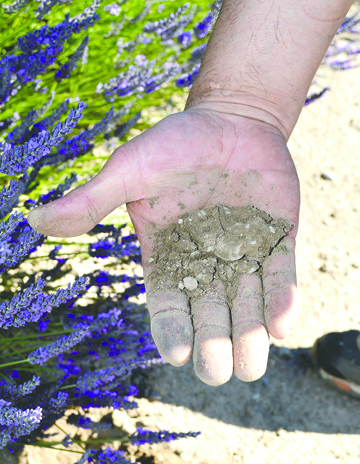
SEQUIM –– Millennia of sediment left behind by the Dungeness River has made Sequim the lavender capital of North America.
With a steep plummet out of the Olympic Mountains’ north face and a trail toward the Strait of Juan de Fuca, the Dungeness River has made alluvial fans and carved terraces across the valley, covering them with rich, loose soil, perfect for lavender growing.
“You pretty much put it in the ground and then just watch it,” said Jordan Schiefen, who owns Jardin du Soleil Lavender with her husband, Paul.
Arturo Flores, manager of Graysmarsh Farm, praised the lavender plants for their ability to thrive in the Dungeness Valley’s sandy topsoil with little to no maintenance.
“The only thing I’ve got to do to this thing is water every once in awhile,” Flores said.
“Give them some space and leave them alone.”
Tens of thousands of visitors are expected to visit the Dungeness Valley from Friday through Sunday to see the plants in their violet glory during Sequim Lavender Weekend, which includes the Sequim Lavender Farmers Association’s Lavender Farm Faire and the Sequim Lavender Growers Association’s Lavender Festival.
Aiding the plants even further is the Dungeness Valley’s moderate, dry climate, which is similar to lavender’s Mediterranean origin.
Sequim is in Zone 8 of the U.S. Department of Agriculture’s Plant Hardiness Zone Map, the standard used by gardeners and growers to determine how a plant will do in a particular climate.
Zone 8 climates, which are semi-Mediterranean, have mild temperatures in the winter and summer with low levels of humidity.
“The humidity attacks the inside of the plants, the crown and the root,” said Paul Jendrucko, also known as “Dr. Lavender.”
This year’s weather has been even better for the lavender plants, Jendrucko said.
A La Niña weather pattern over the past couple of years meant wet, long, cold springs on the North Olympic Peninsula.
That, Jendrucko said, meant the lavender blooms were delayed until after Sequim Lavender Weekend traffic had dispersed.
The end of La Niña means this year’s plants are ready as the lavender celebration gets under way.
“Our farmers are enjoying, if you will, a bumper crop of visitors because of what happened to our weather,” Jendrucko said.
The soil in which all Dungeness Valley crops, even lavender, are planted is the remnants of thousands of years of geological forces, said Bruce Pape of Sequim, a retired soil scientist who taught at Central Michigan University before moving west.
“We live here in the Olympic Peninsula, where the soil’s fantastic,” Jordan Schiefen said.
Their particular soil was left behind by the river fairly recently, at least in geologic terms.
“The dirt down on the valley, that’s been there for about 2,000 years,” said Pape, also a Washington State University Clallam County Master Gardener.
Pape said he moved here, in part, because of the forces of the Dungeness River.
“This place is a physical geographer’s dream,” he said.
The river carried most of the finer materials out to the Strait of Juan de Fuca, with many of them ending up part of Dungeness Spit.
What was left on the valley floor were rocks, sand and other coarse materials that allow moisture to easily drain through the ground.
It’s new soil, Pape said, that is not fully developed when viewed in profile.
“But give it another few thousand years,” he said.
With that soil and climate taking care of the plants, little is left to do for those who tend to them.
“The work isn’t in the growing; it’s in the harvest and the processing and the distilling,” Jordan Schiefer said.
“And the weeding,” Paul Schiefer added.
He admitted to becoming a bit obsessive about seeing unwanted vegetation in his lavender rows.
“I just see every one,” he said. “It drives me nuts.”
Flores said he leaves choppings off the plants on the ground after the harvest, as the residue acts as a combination mulch and herbicide.
After the festival, workers will take to the fields with sickles to harvest the lavender off the plant and put it into bundles.
________
Sequim-Dungeness Valley Editor Joe Smillie can be reached at 360-681-2390, ext. 5052, or at jsmillie@peninsuladailynews.com.
