
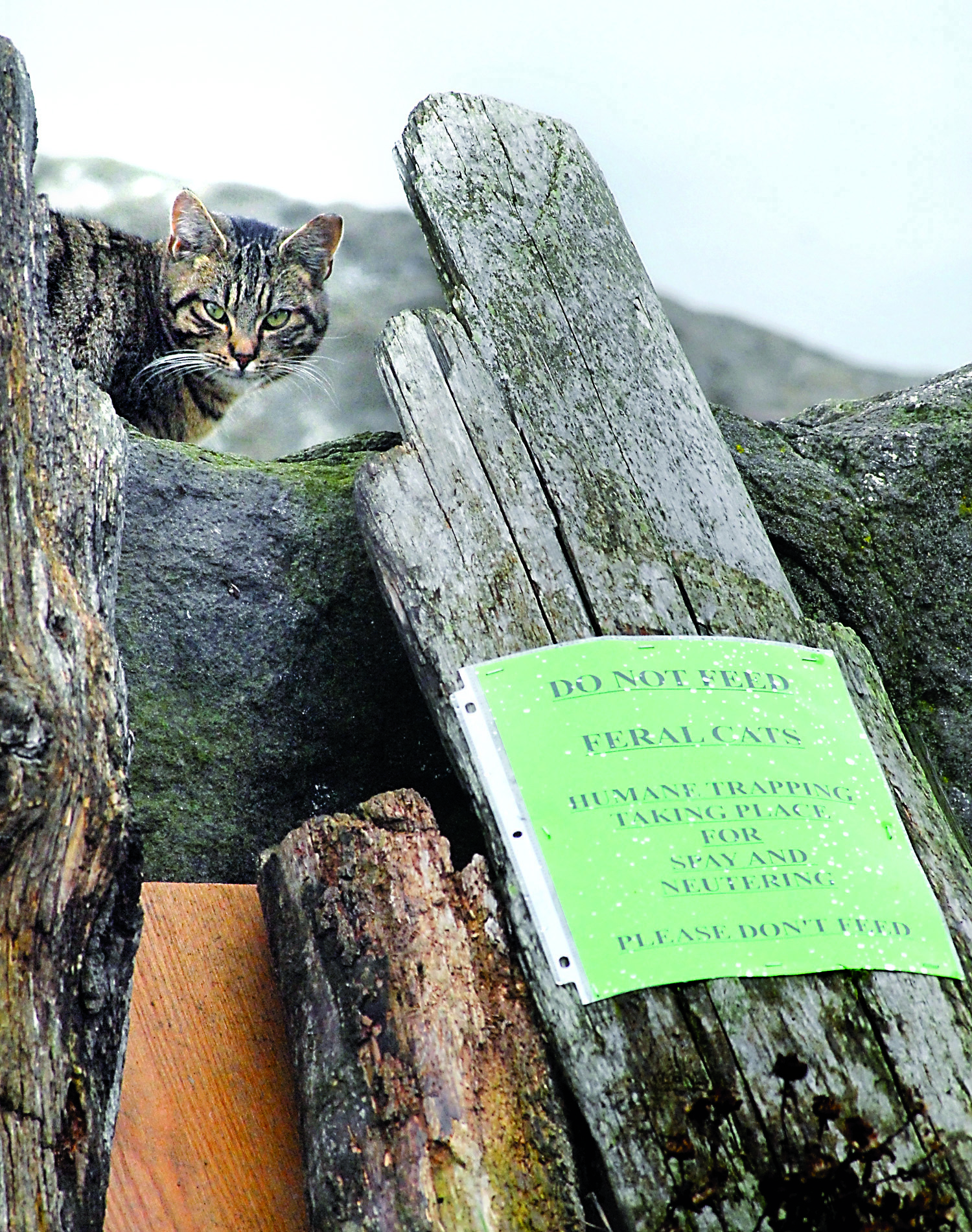
PORT ANGELES — They can often be seen scampering from rock to rock along Ediz Hook in Port Angeles, their eyes peeking out from between the crevices.
The feral cats that call the Hook home have become a particularly visible symbol of a larger issue across Clallam County.
“There’s lots of feral cat colonies out there,” said Tracey Kellas, animal control deputy with the Clallam County Sheriff’s Office.
They survive on plots of private land, such as fields, and maintain their numbers mostly through breeding, rather than through owners dumping animals.
To combat feral cat populations, four Clallam County nonprofits are teaming up to launch a concerted effort, expected to start in the coming months, to capture the cats, spay or neuter them, then return them to their colonies.
“This is a larger cooperative effort among several animal welfare organizations in Clallam County,” said Sue Miles, spay-and-neuter clinic coordinator with Spay to Save, a Port Angeles-based nonprofit that offers low-cost spaying and neutering services.
“This is a brand-new project.”
Miles said the capture, neuter and release method is nationally recognized as the most humane way to deal with feral cat populations because it allows colonies to die out through lack of breeding rather than through trapping and killing cats.
And while feral kittens can be adopted if they are socialized at a young enough age, Miles said the same is seldom true for adult feral cats.
“They’re not pets; they’re like wild animals,” Miles said.
“You can’t adopt them.”
Similar efforts have proven successful in Jefferson County.
Port Hadlock-based Olympic Mountain Pet Pals has taken in fewer feral and free-roaming cats per year — between 50 and 100 — since its cat spay-and-neuter program started in 2001, said Phyllis Becker, who coordinates the effort.
“When you see the number that have been spayed and neutered, pet overpopulation isn’t a problem in Jefferson County,” Becker said.
Spay to Save, the Olympic Peninsula Humane Society, Peninsula Friends of Animals in Sequim and Friends of Forks Animals are working with the Lynnwood-based nonprofit Feral Cat Spay/Neuter Project to train volunteers for monthly spay-and-neuter clinics.
The clinics are expected to begin by the end of February, said Lauren Glickman, executive director of the Lynnwood-based group.
“Ideally, what we want to do is 100 cats [per clinic],” Glickman said, adding that such clinics likely would be held on back-to-back weekends.
Volunteers would be taught how to prepare cats for surgery, Glickman explained, and how to ensure they recover safely afterward.
She said the clinics would be run by licensed veterinarians, who would be paid by the Feral Cat Spay/Neuter Project, while the Clallam County groups would pay for clinic supplies.
The Clallam County nonprofits have provided free and low-cost spay and neutering services for cats and dogs for years, Glickman said, which is part of the reason she wanted her group to become involved.
“There’s lots of activity, and [we] wanted to see how we could accelerate this [and how] can we help in any way to make this [effort] higher-volume and deepen the impact,” Glickman said.
Mary Beth Wegener, executive director of the Olympic Peninsula Humane Society, said the society’s shelter on U.S. Highway 101 has seen an increase in feral stray cats and kittens in the past two years.
The society jumped at the chance to be part of the larger cooperative effort, she added.
“Anything we can do to help cut down overpopulation, we’d be happy to participate,” Wegener said.
Glickman said her group has also arranged for a nonprofit based in Snohomish County to hold a March 29 workshop in Clallam County on safely trapping feral cats, though a place and time have not been decided.
Miles said the feral cats will be trapped from colonies for which loosely organized individuals regularly provide the cats with food and water.
This ensures the cats will continue to have healthy lives once they are spayed or neutered and released, she said.
Volunteers feeding cats are likely the source of signs posted on rocks at Ediz Hook that direct people to not feed the cats since there is a capture effort underway, Miles said.
This is related to one of Spay to Save’s regular spay-and-neuter clinics and is a smaller effort, separate from the larger trap, neuter and capture program being planned, Miles added.
A common way of trapping feral cats is to not feed them for a day or so, then place traps baited with food so cats will come, said Sharon Palmer, a board member with Peninsula Friends of Animals.
Glickman said the trap, neuter and release method is not without its detractors and has been historically criticized by national bird conservation groups for the threat feral cats pose to wild birds and other small animals.
Feral cats definitely have an impact on wild birds and other animals, Glickman said, but she sees that as all the more reason to promote the trap, neuter and release method, which has been shown to work.
“I believe reducing the number of free-roaming cats is the best thing for the cats, for the environment, for everyone,” Glickman said.
Rather than arguing about the effectiveness of the method, Glickman said she would rather continue to promote the method and let the results speak for themselves.
“I’m not interested in arguing or convincing anyone,” she said.
“I just want to spay and neuter the heck out of every [free-roaming] cat I can get my hands on.”
For more information on the feral cat reduction effort, contact Miles at Spay to Save at 360-461-5434 or sue@spaytosave.org, or visit the website at www.spaytosave.org.
More information on the Feral Cat Spay/Neuter Project can be found at www.feralcatproject.org.
_________
Reporter Jeremy Schwartz can be reached at 360-452-2345, ext. 5074, or at jschwartz@peninsuladailynews.com.
