
PORT ANGELES — When fall quarter starts today at Peninsula College, which is based in Port Angeles and has branches in Forks and Port Townsend, students will return to a campus with in-person classes, no masking mandates and no COVID-19 vaccination requirements.
After more than two years of pandemic restrictions that upended how it operated, Peninsula College has inaugurated a post-COVID-restrictions era starting with a new president, a slate of new and updated programs, a revamped focus on online learning and greater incorporation of Native American culture on campus.
Since her arrival in July, President Suzanne Ames has been busy acquainting herself with some of the challenges facing the college, such as stopping a slide in enrollment and meeting with local businesses to understand how the college can continue to bridge the gap between education and demands in the workforce.
“It’s up to us as at the college to work with our local employers to create programs to meet their needs,” Ames said earlier this summer.
Along with this, she said, was learning how to identify barriers to enrollment.
“Who are we not serving in our community?” Ames said. “How do we adjust our systems, our bureaucracy and our teaching to meet them?”
As part of an ongoing effort of tweaking, reassessing and restructuring its programs and course offerings, the college this fall is offering a new paralegal associate of science (AS) degree in its technical professional programs division.
The online, two-year, 90-credit program was developed with input from the local legal community and from examining employment trends that identified paralegals as among the fastest-growing occupations in the country and one that was in great demand on the Olympic Peninsula, said Mia Boster, dean of workforce education and accreditation liaison officer.
“We customize programs to meet local needs,” Boster said, such as an associate in applied science-transfer degree (AAS-T) in the college’s new dental hygienist program that will start in fall 2023.
Like the paralegal program, the dental hygienist program came out of discussions with local businesses that sought to work with the college to develop a skilled workforce.
Presently under discussion is creating professional technical programs to train natural resources field technicians, maritime technicians and paraeducators; the college’s automotive program is being revamped to focus on electric vehicle technology.
While students at Peninsula College can still earn a two-year associate of arts degree that prepares them to transfer to a four-year college or university, the professional and technical programs offer a shorter and more direct route to acquiring skills that can take them into the workforce.
A media technician certificate program that will prepare students to work at performance venues such as the Field Arts and Events Hall by teaching them skills such as carpentry and rigging, audio engineering and projection mapping, will start when the hall opens, mostly likely next summer.
The college also has expanded existing course offerings. For example, this fall, photography instructor Marina Shipova will teach classes in the business of photography, drone photography and nature photography — all added due to demand.
Even courses that have not undergone an overhaul or revision could look significantly different, however, because of the new ways in which Peninsula College is delivering instruction.
More choices
The changes are not just a reflection of what was learned out of the necessity of teaching virtually during pandemic restrictions, but they are also a recognition that students want more choices when it comes to not just how they learn, but where they learn.
Bruce Hattendorf, executive director of the Center for Teaching and Learning, has been working with instructors over the summer on mastering hybrid-flexible (HyFlex) teaching, a format that combines face-to-face instruction with online learning in a single class.
In a HyFlex course, students can choose from day to day where they want to receive instruction: on some days that might be in a classroom with the instructor and other students, while on other days, they might prefer to stay home and attend class remotely.
Auto-tracking cameras that are being installed in classrooms allow instructors to move around freely as they are recorded, rather than forcing them to stand in place at the front of the class, and offer distance learners a more real-life class experience when they watch from home.
Indigenous learning
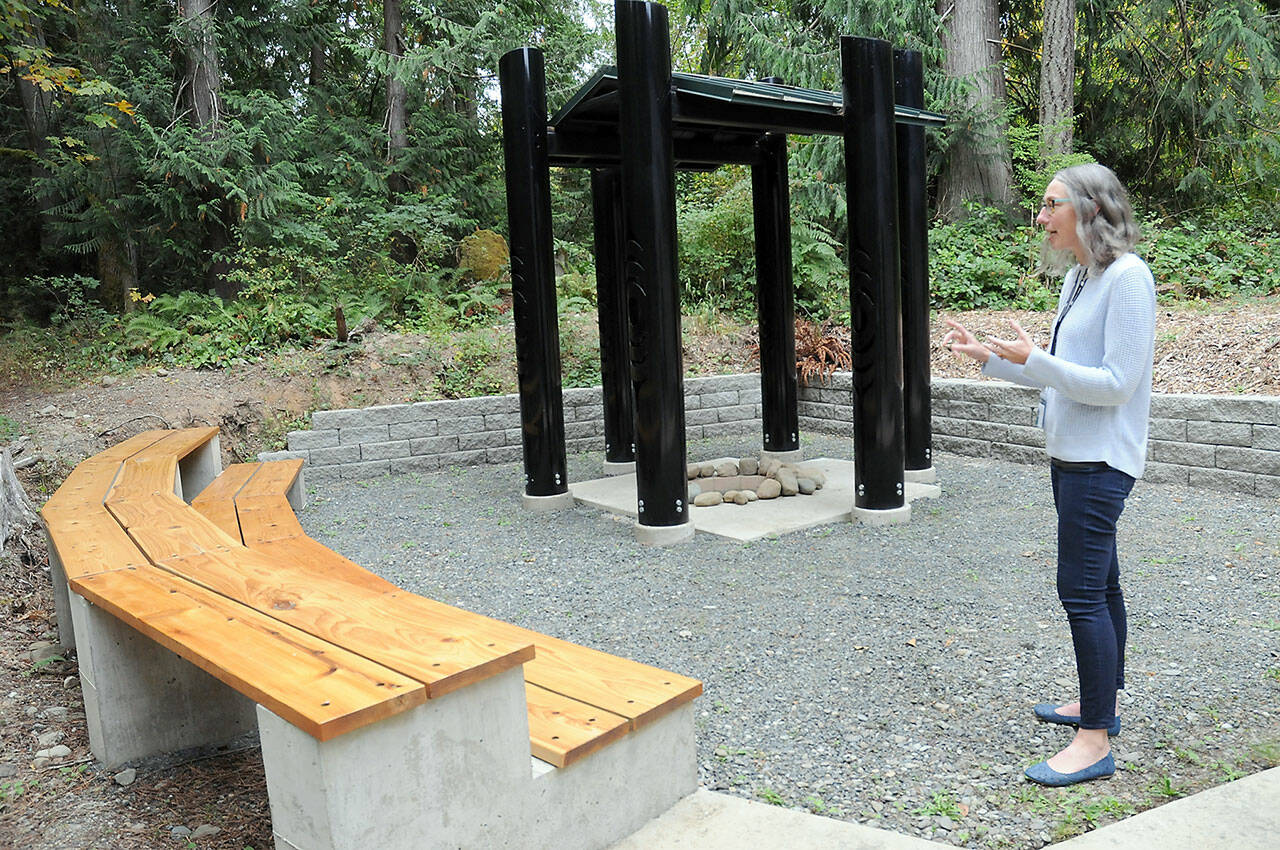
In contrast to new technology and HyFlex teaching, the college this summer expanded its outdoor instructional space to include an indigenous medicinal garden directly behind and to the south of the Port Angeles’ campus’ ʔaʔk̓ʷustəƞáwt̓xʷ House of Learning Longhouse, where Sadie Crowe is steward.
A short paved trail loops around plants used by local tribes for health and healing: salmon berry, blackberry, snowberry, yarrow, Indian plum and huckleberry. More plants will be added later in the fall.
The garden and adjacent outdoor instructional space, which includes a demonstration area and salmon pit, were blessed in June by members of a tribal advisory group representing the Hoh, Quileute, Makah, Port Gamble S’Klallam, Jamestown S’Klallam and Lower Elwha Klallam nations.
The outdoor learning center and medicinal trail were made possible with $35,000 in U.S. Department of Education Title III funding. Title III funding ($28,000) also was used to create new campus signage in English, S’Klallam, Makah, Quileute and Hoh that will be installed within the next month.
Due to the popularity of its S’Klallam language course that began in 2020, the college this fall added an online Makah language course taught by Maria Pasqua, a Makah language expert. It can be taken as a certificate program or as a humanities elective as part of an AA degree, according to Cheryl Crane, dean of arts and sciences.
Support from a $150,000 National Endowment for the Humanities CARES Grant helped the college develop the S’Klallam language program, which was used as a model for the Makah course and for a Quiileute language course that is being developed
The campus, its library and other spaces like the Longhouse are always open to the public, but to encourage people who might not otherwise venture onto it, Peninsula College will hold a Fall Spectacular on Saturday, Oct. 1 from 11 a.m. – 4 p.m. featuring hot air balloon rides, a beer garden, poetry reading, a beading workshop, live music, hands-on classroom activities led by instructors, among many other activities. A free shuttle service will operate from Sequim to Laird’s Corner. Go to pencol.edu/FallSpectacular for details.
For more information, see pencol.edu.
________
Reporter Paula Hunt can be reached at paula.hunt@soundpublishing.com.
