
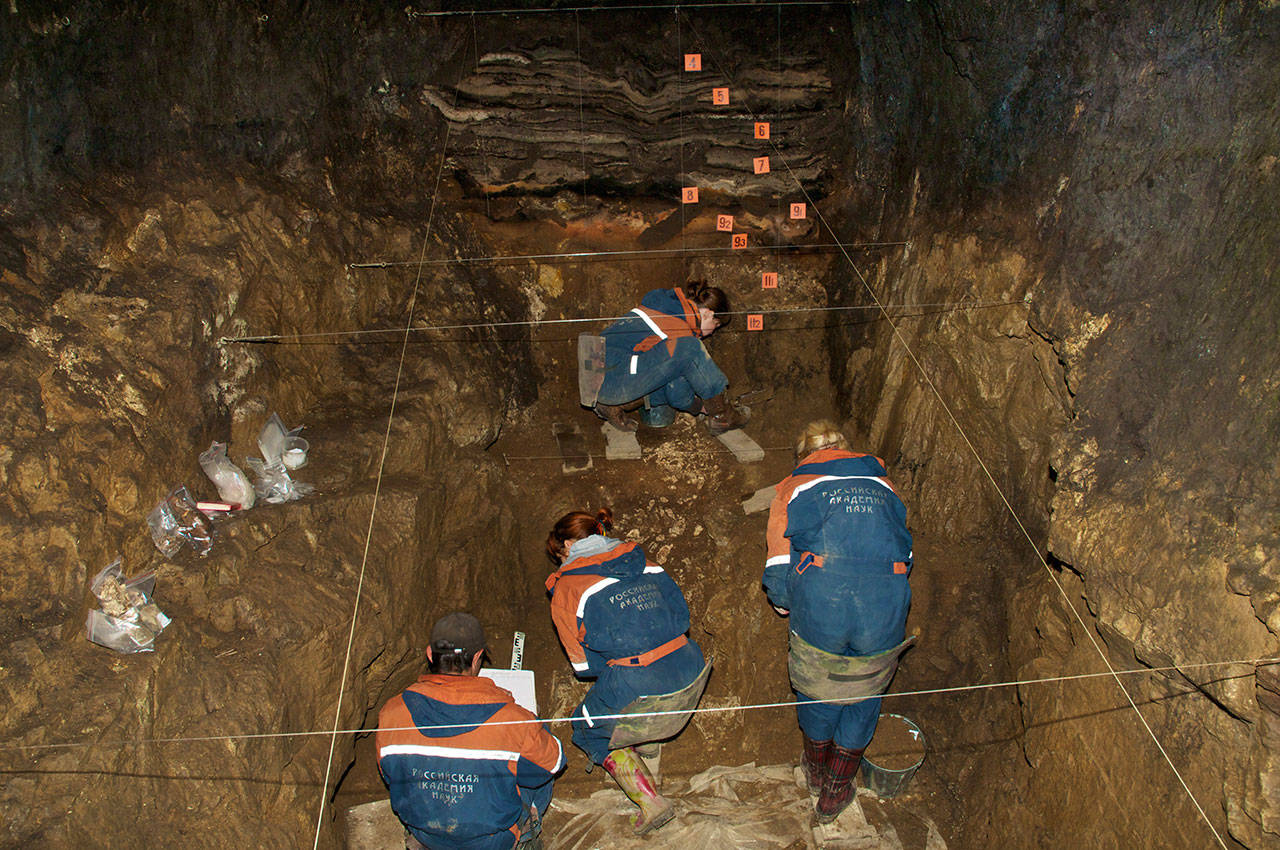
In this 2011 photo provided by Bence Viola of the University of Toronto, researchers excavate a cave for Denisovan fossils in the Altai Krai area of Russia. On Wednesday, Aug. 22, 2018, scientists reported in the journal Nature that they have found the remains of an ancient female whose mother was a Neanderthal and whose father belonged to another extinct group of human relatives known as Denisovans. (Bence Viola/Department of Anthropology - University of Toronto/Max Planck Institute for Evolutionary Anthropology via AP)

In this 2011 photo provided by Bence Viola of the University of Toronto, researchers excavate a cave for Denisovan fossils in the Altai Krai area of Russia. On Wednesday, Aug. 22, 2018, scientists reported in the journal Nature that they have found the remains of an ancient female whose mother was a Neanderthal and whose father belonged to another extinct group of human relatives known as Denisovans. (Bence Viola/Department of Anthropology - University of Toronto/Max Planck Institute for Evolutionary Anthropology via AP)

Fossil shows mixture of humankind’s early cousins

  • By Frank Jordans The Associated Press
  • Sunday, August 26, 2018 11:59am
  • News

By Frank Jordans

The Associated Press

BERLIN — Scientists said they’ve found the remains of a prehistoric female whose mother was a Neanderthal and whose father belonged to another extinct group of human relatives known as Denisovans.

The 90,000-year-old bone fragment found in southern Siberia marks the first time a direct offspring of these two groups has been discovered, according to a study published Wednesday in the journal Nature.

Both groups disappeared by about 40,000 years ago. Neanderthals lived in Europe and Asia, while fossils of Denisovans are known only from the cave where the fragment was found.

Past genetic studies have shown interbreeding between the two groups, as well as with our own species, which left a trace in the DNA of today’s people. But the new study is the first to identify a first-generation child with Neanderthal and Denisovan parents.

“It’s fascinating to find direct evidence of this mixing going on,” said Svante Paabo, one of the study’s lead authors.

Paabo said he was surprised by the discovery, given how relatively few remains of our evolutionary relatives have been found around the world.

The cave near Mongolia where the bone was found contains some remains attributed to Neanderthals as well as Denisovans. But finding an actual offspring of the two groups — which are more different from each other than any two present-day human groups — seemed like a rare stroke of luck, Paabo said.

“The fact that we stumbled across this makes you wonder if the mixing wasn’t quite frequent,” said Paabo, a geneticist at Max Planck Institute for Evolutionary Anthropology in Leipzig, Germany.

The finding doesn’t reveal how often such mating occurred and where, said Ron Pinhasi, a physical anthropologist at the University of Vienna who wasn’t involved in the study.

“Had it happened frequently, we would not have such divergence between the Denisovans and Neanderthal genomes,” he said.

The newly discovered DNA could be interpreted in different ways, said Anders Eriksson, evolutionary population geneticist at King’s College London who wasn’t involved in the study.

“I think they convincingly showed that genetically this individual falls halfway between the Neanderthal and Denisovan fossils found in the same cave,” he said. “But I’m less convinced that it is necessarily a first-generation offspring of a union between Neanderthal and Denisovan.”

The fossil could instead have come from a population with roughly an equal mix of Neanderthal and Denisovan ancestry, he said. It will take analysis of more fossils to find out, he said.

The researchers said the small bone fragment likely came from the arm or leg of a female who was at least 13 years old at the time of death.

Comparison with other ancient DNA showed that the genes she inherited from her mother were more closely related to Neanderthals who lived later in Europe than to other Neanderthal remains found in the cave, suggesting a wave of westward migration.

Together with previously discovered remains of a Homo sapiens that had a Neanderthal ancestor four to six generations earlier, Paabo said the latest find supports the theory that the now-extinct ancient lineages may have been absorbed through interbreeding with modern humans, rather than wiped out through warfare as is widely believed.

More in News

Dan Willis of Port Townsend, a docent at the Point Wilson Lighthouse at Fort Worden State Park, conducts a tour for interested visitors on Thursday. The lighthouse was built in 1878 when Congress approved $8,000 for the light and foghorns. Although the facility is still an active U.S. Coast Guard station, the equipment is monitored and operated remotely and no keepers are present. Regular tours on Saturdays and Sundays will resume in May. (Steve Mullensky/for Peninsula Daily News)
Lighthouse tour

Dan Willis of Port Townsend, a docent at the Point Wilson Lighthouse… Continue reading

EMT Teresa DeRousie, center, was recognized for her long service to Clallam County Fire District 2. Presenting the award were Deputy Fire Chief Kevin Denton, left, and Chief Jake Patterson. (Clallam County Fire District 2)
Clallam 2 Fire Rescue hosts awards banquet

Clallam 2 Fire-Rescue recognized career and volunteer members during… Continue reading

Construction set to begin on new marine life center in Port Angeles

Groundbreaking event scheduled for April 8 at Pebble Beach Park

A seal pops its head out of the water as a dory rower propels his craft in the calm waters of the Salish Sea. Whidbey Island is in the distance. Today’s high temperature is forecast to be in the low 50s with partly cloudy skies. Rain is set to return this weekend. (Steve Mullensky/for Peninsula Daily News)
Rowing on the Strait

A seal pops its head out of the water as a dory… Continue reading

Fire protection may impact insurance rates

New protection class considers nuanced data

The view looking south from Hurricane Ridge, where variable winter weather has limited snow coverage and contributed to pauses in snow sports operations in recent weeks. (Washington’s National Park Fund)
Lack of snow has impact at Hurricane Ridge

Water equivalent well below average for February

Port Angeles secures grant to aid in salmon recovery

State Department of Commerce to provide city with $109,000

Tickets still available for United Way of Clallam County fundraiser

Pajamas are encouraged, teddy bears are optional and comfort… Continue reading

Interviews set for hospital board

At least seven candidates up for commissioner seat

Port Angeles asks for fee to cover lodging tax contracts

Resolution sent to committee for administrative costs

Climate action group is guiding reduction goals

Reduced emmissions require reduced transportation footprint