
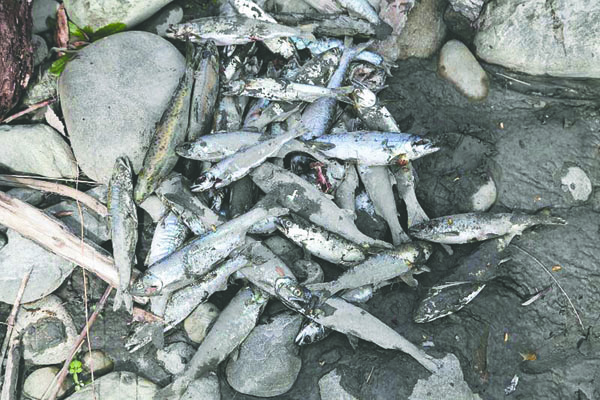
PORT ANGELES — Piles of dead year-old chinook salmon, numbering at least in the hundreds, were found along the Elwha River’s lower banks and mouth after hatchery smolts were released last week.
State Fish and Wildlife Department officials will consider alternatives for future releases of fish, said Mike Gross, Fish and Wildlife fish biologist for Clallam County and West Jefferson County, who called the release “a mistake.”
Sediment from the river clogged the gills of most he examined, said Mike McHenry, a fish biologist and habitat manager for the Lower Elwha Klallam tribe, who saw the dead fish at the river’s mouth and on sandbars Monday and Tuesday.
Staff at the department’s Elwha Channel hatchery released 196,575 juvenile fish, ranging from 4 inches to 8 inches in length April 5, about 3½ miles from the mouth of the river, said Randy Aho, hatchery operations manager for the Fish and Wildlife region that stretches from the Long Beach Peninsula to the Strait of Juan de Fuca.
“We feel that these” — the dead fish — “are fish released from our facility,” Aho said.
Silt in the river increased rapidly after the fish were released, according to U.S. Geological Survey data.
The cause of death had not been confirmed as of Thursday, though Gross said he suspected the fish died of suffocation.
“Suffocation from the inability to uptake oxygen would be the expected diagnosis for the cause of death,” Gross said.
McHenry, after finding dirt in the fish gills, said he expected few smolts made it out of the river and into the Strait of Juan de Fuca.
“I’m guessing the survival for this release is going to be very low,” McHenry said.
The smolts were released in accordance with the hatchery’s release schedule, Aho said.
The amount of sediment in the water, or turbidity, doubled shortly after the fish were released, USGS measurements showed.
The river’s turbidity, measured in formazin nephelometric units (FNU), was at about 800 FNU the evening of April 4 and peaked later in the day April 5 at about 1,600 FNUs.
Hatchery staff checked turbidity levels the evening of April 4 and the morning of April 5 at about 7 a.m. before beginning the release, Aho said.
“[Staff] took some visual observations of the river [Friday morning] and didn’t see anything that made [them] suspicious of the turbidity levels,” Aho said.
“Later in the day, [staff] checked turbidity levels, and they had increased, but by then, the fish were already moving out.”
The sediment coursing down the Elwha has been freed by the removal process for the once-towering Elwha dams, part of a $325 million river restoration project still under way.
The cost of the fish is difficult to estimate, Aho said.
The smolts ate roughly $29,000 worth of food while they were being reared, according to numbers provided by Aho, though staff time is not broken down per hatchery duty, such as feeding specific groups of fish.
“We pay our staff to be there for a month, so it’s really difficult to break out,” Aho said.
The Fish and Wildlife hatchery has an annual budget of $303,367, according to the facility’s hatchery and genetic management plan.
McHenry said he saw dead fish on the sand banks in the body of the river stretching from the mouth to the Fish and Wildlife hatchery, which is about 3½ miles upstream from the mouth of the river.
Numerous kinds of predatory birds and some mammals, including otters, could be seen feasting on the salmon carcasses as they washed onto the Elwha banks and sandbars, McHenry said.
“[There was] lot of predator activity between the sea gulls, mergansers [ducks] and eagles.”
Gross said the predation seen over the past few days will make it difficult to judge how many fish died and how many made it alive into the Strait.
No dead fish were observed along the Elwha mouth or on the banks roughly 1,500 feet upstream late Wednesday afternoon.
Aho said Wednesday he heard reports of hundreds of dead fish seen, though those counts could not be confirmed.
Aho said the dead fish are “absolutely a worry” for Fish and Wildlife, adding that potential alternative release methods will be discussed before roughly 900,000 salmon, less than a year old, are released from the hatchery this June.
“That’s something we will discuss prior to release,” Aho said.
“I’m not saying we’ll make definite plans, but we’ll definitely discuss it.”
Alternative release methods include transporting the young salmon to the Strait using specially designed trucks, Aho added.
Gross agreed that different release methods likely will be discussed because of heavy sediment loads, though he could not predict what specific techniques might be used.
“If we can figure out ways to avoid mortality, we’ll pursue them undoubtedly,” Gross said.
“We’ll try not to make the same mistake.”
The timing of the release was to make room for younger salmon and to ensure the yearlings could find their way out into the salt water of the Strait, Aho explained.
“[The salmon] want to leave,” Aho said.
“And if you hold on to them too much longer, you can take out that migration response, and that would just kill them for sure.”
This release strategy also allows the fish to slowly get used to the salt water as they swim downstream rather than be deposited directly into the Strait, which Aho said could cause health issues.
Aho said staff don’t monitor mortality rates of the hatchery-raised fish once they are released, adding that the fish are left to fend for themselves once they leave the facility.
“We generally don’t know survival rates until that release population returns to the river system and hatchery,” Aho said.
Aho said Fish and Wildlife hatchery staff released 212,900 year-old chinook and about $1.5 million fish younger than 1 in 2012, adding that staff generally see a couple thousand adults return to spawn each year.
Reporter Jeremy Schwartz can be reached at 360-452-2345, ext. 5074, or at jschwartz@peninsuladailynews.com.
