
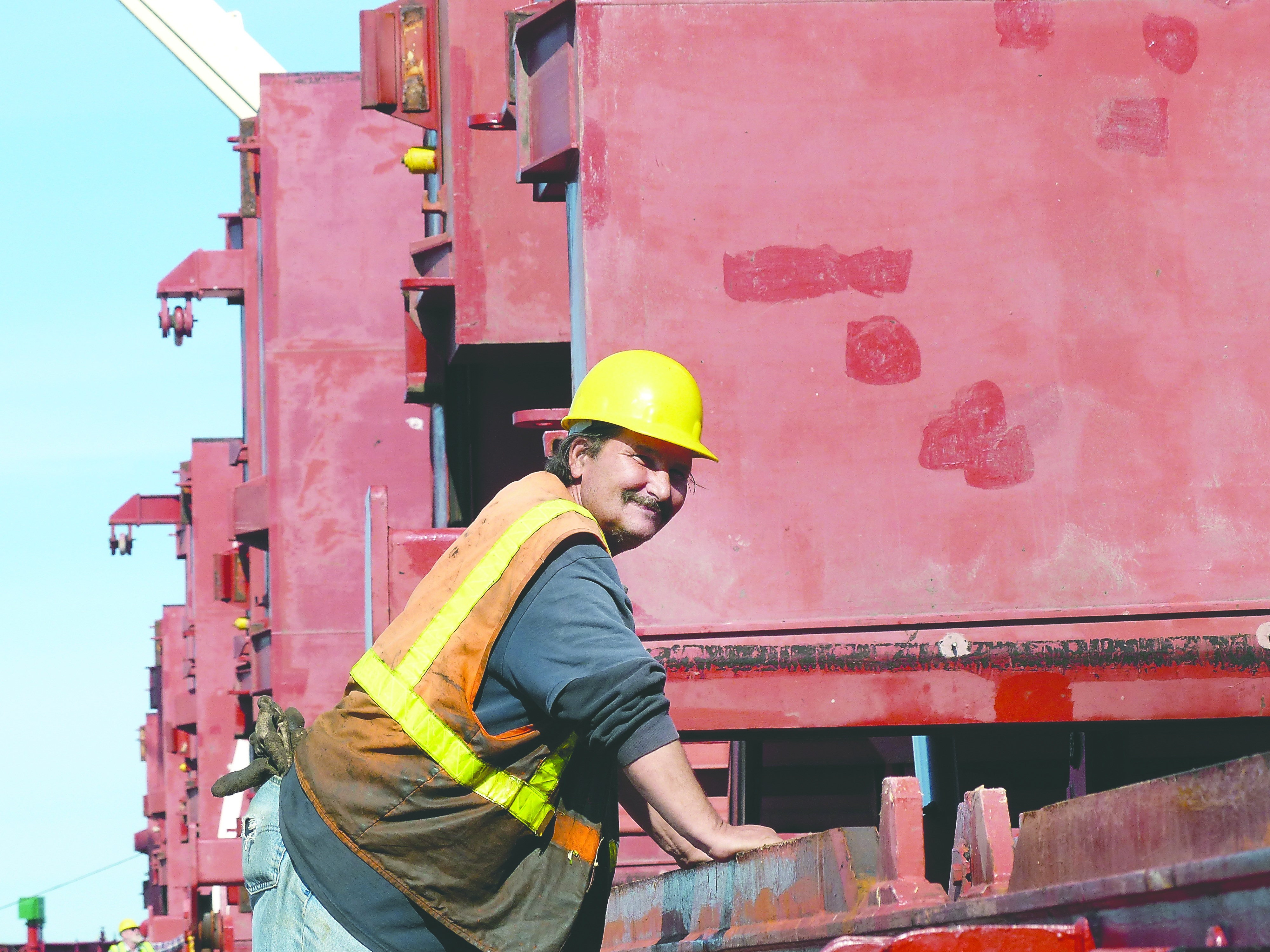
THE LARGEST BULK cargo ship to arrive for a load of logs at the Port of Port Angeles in recent memory was tied up at Terminal 3.
The 2-year-old STX Rapido arrived Aug. 12 from Korea by way of San Diego, Los Angeles and Vancouver, B.C., where she offloaded coils and plates of steel in each port.
She is a little better than 650 feet long and nearly 57,000 deadweight tons, or DWT.
Glenn Gokami, a 34-year employee with Jones Stevedoring, gave me a topside tour of the Rapido on Thursday, and we discussed a couple of the major differences between this ship and the smaller vessels that typically come dockside for logs.
With some regularity, the latest wave of log ships has been coming into Port Angeles for the past 3½ years.
With few exceptions, the vessels have ranged in length from 554 feet to about 600 feet and average about 33,000 DWT.
Logs are loaded into the holds of these ships, and when they are full, the hatches are closed, and stanchions that ring each vessel’s main deck are raised up and locked in place.
Logs then are loaded onto the vessel’s main deck and stacked nearly 30 feet high — until the ship’s load capacity is reached.
The holds on these ships extend about 43 feet below the main deck with a capacity exceeding 3 million board feet of logs. Topside, the vessels hold an additional 2 million board feet.
STX Rapido is a high-sided bulk cargo ship with the ability to transport unpackaged bulk cargoes such as grains, coal, ore, cement, sugar, steel products — and forest products.
The notable differences between the Rapido and the smaller vessels, in addition to length and tonnage, are Rapido’s five holds.
Each is nearly 60 feet deep, and unlike any of the other ships, no logs will be loaded atop Rapido’s main deck. The
5 million-plus board feet of logs are in the ship’s cavernous holds.
Glenn also gave me a brief overview of the role Jones Stevedoring plays in the loading of a log ship.
He explained that Dkoram, a U.S. subsidiary of a South Korean company that imports logs into South Korea and China, is Jones’ customer.
Jones hires the longshoremen and the supercargo.
As Jones’ representative, Glenn is the superintendent of the ship and is the person responsible for overseeing the loading process.
Jones also provides all the gear necessary for loading the ship, including the slings and a piece of equipment called safety release gear — more on that later.
According to Glenn, prior to a ship’s arrival, he pencils out a stow plan.
Grant Munro, a log buyer (and former Port Angeles City Council member) whose company, Munro LLC, brokered the sale of the logs to Dkoram, provides Glenn with a tally of the logs.
Grant also subdivides the overall count according to log lengths.
Armed with this information, Glenn formulates a schematic — much like a jigsaw puzzle — of how many of what sized logs would go in each hold.
Safety release
The safety release gear mentioned earlier is a nifty contraption that attaches to the ship’s cranes.
From this gear hang two cables that must be 20 feet long. At the end of each cable is a pressed fitting about half the size of a golf ball.
To pick up a load of logs, the crane operator lowers the gear down to the dock, where waiting longshoremen loop each cable near each end of a bundle of logs.
The logs then are hoisted aboard ship and positioned according to the stow plan.
The crane operator then lowers the gear onto the stowed bundle, which activates the plunger, releasing the cable from the gear.
The cables are pulled from between the logs, lowered to the dock — and the process is repeated until the ship is loaded.
Prior to the use of the safety release gear, two longshoremen were required to be in each hold to take the slings off the crane’s hook.
It was (and remains) incredibly dangerous to be in the hold of the ship while logs are being stowed.
The last load of logs went aboard Rapido just before noon Friday, then she got underway for Lanshan, China, long before the bewitching hour.
Port Townsend roots
For you history buffs out there, Jones Stevedoring Co. began life in 1858 and was initially founded under the name of Rothschild Stevedoring.
The founder, DCH Rothschild, was a resident of Port Townsend who operated a mercantile and ship service business.
Rothschild’s residence at Taylor and Franklin Streets in Port Townsend was listed on the National Register of Historical Places in 1970.
The Jefferson County Historical Society operates a museum in the Rothschild House that is open seasonally through next month.
Check out http://tiny.cc/cuwb2w for more details, including when Jefferson County residents can get in for free.
Vehicle carrier
Taiko, an 860-foot roll on/roll off vehicle carrier, dropped her anchor Wednesday in the easternmost anchorage of Port Angeles Harbor.
A few hours earlier, she had departed Tacoma for Lazaro Cardenas, Mexico, when she encountered a mechanical issue and came into port for the few hours it took to make repairs.
Taiko was built in Korea in 1984 and launched as Barber Hector.
For nearly 20 years, she was a bit of a hybrid because her main deck was used to carry containers and below decks she was a ro/ro.
Her name was changed to Taiko in 1988, and she was refit into a vehicle carrier in 2003.
Also last week, the motor vessel Sea Life Discovery got underway from Port Angeles Boat Haven, where she had been moored for about a month.
The unusual-looking boat that hails from Sitka, Alaska, is a semi-submersible vessel that has a series of windows that line both sides of the hull, three below the waterline.
The glass-bottom boat takes guests into Alaskan waters where as many as 49 people at a time can peer into the marine environment.
Sea Life Discovery, which is 65 feet long, has been doing naturalist tours from May to September since 2000.
I understand that the owner of the enterprise has pulled up stakes and is moving the business to San Diego.
Apparently the prospects of using the boat for more than five months a year in warmer climes is more temptation than he could resist.
________
David G. Sellars is a Port Angeles resident and former Navy boatswain’s mate who enjoys boats and strolling the area waterfronts.
Items and questions involving boating, port activities and the North Olympic Peninsula waterfronts are always welcome. Email dgsellars@hotmail.com or phone him at 360-808-3202.
His column, On the Waterfront, appears every Sunday.