Jamestown S’Klallam Tribe/Northwest Indian Fisheries Commission
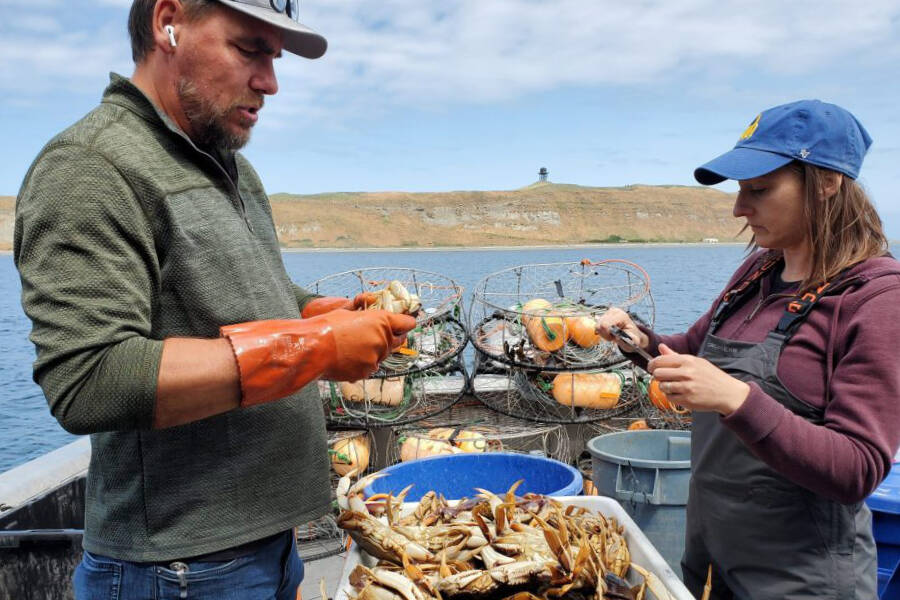
Jamestown S’Klallam tribal fisherman Josh Chapman and Jamestown S’Klallam Tribe shellfish manager Liz Tobin measure Dungeness crab samples as part of the genetics project.

Jamestown S’Klallam Tribe/Northwest Indian Fisheries Commission Jamestown S’Klallam tribal fisherman Josh Chapman and Jamestown S’Klallam Tribe shellfish manager Liz Tobin measure Dungeness crab samples as part of the genetics project.

Crab DNA study examines possible distinct populations

Jamestown S’Klallam Tribe partners are considering genetics

  • By Tiffany Royal Northwest Indian Fisheries Commission
  • Wednesday, January 24, 2024 1:30am
  • NewsClallam County

BLYN — The Jamestown S’Klallam Tribe is working with a diverse group of partners to learn more about the population structure of Puget Sound’s Dungeness crab by studying the DNA of both larvae and adults.

“The main question our team is looking to answer is whether Dungeness crab in the region belong to a single large population or are there multiple genetically distinct populations?” said Liz Tobin, the tribe’s shellfish program manager.

Biologists have been working with tribal and non-tribal commercial crab fishermen to collect genetic material from crab larvae and adults from 11 management areas throughout Puget Sound this year.

After genetic analysis is completed by Jay Dimond, a research assistant professor at Western Washington University, tribal and state co-managers and members of the shellfish industry will evaluate the results to determine if the population’s genetics vary throughout the region and how that aligns with the current Dungeness crab management regions and boundaries.

“Genetic diversity is a species’ best defense against environmental change, so our goal with this research is to provide fishery managers with the information needed to maintain this diversity,” Dimond said.

“Genetic data can also provide us with information about where crab larvae are coming from and where they are going. Some populations may be self-seeding, while others may be seeded by larvae from distant sources.”

This work also can help scientists understand fluctuations or declines in crab populations that may be explained by natural factors such as larval supply, he said.

In the end, the goal is to maximize harvest opportunities while ensuring the long-term sustainability of the resource.

The tribes and state have been conducting surveys and test fisheries to get an idea of how much crab is out there and observe seasonal molting patterns.

A region-wide light trap project since 2018 also has helped scientists track when and where crab larvae are present across the inland waters of Washington and British Columbia.

So far, more larvae have been found in North Sound and the Strait of Juan de Fuca, while fewer crab have been showing up in South Sound and Hood Canal.

“This project is a great demonstration of multi-partner collaboration across the region,” said Emily Buckner, program coordinator for the Pacific Northwest Crab Research Group (PCRG).

“Between the project leads, technical reviewers and data collectors, 19 unique partners have contributed to this effort via the coordination of the crab research group.”

Funded by a National Oceanic and Atmospheric Administration Saltonstall-Kennedy grant, the principal researchers on the project are Western Washington University, Jamestown S’Klallam Tribe, Puget Sound Restoration Fund/PCRG, Swinomish Indian Tribal Community and Washington Department of Fish and Wildlife.

Additional partners include other state departments and tribes, including the Port Gamble S’Klallam Tribe.

________

This story was originally featured in the Northwest Indian Fisheries Commission’s Northwest Treaty Tribes and was used by permission. See nwtreatytribes.org for more information.

Jay Dimond, Western Washington University research assistant professor, inspects samples of Dungeness crab that have been collected for DNA testing. (Tiffany Royal/Northwest Indian Fisheries Commission)

Jay Dimond, Western Washington University research assistant professor, inspects samples of Dungeness crab that have been collected for DNA testing. (Tiffany Royal/Northwest Indian Fisheries Commission)

More in News

Port Townsend Main Street Program volunteers, from left, Amy Jordan, Gillian Amas and Sue Authur, and Main Street employees, Sasha Landes, on the ladder, and marketing director Eryn Smith, spend a rainy morning decorating the community Christmas tree at the Haller Fountain on Wednesday. The tree will be lit at 4 p.m. Saturday following Santa’s arrival by the Kiwanis choo choo train. (Steve Mullensky/for Peninsula Daily News)
Decoration preparation

Port Townsend Main Street Program volunteers, from left, Amy Jordan, Gillian Amas… Continue reading

Port Angeles approves balanced $200M budget

City investing in savings for capital projects

Olympic Medical Center Board President Ann Henninger, left, recognizes commissioner Jean Hordyk on Wednesday as she steps down after 30 years on the board. Hordyk, who was first elected in 1995, was honored during the meeting. (Paula Hunt/Peninsula Daily News)
OMC Commissioners to start recording meetings

Video, audio to be available online

Jefferson PUD plans to keep Sims Way project overhead

Cost significantly reduced in joint effort with port, city

Committee members sought for ‘For’ and ‘Against’ statements

The Clallam County commissioners are seeking county residents to… Continue reading

Christopher Thomsen, portraying Santa Claus, holds a corgi mix named Lizzie on Saturday at the Airport Garden Center in Port Angeles. All proceeds from the event were donated to the Peninsula Friends of Animals. (Dave Logan/for Peninsula Daily News)
Santa Paws

Christopher Thomsen, portraying Santa Claus, holds a corgi mix named Lizzie on… Continue reading

Peninsula lawmakers await budget

Gov. Ferguson to release supplemental plan this month

Clallam County looks to pass deficit budget

Agency sees about 7 percent rise over 2025 in expenditures

Officer testifies bullet lodged in car’s pillar

Witness says she heard gunfire at Port Angeles park

A copper rockfish caught as part of a state Department of Fish and Wildlife study in 2017. The distended eyes resulted from a pressure change as the fish was pulled up from a depth of 250 feet. (David B. Williams)
Author to highlight history of Puget Sound

Talk at PT Library to cover naming, battles, tribes

Vern Frykholm, who has made more than 500 appearances as George Washington since 2012, visits with Dave Spencer. Frykholm and 10 members of the New Dungeness Chapter, NSDAR, visited with about 30 veterans on Nov. 8, just ahead of Veterans Day. (New Dungeness Chapter DAR)
New Dungeness DAR visits veterans at senior facilities

Members of the New Dungeness Chapter, National Society Daughters of… Continue reading

Festival of Trees contest.
Contest: Vote for your favorite tree online

Olympic Medical Center Foundation’s Festival of Trees event goes through Dec. 25