
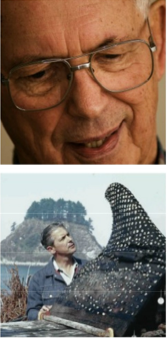
By Washington State University News Bureau
PULLMAN — Richard Daugherty, the Washington State University archaeologist who led the excavation of the Ozette village site, “the Pompeii of America,” and numerous other key Northwest finds, died Saturday of bone cancer. He was 91.
“Doc” Daugherty, as he was known by many of the Makah in Neah Bay, died Saturday at his home outside the WSU campus in Pullman of bone cancer.
Starting in the 1970s, Daugherty worked closely with the Makah during the 11-year Ozette excavation on the North Olympic Peninsula coast southwest of Neah Bay, setting a new standard for native and archaeological cooperation, said Allyson Brooks, state historic preservation officer.
“He really set the path for archaeologists and Native Americans to work together instead of in opposition,” she said. “That’s a big deal.”
“The way he involved elders in helping identify artifacts was very progressive,” said Janine Ledford, executive director of the Makah Cultural and Research Center in Neah Bay, which houses 55,000 Ozette artifacts, all of which date from before Europeans arrived on the continent.
Longhouses uncovered
Daugherty had already surveyed the Ozette site and some 50 others along the coast when a winter storm in 1970 eroded a bank near Cape Alava, revealing five longhouses buried by a landslide, possibly from the magnitude 9 earthquake of 1700.
The site had been occupied continuously for at least 2,000 years before it was abandoned in the 1920s, when the federal government forced the last remaining inhabitants to move 20 miles to Neah Bay so their children could attend school.
Called to the site by Ed Claplanhoo, a Makah tribal leader and WSU graduate, Daugherty saw the first artifacts of an enormous trove preserved in the oxygen-free environment of wet clay — a canoe paddle, wooden halibut hooks, a harpoon shaft, wooden house planks.
A village soon emerged as dozens of scientists, students and locals focused on three longhouses that yielded 1,424 arrow shafts, 103 bows, 110 harpoon shafts, 1,000 baskets, 13 looms, perfectly preserved cedar rope, whale bones and more.
It became the largest, most complex archaeological site in the Pacific Northwest.
“Anyone who takes a college class in archaeology covers the Ozette site,” said Ledford.
The site yielded numerous insights into Makah culture.
The people had long been whalers, for example, and whale bones were everywhere in the dig. But the Makah also ate fur seal, sea lion, halibut, waterfowl and various berries.
Many insights came in consultation with elders as the archaeologists tapped them to identify the meaning and uses of mysterious objects.
“If you work in partnership, you can’t have a better way of gaining the cultural side, because they” — the natives — “are the experts on the cultural side,” said Dale Croes, WSU adjunct faculty member and president of Pacific Northwest Archaeological Services.
As part of the archaeologists’ partnership with the Makah, Croes had to learn basket weaving from the elders.
“I probably learned more in that semester than any graduate class here,” Croes said. His doctoral dissertation is one of nine produced from the site.
Blimp pilot
Daugherty was born and raised in Aberdeen, Wash. During World War II, he piloted blimps out of Lakehurst, N.J., to look for enemy ships and submarines off the East Coast.
He earned a B.A. in anthropology from the University of Washington in 1946 and spent four years as a WSU anthropology instructor until 1954, when he finished his Ph.D. in ethnography at the University of Washington and became a WSU assistant professor.
At various times over nearly 30 years, he served as department chair, director of the WSU Laboratory of Archaeology and History and director of the Washington Archaeological Research Center.
Many of his graduate students were women, with “Daugherty’s Daughters” going on to serve in the National Park Service, the U.S. Forest Service and private archaeological services.
In addition to the Ozette site, he directed excavation of the Marmes rockshelter before it was inundated by waters behind the Snake River’s Lower Monumental Dam.
The state’s only archaeological national historic landmark, it had the oldest set of human remains in North America when it was investigated.
Daugherty also was the principal investigator of a burial site at the mouth of the Palouse River where a Jefferson “peace medal” was found.
The medal was one of fewer than 90 carried by Lewis and Clark on their journey to the Northwest in 1805.
In 1971, at the request of the Nez Perce tribe and on Daugherty’s recommendation, WSU gave the medal to the tribe.
Sequim mastodon
In 1977, Daugherty was co-investigator with Carl Gustafson of a hand-hewn projectile point in a mastodon bone found near Sequim, Wash.
The artifacts turned back the clock on North American settlement as subsequent new research determined they were 13,800 years old, 800 years older than the Clovis people long regarded as the New World’s oldest culture.
Daugherty also left a legacy in how future archaeological research is done, working with Washington senators Warren G. Magnuson and Henry M. “Scoop” Jackson to bolster passage of the National Historic Preservation Act.
The act requires federal agencies to consider the impacts of federally funded or permitted operations on archaeological sites and historic structures.
Daugherty was preceded in death by his first wife, Phyllis.
He is survived by his wife, Ruth Kirk, whom he married in the replica of an Ozette village longhouse at Neah Bay in 2007.
Other survivors include Melinda Beasley of Pullman, Carol Ewen of Pendleton, Ore., Rick Daugherty of Ellensburg, Wash., five grandchildren and six great-grandchildren.
The family is planning a gathering of friends, family and colleagues in the spring.
Memorial donations may be made to the Phyllis and Richard Daugherty Scholarship for Graduate Student Excellence in Anthropology at WSU and the Makah Cultural and Research Center in Neah Bay.
