
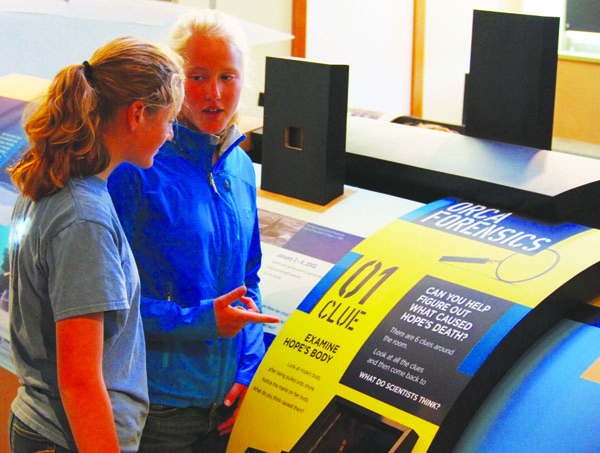
PORT TOWNSEND — An exhibit about ocean pollution and orcas, dominated by the skeleton of an orca found beached at Dungeness Spit, will open at the Port Townsend Marine Science Center at noon Saturday, with free admission offered all weekend.
“Learning from Orcas — The Story of Hope,” which has been in preparation since 2010, will be the centerpiece of the marine science center’s natural history exhibit in Fort Worden State Park.
Admission will be free to the exhibit, which is open noon until
4 p.m. both Saturday and Sunday.
After that, general admission will be charged for the exhibit.
The new exhibit tells a story that started in 2002 when a full-grown female orca was found dead, beached at Dungeness Spit north of Sequim.
The carcass contained the highest levels of PCBs and DDT ever found in an orca, the science center says on its website, www.ptmsc.org.
The orca, which had been given the identifying number of CA 189 after being spotted off California coast, was named Hope posthumously by science center students.
“The exhibit title exemplifies the process we’ve been through — a voyage, with Hope at the helm,” said Anne Murphy, executive director for the marine science center.
“We’ve learned so much about the health of food webs, toxics in the ocean and most importantly about our ability to make a difference,” she added.
“This exhibit invites you to help turn the tide on the declining health of our marine environment.”
The addition features Hope’s 22-foot skeleton as “this beautiful over-arching hanging exhibit,” Murphy said.
“The story we tell launches forward from that.”
A three-minute film tells the story of her stranding, Murphy said.
“Then we go on to talk about why she died.
“We started asking questions. We paralleled the course we went on trying to learn what we could about why she died.”
The exhibit includes a forensics station, where “the public can do similar investigations we did to learn about her cause of death and the health of the water she swam in,” Murphy said.
For instance, people can look at lab reports and at photos of the orca’s stomach contents.
The display moves on from the circumstances of Hope’s death to facts about orca communities and families.
When Hope’s carcass was found, another orca, a male thought to be her son was nearby in shallow water, alive and staying close to the dead female.
Eventually, the orca, known as CA188, was towed into deeper water.
Orca families — mothers and children — stay together for life, researchers say.
“One thing we’re trying to do is help people feel connected to orcas,” Murphy said.
Because of the toxins found in Hope’s body, the exhibit also emphasizes contaminants in the oceans.
“We connect that to the same process we went through, which is, if the marine environment is contaminated, what about us?” Murphy said, “and how do we participate in contaminating the water and what can we do to stop the flow of contaminants into the water?”
For instance, the exhibit includes a mock storm drain big enough for visitors to climb through “to help them understand how water from the land goes into the sea,” Murphy said.
A computer kiosk and a bone table are among the other hands-on activities.
Scientists, community members and marine science center staff and volunteers have worked on the exhibit.
The more than 200 bones of the orca skeleton have been prepared and documented.
Lee Post, an “articulation expert” from Alaska, put together the approximately 22-foot-long skeleton one bone at a time,
“Her skeleton was buried for many years in a farm in Sequim so that the bacteria and bugs could clean the debris off the bones,” Murphy said.
The marine science center requested the skeleton from the National Oceanic and Atmospheric Administration.
For the first time, scanned digital images of the bones and skeleton of an orca can be examined on the web at www.ptmsc.org/boneatlas/.
A collaboration between the Port Townsend Marine Science Center, NOAA and the Idaho Virtualization Laboratory at the Idaho Museum of Natural History resulted in the development of this free online research and education tool.
Murphy said she had not compiled the total cost of the exhibit yet.
The Port Townsend Marine Science Center is celebrating its 30th anniversary this year.
Both the natural history exhibit and the marine exhibit are open from noon to 4 p.m. Fridays through Sundays.
Admission is $5 for adults, $3 for youth and free to marine science center members.
For more information, phone 360-385-5582, e-mail info@ptmsc.org or visit www.ptmsc.org.
Managing Editor/News Leah Leach can be reached at 360-417-3531 or at leah.leach@peninsuladailynews.com.
