
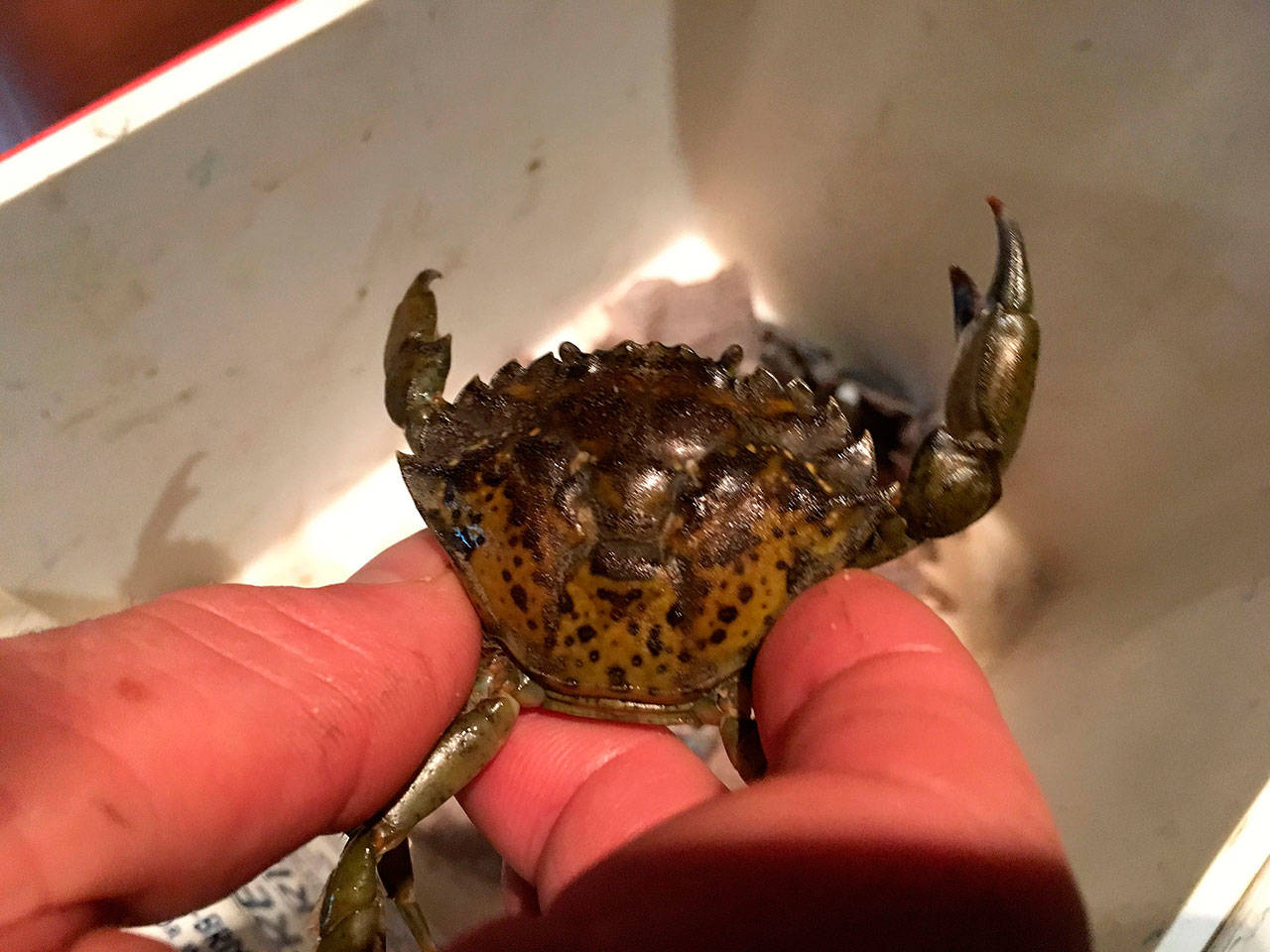
SEQUIM — The hunt in Dungeness for the invasive European green crab is over for the season.
Resource managers report that since April, they’ve caught 96 green crabs on the Dungeness Spit and one in Sequim Bay.
Lorenz Sollmann, deputy project leader at the Washington Maritime National Wildlife Refuge, said researchers opted to extend the search for green crab after finding a few more of the invasive species, but in their last few days of trapping Oct. 16-18, no green crabs were caught.
Since the crabs were discovered on Graveyard Spit north of Dungeness Landing, Sollmann and a team of about 20 volunteers set as many as 127 traps at a time to bring down the crabs’ numbers.
“I think we handled it really well,” Sollmann said. “I think our volunteers stepped up to the occasion. They were the backbone to the whole thing.
“We’re short-staffed and have been for a really long time, and if not for the volunteers, it would not have had the intensity or the duration to go that long trapping four to five days a week from April through October. That’s thousands of hours.”
Resource managers say the European green crab, known for its five spines on the sides of its eyes, is one of the most invasive species on the planet, and Dungeness’ population is the largest known in Washington state.
Green crabs were spotted in Westcott Bay on San Juan Island and Padilla Bay near Anacortes in the summer of 2016. One crab was seen in Sequim Bay last August and another on Whidbey Island at Lagoon Point in September.
No more green crabs were found in Sequim Bay by staff with the Jamestown S’Klallam Tribe despite thorough trapping in recent months.
Rapid response trapping is the “most efficient and economically feasible way of handling the crabs,” Sollmann has said previously, because if it’s controlled here, then they prevent the crabs from infesting another area.
Emily Grason, Crab Team project coordinator through Washington Sea Grant, said one female green crab can release up to 500,000 larvae at a time at least once a year.
Allen Pleus, aquatic invasive species coordinator for the state Department of Fish and Wildlife, said their trapping efforts are similar to fighting dangerous illnesses: “If you find small pockets, you try to get rid of it before it gets exponentially worse.”
Sollmann said he and other resource managers tentatively plan to host a stakeholders meeting before next year to talk about the next steps to take.
Pleus said they’ll work on a management plan for next year while expanding partnerships between agencies.
Grason intends to work with Sollmann’s staff to use data for better trapping starting in April.
“We’ve already got someone going through all the traps making repairs and pulling the traps not repairable,” he said. “Bait has already been acquired.”
Through the summer, Sollmann said volunteers at the entrance to the wildlife refuge provided information to visitors about the green crabs.
He said there’s been some confusion about catching them through recreational crabbing, though. If you were crabbing in the middle of Sequim Bay or Dungeness Bay or fishing off Port Williams, the likelihood of catching them there is low because it’s not ideal green crab habitat, he said.
Sollmann encourages people to snap pictures of the crabs and send them to the Crab Team at crabteam@uw.edu for identification or bring them into the office of the wildlife refuge.
Where they are coming from remains a mystery.
Resource managers continue to wait for grant funding to pay for genetic testing of 15 green crabs to determine where they floated from.
Staff and volunteers have been monitoring the Dungeness Spit since 2001, and it’s one of 52 early detection sites for green crabs.
For more resources on the green crab, visit wsg.washington.edu/crabteam/about/blog.
________
Matthew Nash is a reporter with the Olympic Peninsula News Group, which is composed of Sound Publishing newspapers Peninsula Daily News, Sequim Gazette and Forks Forum. Reach him at mnash@sequimgazette.com.
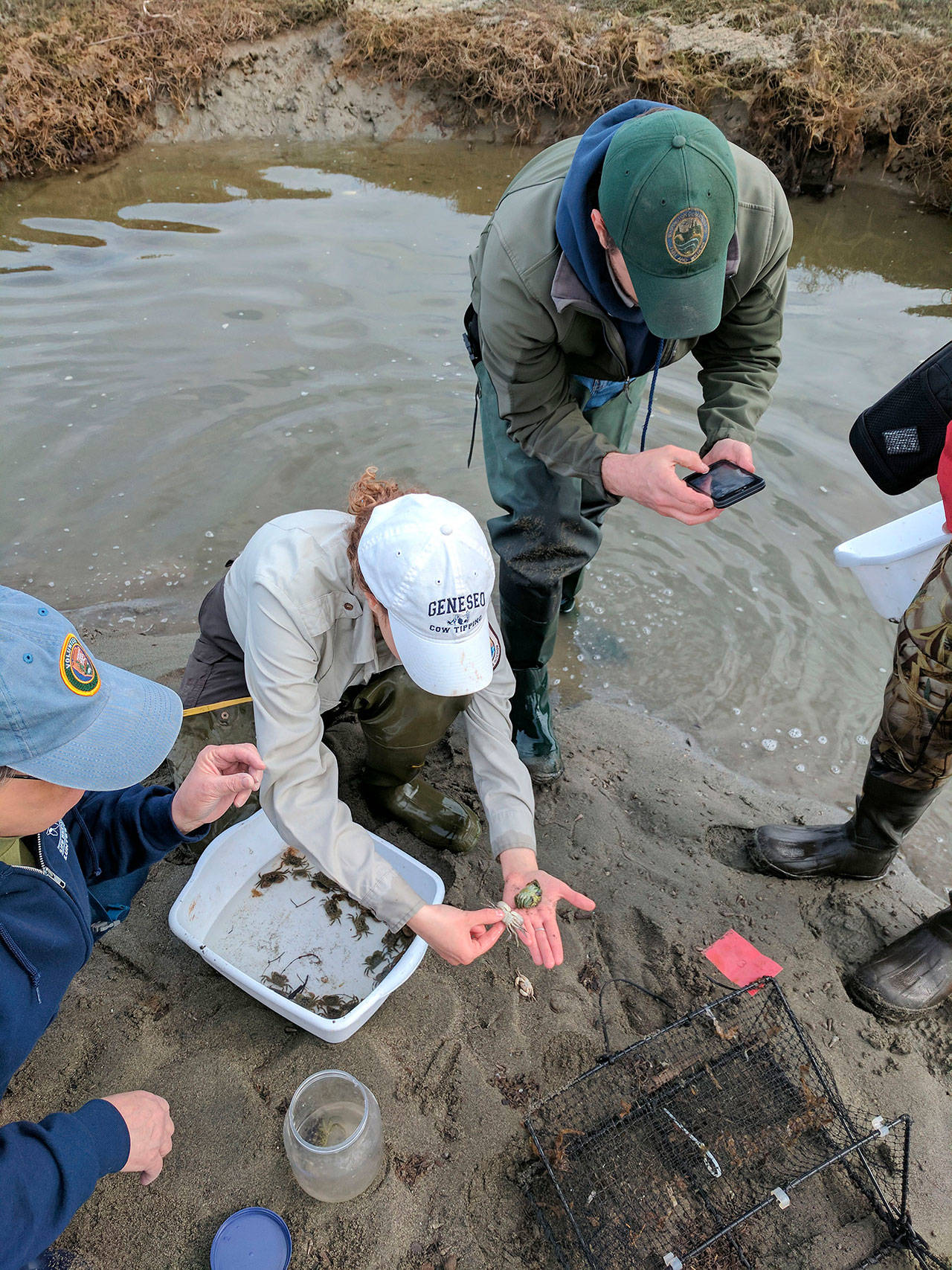
At one point, volunteers and resource managers placed upward of 127 traps for the European green crab. They plan to begin trapping again in April when the crabs are more active. Below, resource manager shows a green crab caught at Graveyard Spit between April and October. (Jason West /U.S. Fish and Wildlife Service)
