
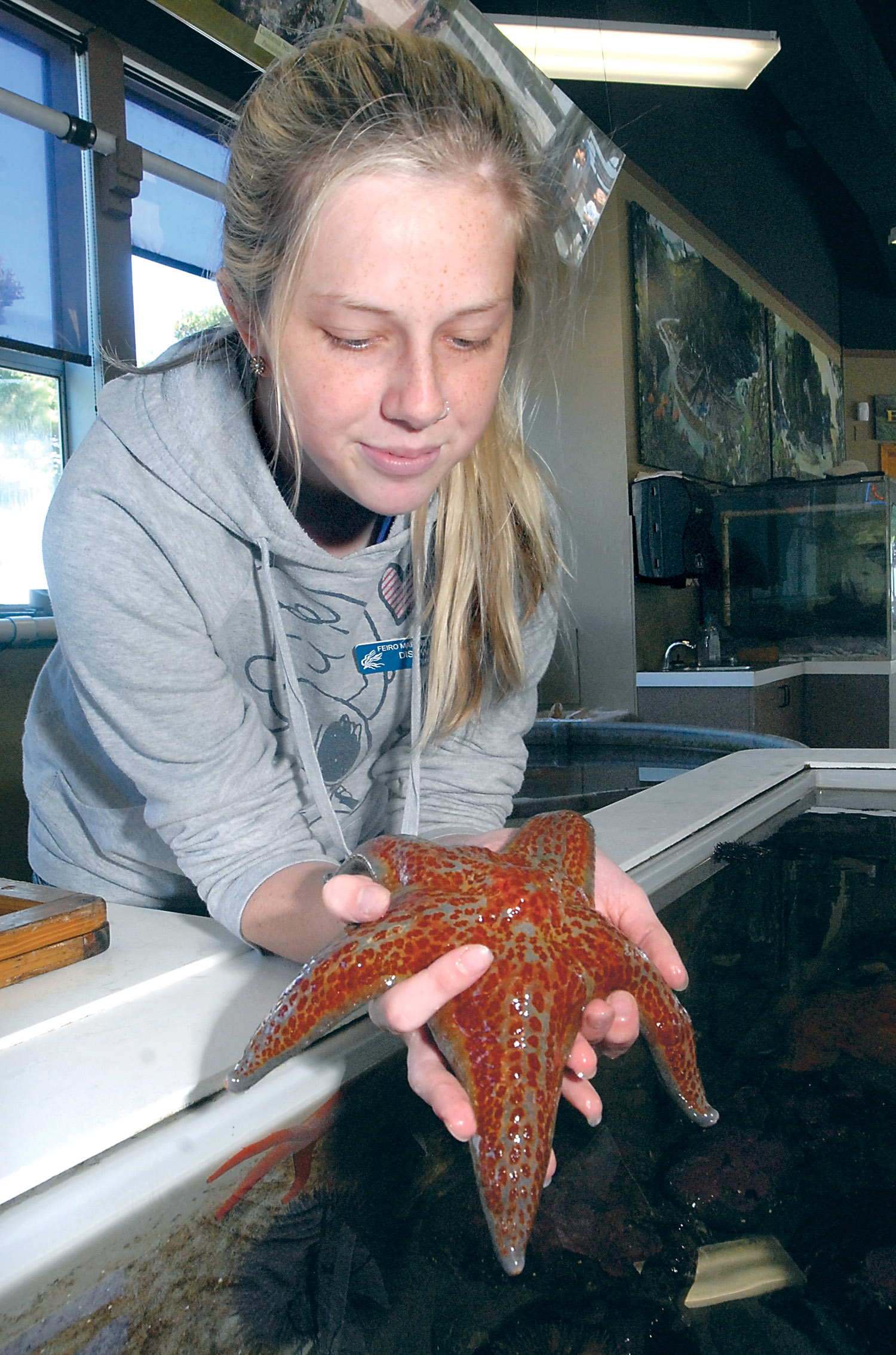
Visitors to the North Olympic Peninsula’s two major marine science centers are likely to see few sea stars.
Sea star wasting disease, which has decimated wild populations, also is tearing through captive collections.
The disease has accelerated this summer, said staff members at both the Feiro Marine Life Center in Port Angeles and the Port Townsend Marine Life Center.
It has eliminated at least one species of sea stars from the tanks at Feiro on City Pier, and has claimed 12 of the 15 ochre stars in a single tank at the Port Townsend Marine Life Center in Fort Worden State Park.
The centers, which pipe sea water into their tanks, are mirroring the devastation seen in the wild.
Sea stars are dying by the millions on the West Coast of the disease in which they seem to be sick and “deflated” and then “melt” into a white substance.
“It’s the largest mortality event for marine diseases we’ve seen,” Drew Harvell, a marine epidemiologist at Cornell University, told EarthFix, a public radio media project.
“It affects over 20 species on our coast, and it’s been causing catastrophic mortality,” she added in a report published this month by the Public Broadcasting Service.
Harvell, who has led nationwide efforts to understand the cause, saw more sickened sea stars this summer as the water around the San Juan Islands warmed.
She and others think the syndrome may be an infectious disease caused by a bacteria or virus.
If so, warming waters could make sea stars more vulnerable to the pathogen.
Caretakers at the Peninsula’s marine science centers don’t intend to replace sea stars until they feel more confident they can keep them alive — and avoid taking breeding adults that may be needed to replenish wild colonies.
Port Townsend center
The Port Townsend Marine Science Center lost most of its ochre sea stars in the last few weeks.
“Our ochre stars are really hard hit,” said Shannon Phillips, AmeriCorps marine exhibit educator.
The tank has been cordoned off with caution tape to keep visitors from touching it and possibly spreading the disease to a single healthy tank nearby.
It also draws public attention to the ongoing problem, she said.
Feiro tanks
A giant, 30-inch sunflower sea star that once occupied the large octopus tank at Feiro has succumbed to the disease, and all of the other sunflower stars also have died off, Facility Coordinator Bob Campbell said last week.
“I’ve seen it in all the species” of sea stars, in the center’s tanks, he added.
Sea stars once were prominent in the center’s tanks.
Now, fewer than 10 of the orange or purple ochre stars remain along with a small selection of blood stars and adult six-rayed stars.
At Feiro, an array of baby six-rayed stars smaller than the end of a pencil eraser provided a little bit of hope for the future of the sea creatures.
In the wild, the sunflower star — the largest sea star in the world, which can grow to an arm span of more than 3 feet — is both a predator and an efficient carrion eater that helps keep the ocean clear of the carcasses of dead animals, Campbell said.
The loss of those carrion eaters could result in ecological shifts, Campbell said.
Each sea star death in the tanks is recorded.
“You can’t have too much data, but we haven’t learned anything from it yet,” Campbell said.
Surveys by workers with both centers are surveying wild populations on the Peninsula.
Freshwater Bay
In a June survey of Freshwater Bay west of Port Angeles, Feiro volunteers found that 8 percent of the sea stars were infected — a jump from the 2 to 4 percent found during monthly surveys since last fall.
The July survey, taken Sunday, found that the rate had leaped higher.
Signs of sea star wasting syndrome was found in 12 percent of blood stars and 30 percent of ochre stars.
Indian Island
A June survey of a beach on Indian Island near Port Townsend found a similar loss of sea stars, Phillips said.
But the center’s staff members found an unusually large number of juvenile stars.
The primary predator of juvenile sea stars is adult sea stars, so they may be coming out of hiding because they feel safer, or they may simply be surviving at higher rates, Phillips said.
Researchers are studying if juvenile stars are more resistant to the disease than adults, Phillips said.
Disease observations
The current outbreak of sea star wasting disease, a sickness recorded on the Pacific Coast for more than 40 years, was first identified in June 2013 among sea stars on the Olympic National Park coastline.
By September, infected sea stars were spotted in isolated bays from British Columbia to Southern California.
The disease also was found in July 2013 among sea stars on the East Coast between Maine and New Jersey.
It was first seen in the Port Angeles area in December, when a sea star in the tanks in the Feiro building on City Pier was found to be infected and coastline surveys unearthed infections in the wild.
Other outbreaks were recorded in Maine in 1972 and in California in 1978, 1983 and 1997.
Outbreaks were associated with warmer than usual water temperatures, according to a study by Amanda Bates, Brett Hilton and Christopher Harley published in the Diseases of Aquatic Organisms in 2009.
Central information site
The National Park Service, Bureau of Ocean Energy Management, Partnership for Interdisciplinary Studies of Coastal Oceans, and the University of California, Santa Cruz, have established a central information website to track the disease, www.seastarwasting.org.
The site includes the most recent scientific discoveries and a map of sea star wasting syndrome survey locations, with the severity of infection rates in those locations.
________
Reporter Arwyn Rice can be reached at 360-452-2345, ext. 5070, or at arwyn.rice@peninsuladailynews.com.
