
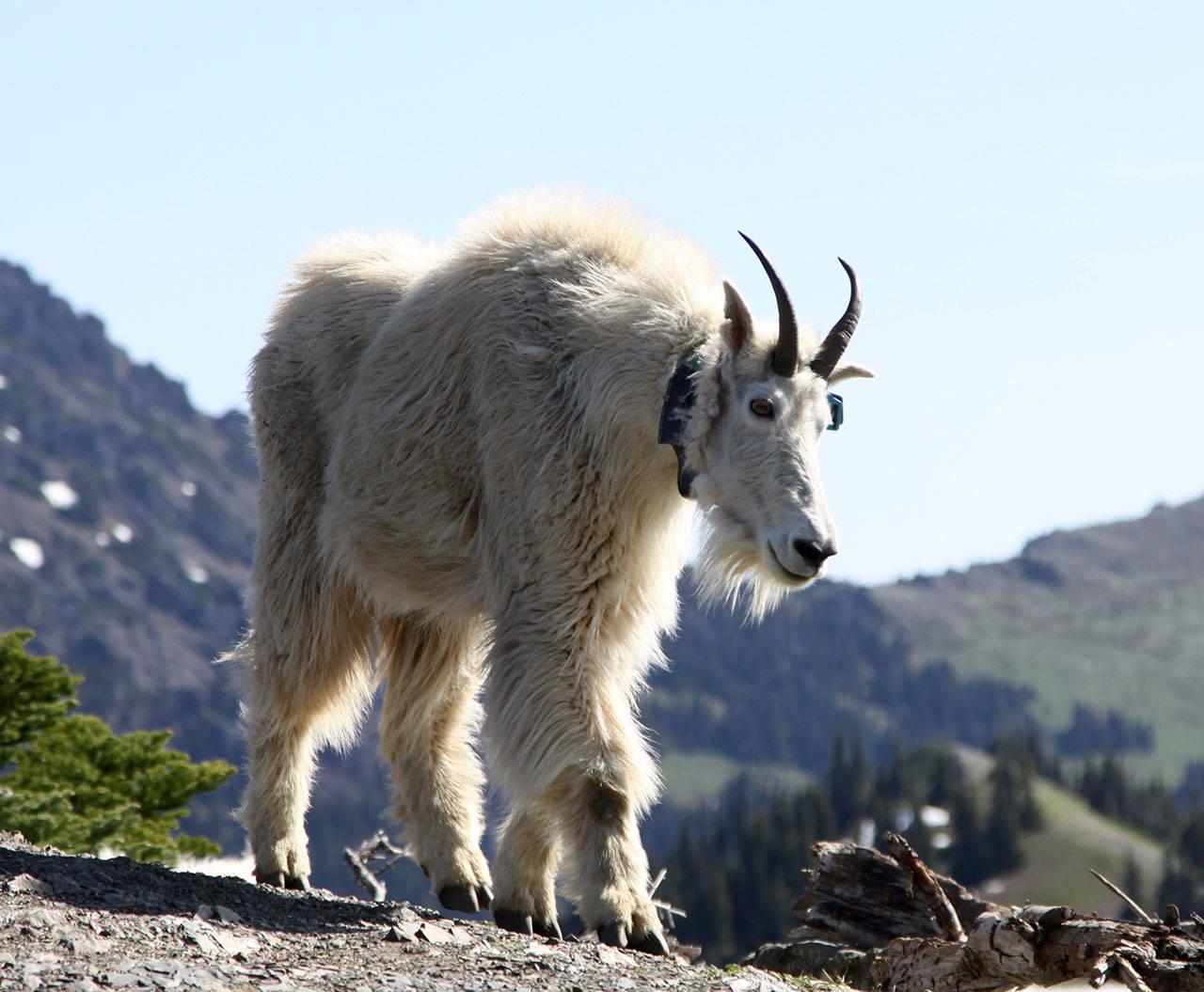
OLYMPIC NATIONAL PARK — The growth in the population of mountain goats in Olympic National Park will start skidding to a halt this summer.
The National Park Service plans to move the non-native goats that can be captured to the U.S. Forest Service land in the North Cascades, where they are native, according to the final environmental impact statement (EIS) issued Friday.
Those that cannot be caught will be shot, probably starting in 2019.
The strategy is the park service’s preferred alternative for its new Mountain Goat Management Plan. The final EIS is available for public viewing at https://parkplanning.nps.gov/OLYMgoat.
Friday began a 30-day wait period which is required before making a final decision on a proposed action. After the wait period, the park service will sign a Record of Decision documenting the final decision and course of action.
Then, the park service will aim to begin eliminating the goats from Olympic National Park this summer.
The plan’s purpose is to allow Olympic National Park “to reduce or eliminate the environmental damage created by non-native mountain goats and the public safety risks associated with their presence in the park,” the park service said.
In 2010, Bob Boardman of Port Angeles was fatally gored by a mountain goat on Klahhane Ridge in Olympic National Park.
About 2,300 comments were received on the draft EIS, the park service said.
The comments were used to develop the final version of the document, which includes modified versions of alternatives C and D (the preferred alternative), other minor revisions, and the agencies’ responses to public comments.
“The plan is to reach a zero population level of mountain goats in the park and adjacent Olympic National Forest lands through capture and relocation and then lethal removal,” according to the park service.
“Our top priority is capture and relocation; however, once capture operations become impractical or hazardous due to steep terrain the remaining goats would be removed by lethal means.”
That would remove about 90 percent of the projected 2018 mountain goat population, or some 625 to 675 mountain goats.
“The remaining 10 percent would be addressed through ongoing maintenance activities which would involve opportunistic ground- and helicopter-based lethal removal of mountain goats, with a focus on areas near high visitor use and areas where goats are causing resource damage,” the park service said.
A 2016 population survey of mountain goats in the Olympic Mountains showed that the population increased an average of 8 percent annually from 2004-2016, the park service said.
The park service worked with the U.S.Forest Service and the state Department of Fish and Wildlife to develop the plan.
“We are very pleased to collaborate with our partners the USDA Forest Service and the Washington State Department of Fish and Wildlife to develop the FEIS,”
“Federal and state agencies are poised to begin the effort that will help grow a depleted population of mountain goats in the Cascades and eliminate their impact on the Olympic Peninsula,” said Olympic National Park Superintendent Sarah Creachbaum.
Public meetings to review the draft EIS were held in August.
