
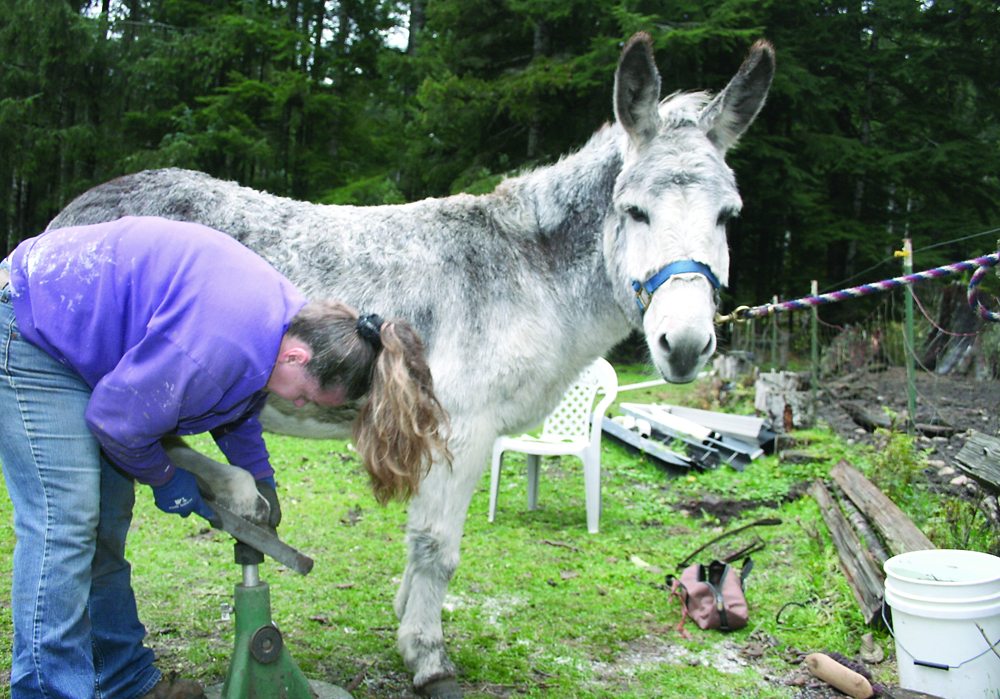
I’VE HEARD SOME use a tree stump, a few use a makeshift stand, and others use their hands and knees to support the hoof as they trim and shape it and add a metal shoe.
My friend Z Barker and most farriers I know use a Hoofjack to prop the hoof up and cradle it while working on it.
Other tools needed are a good farrier’s rasp, hoof knife, nippers and a wire brush to remove little pebbles and white flakes on the sole.
Why am I sharing this? I’ve always had a keen interest in hoof trimming, as gait issues and lameness can spring forth from a bad trim.
And now that our pony, Snowball Express, struggles with laminitis, he needs more frequent trims, so I want to learn how to do it myself.
Thus, last Saturday, I ventured over to my pal Z Barker’s home in the Sol Duc Valley.
She started working on her own horses years ago.
At the time, she only had one horse and was single and childless.
Now, she’s married, has two adorable horse-loving kids and owns three horses and a donkey.
‘Patient and forgiving’
“My horses are very patient and forgiving with me,” she says. “I think they’d rather have Mom or Dad, who they know well, than someone they don’t who comes flying in every couple months.”
She was quick to point out she’s no expert, saying: “This is what works for me. I’m not trying to give advice to other people, and I wouldn’t attempt to work on other people’s horses.”
She says friends Jennifer Reandeau and Carol Cross, along with farriers Eric Hodgson, Brad Erickson and Chris Niclas, all encouraged her to trim her own and have taught her many do’s and don’ts.
In the early years, she’d ask Hodgson to come out to check on her work, and he’d “tidy up my trims a bit.”
Occasionally, she still pays a farrier to check on her work.
“My first trim was on one of Jen’s horses. I trimmed him too short and felt horrible after,” says Z.
“But Jen said it was OK; the hooves would grow, and she just wouldn’t ride the horse for a couple weeks.”
When she first started, it took her an hour just to trim one hoof.
By the time she got to the back, both her and the horse would be irritated and edgy.
So years ago, she started trimming the hind feet first, saying, “It’s made a world of difference in their attitude and mine.”
She still tries to follow Jen’s advice to relax and not stress over mistakes because “the hoof will grow out.”
As she worked on her donkey Broos’ feet, she explained how his hooves differed from horses.
“A horse hoof is round, whereas a donkey’s hoof is longer, narrower and more of a cylindrical shape,” she says. “It’s important to know each has its different shape and should be trimmed at the proper angle for its breed and type.”
A novice shouldn’t make any drastic changes to the hoof. Hooves are not symmetrical, so just as “your right hand is different from your left, so should balancing each hoof be treated separately and not as a pair.”
It’s also important to learn how much to trim off and where.
Some take too much off the heel, others not enough.
Trimming should be performed on a regular schedule of every four to eight weeks.
When shaping the hoof, my own farrier instructed me to put the edge of a metal rasp on the front of the hoof and look for gaps.
A gap will occur when a hoof wall flares out, and that’s a sign it’s no longer at a natural angle.
Unless she’s riding on soft dirt trails, Z protects the feet with Old Mac Hoof Boots.
Applying metal shoes is a whole different learning curve.
It’s important to note when applying shoes, the correct way is to trim the hoof, then shape the shoe to fit that hoof, not the other way around, which can throw off the gait and lead to lameness.
The sole is the first line of defense between the horse and the ground.
Becoming calloused
Did you know the hoof sole needs to become calloused just as the bottom of our feet do if we want to walk barefoot outside without cringing at every rock or rough patch we cross?
It can be difficult to build up thick calluses in our region because of the abundant rain, which is why many horses owners will apply a few inches of crushed gravel the animal must walk over to get to its feed.
She says for the horse’s sake, it’s best to “set aside the time to do all four hooves in one day.”
It’s not OK to trim one hoof one day, another tomorrow and two the next week.
She trims each animal every four weeks because “it keeps them healthy and isn’t as much work to keep them balanced.”
She adds: “We are blessed in our area to have farriers and skilled friends willing to come out and teach us. I ask a lot of questions, weigh what they have to say and then do what I think is best for me and my horses.”
________
Karen Griffiths’ column, Peninsula Horseplay, appears every other Wednesday.
If you have a horse event, clinic or seminar you would like listed, please email Griffiths at kbg@olympus.net at least two weeks in advance. You can also write Griffiths at PDN, P.O. Box 1330, Port Angeles, WA 98362.
