
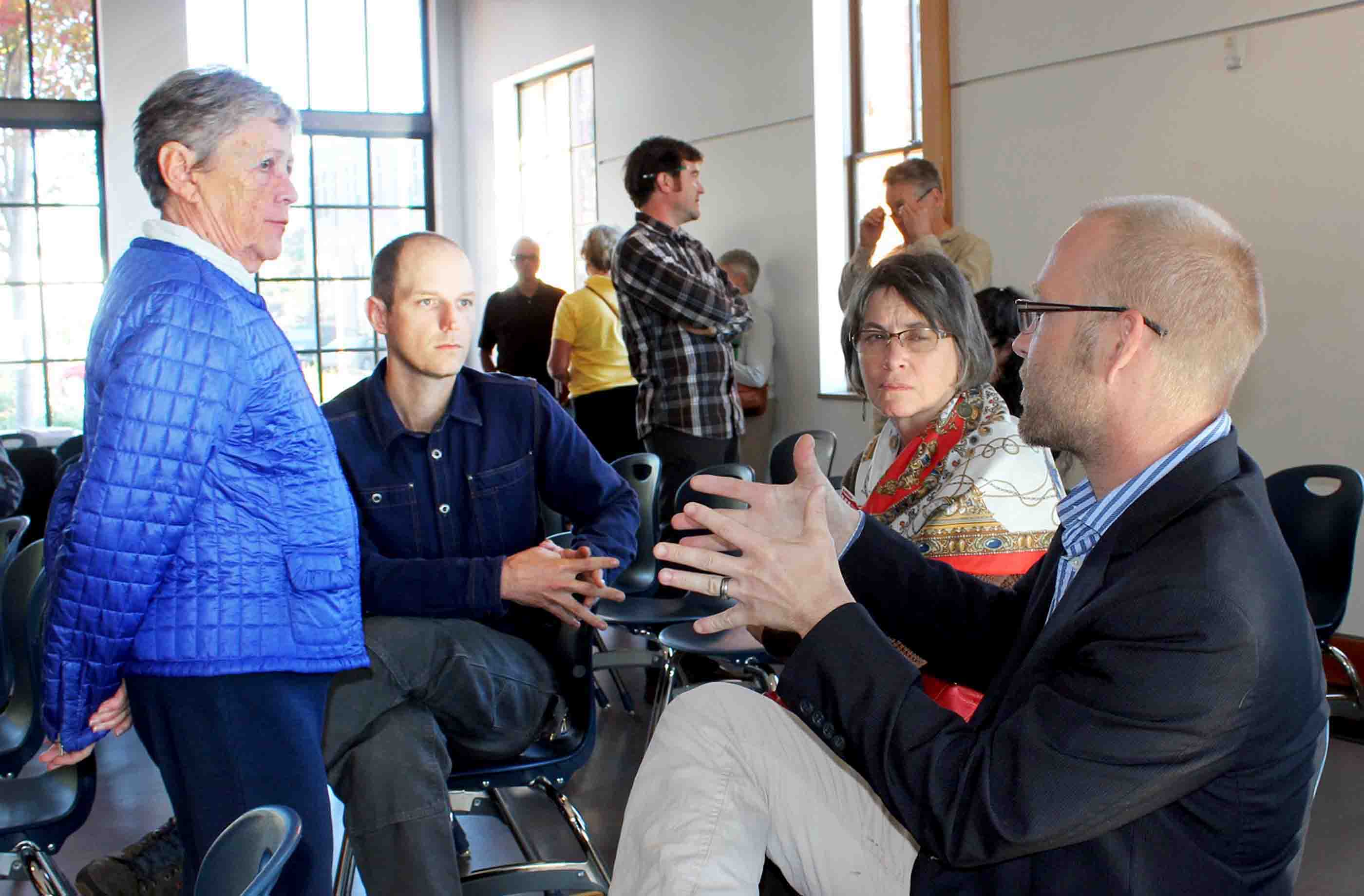
PORT TOWNSEND — Jefferson County Commissioners John Austin and David Sullivan got an earful during a two-hour public hearing on the current county moratorium on commercial marijuana growing and processing facilities in rural areas.
But if they were looking for a consensus, they were disappointed.
More than two dozen local citizens gave their opinion on the moratorium during Monday’s hearing, with those for and those against roughly equal in number.
The third commissioner, Phil Johnson did not attend. He is on vacation.
The commissioners, acting on a recommendation from the county Department of Community Development, put the six-month emergency moratorium into place Aug. 11.
Under state law, an emergency moratorium requires a public hearing within 60 days.
County Administrator Philip Morley said the commissioners put the moratorium in place “to find out what, if any, new regulations” are required.
“The whole purpose is to give staff time and information to further consider the issue,” said Austin, board chairman.
Commissioners could renew the moratorium in February, let it expire then or withdraw it before the end of the six-month period.
They plan to discuss it. No date for the discussion had been set as of Monday.
State voters approved Initiative 502 November 2012 and made recreational marijuana legal in Washington.
The Washington State Liquor Control Board, which oversees the new industry, received dozens of applications for growing and processing facilities in Jefferson County. Most of the applicants plan to do both.
Prior to the implementation of the moratorium, county officials were guided by the existing land-use and zoning regulations as they dealt with the new businesses.
Under those rules, agriculture can take place in rural areas that are also approved for residential use.
Carl Smith, Jefferson County community development director, said the new industry immediately raised new issues.
He cited three concerns, noting more than half of the new applications were for growing and processing facilities in rural residential areas rather than commercial and industrial sites.
He also pointed to one application, filed by William Staples, for a large growing and processing facility at 1743 Discovery Road.
Staples’ application calls for the construction of a 40,000-square-foot enclosure with a staff of 50 workers. A new 30-vehicle parking lot also would be built.
Annette Gardiner, who lives near the proposed facility, told the commission she is opposed to any such development in the county.
She said her family has relied on the rural residential designation to ensure they aren’t subjected to the intrusion of large commercial facilities.
Gardiner also took issue with designating marijuana growing as an agricultural use.
“Consider the families,” she said, and asked the commissioners to ensure any new facilities are built in appropriate areas.
Ted Hunter, an attorney for the Gardiners, also urged the commissioners to abandon any idea that using conditional use permits for growing and processing facilities would be appropriate and effective.
He said most conditional use permits are routinely approved, and added that the commission has the right to create new rules regarding the placement of the new facilities.
“There will be impacts,” he told the commissioners. “And you were elected to deal with the impacts.”
Those supporting rural residential growing and processing facilities were equally outspoken, with many noting the county may lose tax revenues by curtailing the opportunities for local farmers and entrepreneurs.
Tom Brotherton of Quilcene said he recently visited a marijuana farm in Sequim and said many of the concerns of opponents are overblown.
“There is very little water use. No odor, no chemicals. No waste. You couldn’t know it was happening.”
It’s the perfect home business.”
Brotherton, whose son Greg owns the Sea Change Cannabis retail shop in Discovery Bay, compared the environmental impacts of marijuana growing to livestock.
“Anything that walks takes much more water and creates much more waste,” he said.
Tami Mendonca, questioning concerns about a possible increase in crime, said crime has gone down in Denver following the legalization of marijuana in Colorado.
She also noted that recreational marijuana farms are highly regulated.
She contrasted the I-502 operations to medical marijuana growing facilities already operating in Jefferson County, saying the latter lack fences, cameras and other security items required by the Liquor Control Board for growers.
Jean Ball of Chimacum, an applicant for a production and processing license, said the cottage industry should be allowed to flourish.
She said she hopes to grow one crop a year on her 5-acre farm. The crop is just “dried flowers,” she said.
“I teach land stewardship, sustainable farming, animal husbandry, beekeeping and humane processing of meat animals. I need to find a way to support myself from home or face becoming a dependent.
“I-502 is a chance for me to support myself and my family on our farm land with our extensive skills,” Ball continued.
“The bottom line is simple for me. . . . I want a job and I want to work from home,” she said.
Ball said she finds support for her stand in the Jefferson County land use and zoning regulations, including the express goal of fostering “home-based businesses or cottage industries in order to provide economic and employment opportunities outside of rural village centers.”
“As a farmer, I don’t see the need for an agricultural product to be produced (grown) or processed (packaged) in commercially zoned areas. I can grow my plants and package the flowers on my farm.”
“If a lumber mill, an auto mechanic or a lavender farm can operate on rural/residential land … so, too, should a cannabis farmer.”
Tim Fager, Discovery Bay, said some of the concerns of opponents, including the possibility of odors, are unfounded.
He added, “It’s the American Dream — living and working on your own land.”
________
Reporter Mark St.J. Couhig can be reached at 360-452-2345, ext. 5074, or at mcouhig@gmail.com.