
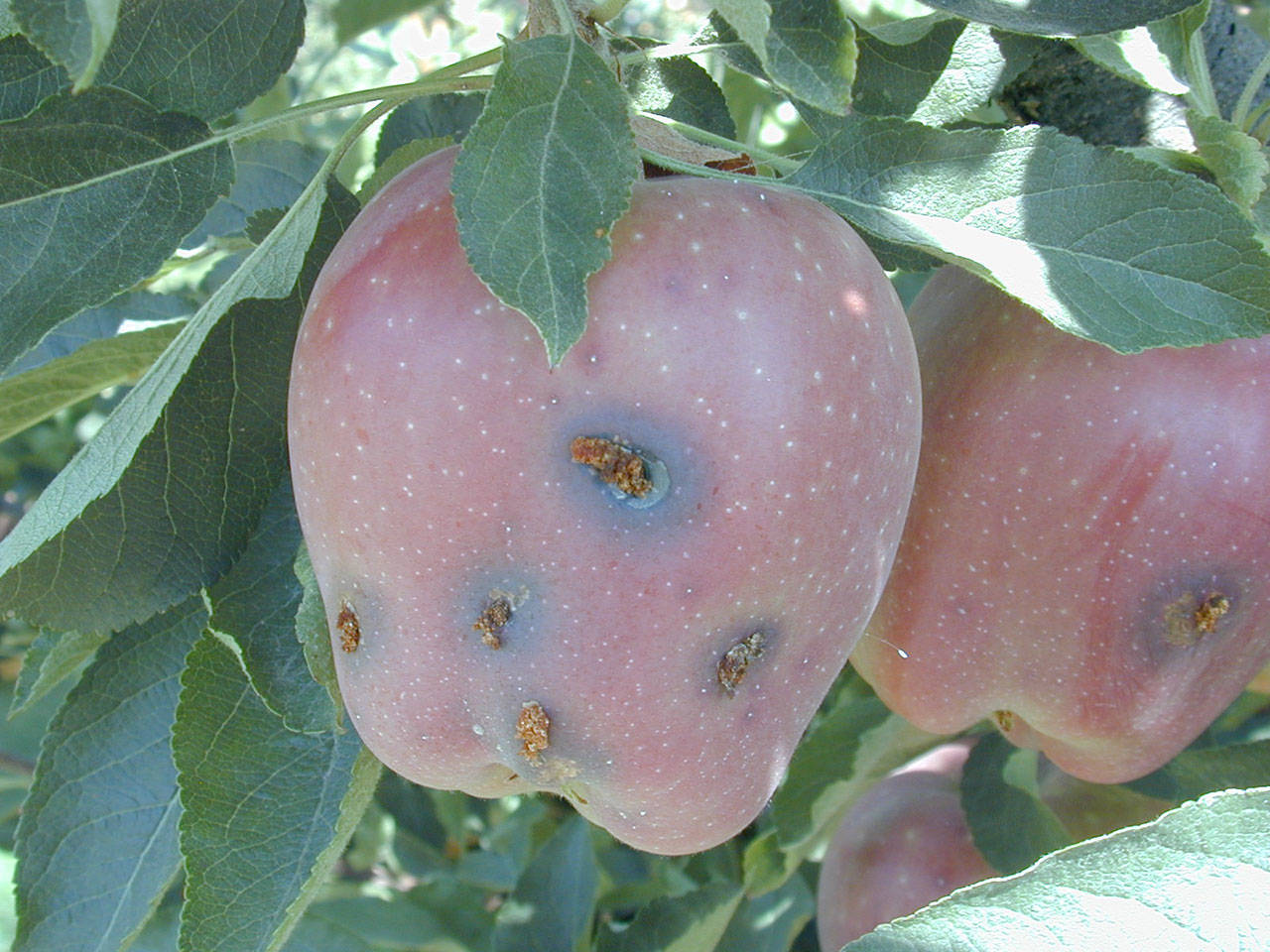
The image seems innocuous enough: the classic worm-in-the-apple cartoon.
In reality, the highly narrativized codling moth can destroy 80 percent to 90 percent of an apple crop within one to two years if not controlled.
Both Clallam and Jefferson counties reported cases of codling moth in home apple orchards this summer, and Jeanette Stehr-Green fears the latter scenario if homeowners do not take action now.
The impact to commercial orchards, if the pest multiplies and spreads, would be substantial, said Stehr-Green, master gardener with the Washington State University Clallam County extension.
Master gardeners have not yet conducted a systematic study to map the infestations and their proximity to commercial orchards, she said.
However, the codling moth can fly up to a mile.
“Therefore, it is very possible that other areas are also experiencing this problem or could experience it in the future,” Stehr-Green said.
Clallam County cases
Cases of codling moth in the Supplemental Nutrition Assistance Program Education (SNAP-Ed) program increased from last year, she said.
Karlena Brailey, the nutrition and physical activity coordinator of the program, reported that Clallam County Gleaners picked between 2,000 and 2,500 pounds of apples this year.
Of those, 30 percent were infested with codling moth, in contrast to about five percent in 2016, Stehr-Green said.
“We’ve had a problem recruiting home growers to SNAP-Ed [due to infestations],” she said.
The program donates fresh fruit to the Port Angeles Food Bank, but spoiled apples must be tossed out.
“These infestations have negatively impacted the efforts of the Clallam County Gleaning Group, which each year supplies thousands of pounds of apples to local food banks, senior centers and school children.”
Clallam County Master Gardeners also noted the problem during its weekly plant clinics.
The clinics provide a place to bring gardening questions and plant problems. That’s where samples of codling moth in Port Angeles and Carlsborg apples caught Stehr-Green’s attention, she said.
“Our coordinator, Lorrie Hamilton, says that we have not seen as many codling moth samples as seen this year in her previous years on the job.”
The pest in Jefferson
The pest exists in Jefferson County, too, though it’s not certain to what extent, Stehr-Green said.
Bridget Gregg, master gardener coordinator in the WSU Jefferson County extension, said at least three apple samples contained the trace of codling moth.
“I spoke to my most seasoned plant clinician in Jefferson County, Sarah Fairbank, to get a sense of how this compares to her previous years at clinic. She indicated that this seems about average for Jefferson County,” Gregg said in an email.
A few cases of codling moth are not out of the ordinary.
“We see occasional codling moth in apples each year but we have not seen it in this extent until this summer,” Stehr-Green said.
The telltale signs include a dirty brown core and pin-sized hole oozing a reddish brown granular substance, or larvae excrement.
The larvae, not the moth, enacts the damage to fruit, Stehr-Green explained.
Adult females lay eggs on leaves and fruit. After hatching, the larvae burrow into the fruit, typically through the blossom and feed on the core and seeds.
“I think they’re smarter than we are,” Stehr-Green joked.
About a month later, the larvae tunnel out, fall on the ground and form cocoons under loose bark on the tree trunk or soil below. At maturity, the larvae span ¾ inch and appear cream-colored or pink and white with brown heads and six claw-like legs. They pupate and produce adult moths, and the cycle continues.
In one summer, up to three generations might pupate, especially in a warmer climate, Stehr-Green said.
“Maybe this was actually brewing in previous years,” she said. “Between neglect of orchard sanitation and warmer summers, it’s allowed for additional generations.”
Control methods
How do homeowners ward off the pest?
“The most important thing is to keep orchard sanitation,” she said.
Fruit tree owners should remove windfalls, fruit that falls to the ground, and routinely inspect the fruit for codling moth entry holes.
“A lot can be achieved by that alone,” Stehr-Green said.
Orchard stewards on the defense may choose to individually bag fruit on the tree to prevent codling moths from landing on the surface and laying eggs. This method, though “very efficient,” requires more time than some people can expend, she said.
Cardboard also offers an unlikely barricade.
Wrapping the tree trunk with corrugated cardboard traps the larvae seeking a home for its cocoons, Stehr-Green said.
Fruit that is found to contain codling moth should be destroyed, not composted, she emphasized.
One chemical control option, kaolin clay, forms a “distasteful” film on trees that causes insects to leave the host tree and others to avoid settling there.
No matter the control measure, Stehr-Green stressed that fruit tree owners possess a responsibility to keep up good orchard sanitation.
“Fruit trees come with a responsibility because what you do with your trees affects your neighbors and even small businesses.”
“If you can’t take care of your trees, you might even consider taking them out.”
________
Reporter Sarah Sharp can be reached at 360-452-2345, ext. 56650, or at ssharp@peninsuladailynews.com.
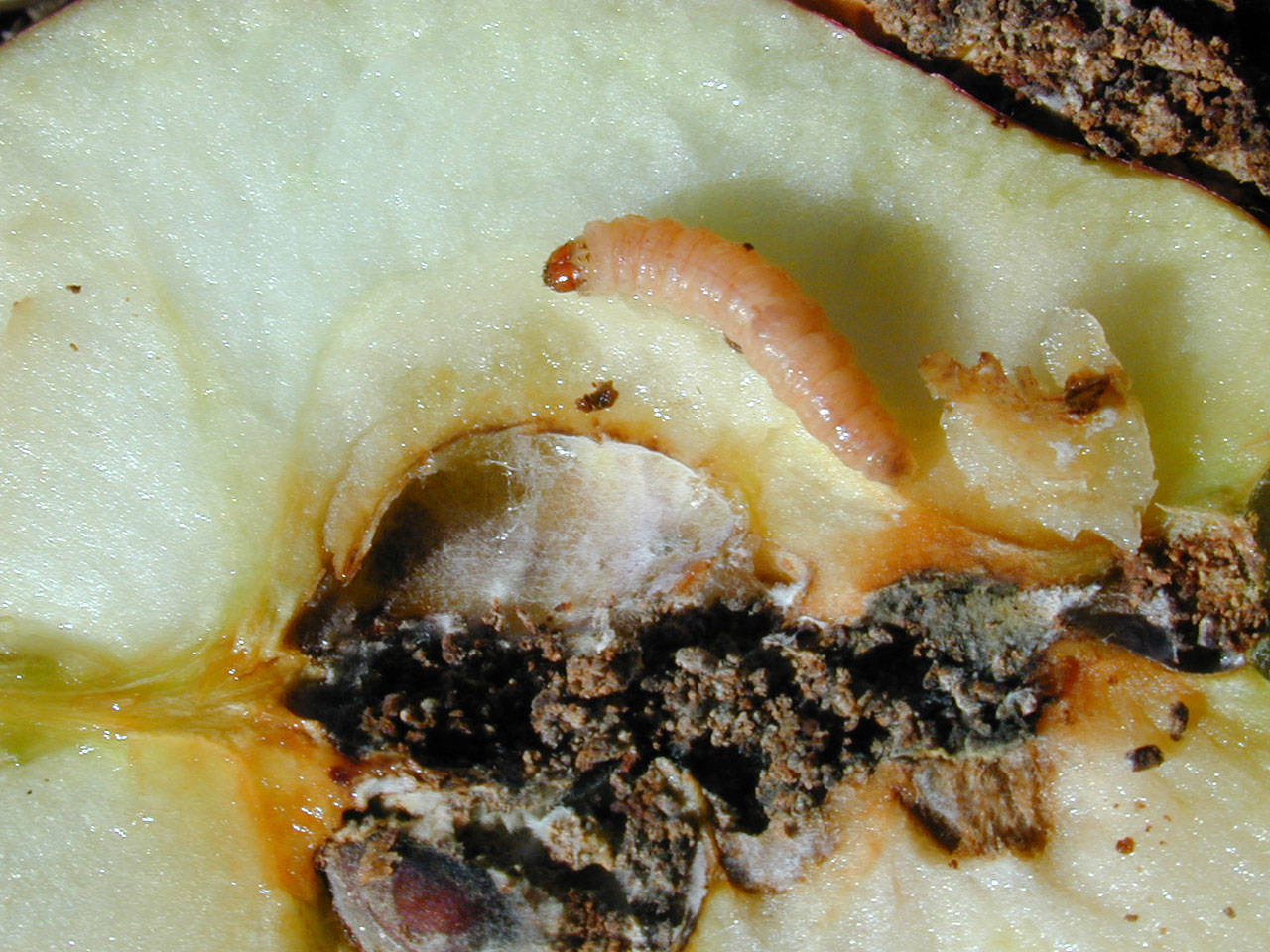
A dirty brown, rotten core demonstrates the impact of codling moth infestations. (Jay Brunner)
