
IF WE DO not have anything to talk about, there is always the weather. People have often remarked, “Everyone discusses the weather, yet no one ever takes action to change it.” This quotation is often credited to Mark Twain, although there is no definitive evidence that he authored it.
It seems we live in the perfect place to talk about the weather. Come spring, we may experience 100 types of weather every day.
We have experienced quite the season for rain. Atmospheric rivers followed by severe flooding in western Washington. Every time news outlets interview people who tell us they “have never seen the water this high,” we should stop and recall our local history before we think it has never been this bad before.
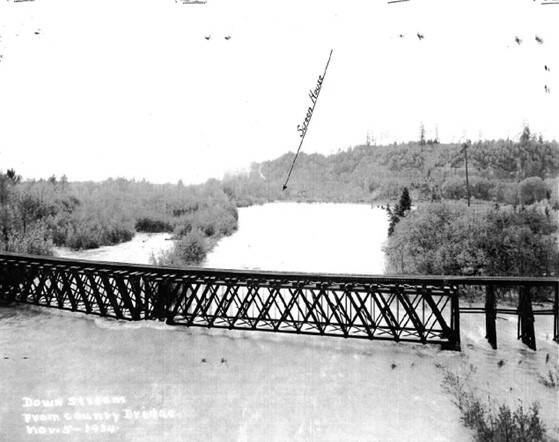
We experienced strong winds and heavy rain on Nov. 4-5, 1934. On the coast, wind gusts hit 61 mph. In Seattle, 49 mph gusts were recorded. In the same 24-hour period, Port Angeles received 1.9 inches of rain. That did not quite top the 2.43 inches of rain for Nov. 17-18, 1892.
The rain also melted mountain snow in the Olympics. On Nov. 5, 1934, the Elwha River severely flooded.
The flow of water was estimated at 30,000 cubic feet per second passing over the Elwha dam. That equals 224,415 gallons of water passing by every second, 13,646,900 gallons of water every minute, 807,894,000 gallons of water every hour. Normally, the Elwha River’s flow was about 1,600 cubic feet per second.
That sort of water flow had occurred twice previously, in November 1921 and December 1933. The 1933 flood was followed 11 months later by the 1934 flood. People began to wonder if it was going to be a regular event.
1934 was not the end of it. By Jan. 18, 1935, Forks was covered with deep snow. Then a pineapple express came through. In 40 hours, Forks endured 12.25 inches of rain. Put all that rain on deep snow and you have extreme flooding. The Forks prairie was covered with 16 inches of water.
The Forks area experienced heavy damage. The Bogachiel and Quilayute rivers both flooded. At least 15 families were driven from their homes. Roads were blocked. Telephone lines were down. Bridges were washed away. Travel and communications outside the area was nearly impossible.
A Forest Service truck got stuck on the bridge crossing Hell Roaring Creek (Yes, it’s real!) The driver left the truck to get help. He returned shortly to find both the truck and the bridge were missing.
Port Angeles was no better off. Over two days, the city had 3.02 inches of rain. Local creeks flooded. There was concern the Valley Creek culvert under the Olympic Highway (U.S. 101 now) would plug. A log had washed down Valley Creek, lodging in the roadway embankment. If the culvert plugged, huge amounts a water would back up south of the highway. The highway embankment could wash out, sending vast amounts of water and debris downstream.
City firefighters warned all the residents along Valley Creek to either evacuate or be ready to evacuate at a moment’s notice.
High flows in Valley Creek flooded the area at the foot of Cherry Street. An area with many homes was sitting in 3 feet of water. Using a rowboat, Hugo Olson rescued Elmer Bailey and a cat. Using the same rowboat, Nate Cohen rescued Mrs. McCormick. Nate Cohen had an automobile salvage business south of Second Street next to Valley Creek. His business was named House of a Million Parts. Even though his business was inundated with water, Cohen was out helping his neighbors.
The swirling muddy water rapidly piled up silt in the Standard Oil and Shell Oil facilities. Farther west, The Angeles Foundry and Concrete Products plant and the Union Oil Facility were under 6 to 8 feet of water.
To make matters worse, high tides were backing up water into the Valley Creek and Tumwater Creek culverts.
Muddy water also contaminated the city’s water supply, “but the city water department has a chlorinator in action and declares the water is safe for use.” Of course the water was “safe,” by 1935 standards. Farther south a 10-inch water main broke, leaving a number of homes without water.
Our newspaper’s Wandering Scribe offered several observations.
“If folks in Valley and Tumwater gulches had raised ducks instead of chickens they would not have suffered such heavy loss. It was declared by rescuers today the chickens could not swim. So went down squacking. It was quite a sight to see folks rowing boats and canoes around the flat near the Port Dock. Sightseers were as numerous as workers.”
Areas east of Port Angeles were not immune to this storm. High water in McDonnell Creek washed out an irrigation flume and eroded the highway’s embankment. There was 6 inches to a foot of water over the highway in the Fairview area at the Chambers Ranch. (The Chambers barn still stands next to U.S. 101.)
There were concerns for the highway at every creek and river crossing. People were warned to exercise caution at Lees Creek, Ennis Creek, White Creek, Siebert Creek and McDonald Creek.
Even east of Sequim, at Discovery Bay, Snow Creek overflowed its banks and flooded the highway. As in Port Angeles, an exceptionally high tide blocked the flow of water.
These weather events happened 91 years ago. Yet they sounded like everything we heard and read in news media this year.
It seems, though, that Ecclesiastes 1:9 is very true: “History merely repeats itself. It has all been done before. Nothing under the sun is truly new.”
History can teach us many things. When it comes to the weather (and earthquakes), history teaches us to be prepared, not surprised.
________
John McNutt is a descendant of Clallam County pioneers and treasurer of the North Olympic History Center Board of Directors. He can be reached at woodrowsilly@gmail.com.
McNutt’s Clallam history column appears the first Saturday of every month.
