
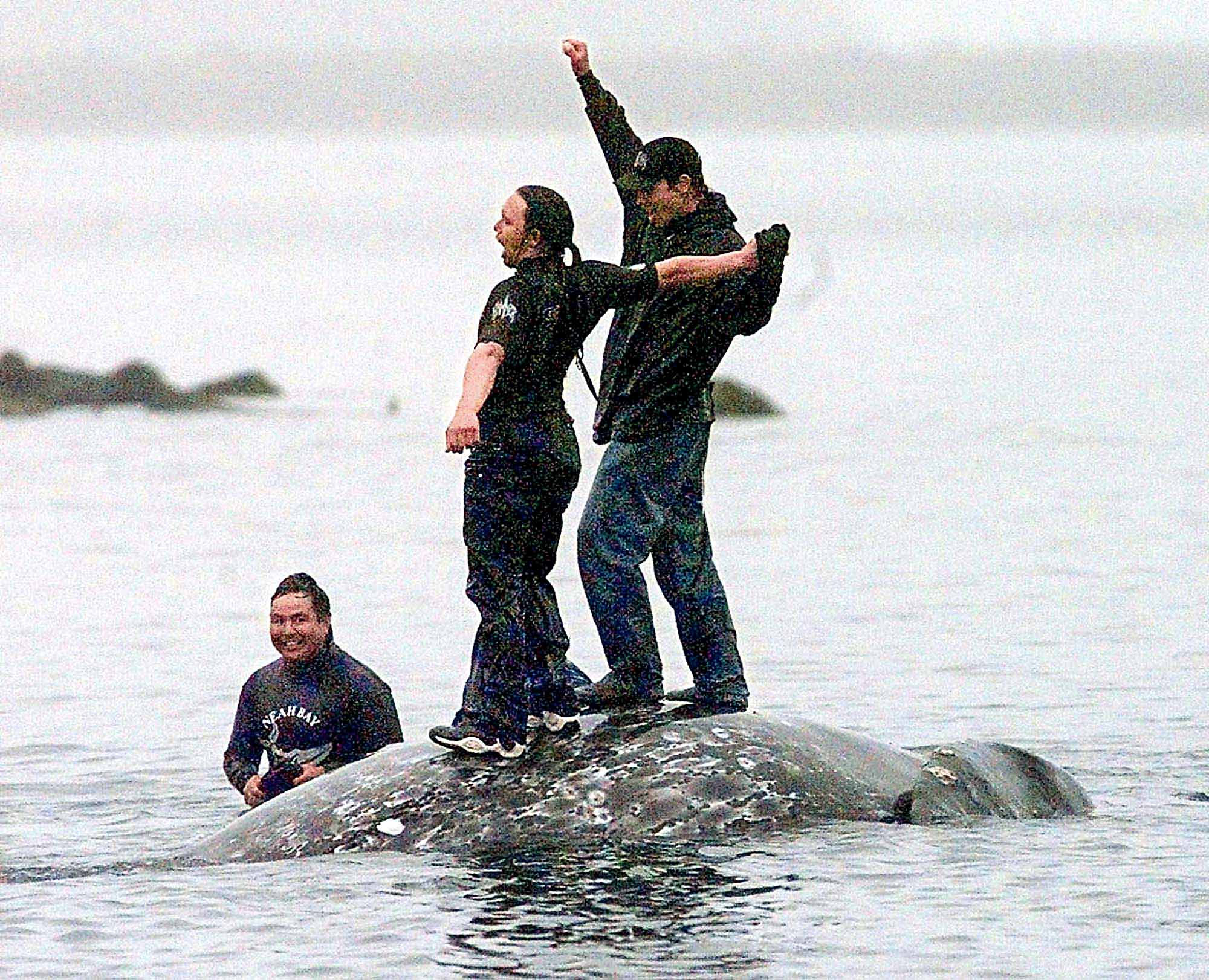
NEAH BAY — The public has until June 11 to comment on a draft environmental impact statement on the Makah tribe’s long-pending request to resume hunting gray whales off the North Olympic Peninsula.
It has been almost 16 years since the tribe’s last legal whale kill.
The National Marine Fisheries Service of the National Oceanic and Atmospheric Administration released the 1,229-page draft study Friday.
“We look forward to the comment period and certainly hope that we can resume our traditional practices in a timely manner,” Makah Tribal Chairman Timothy J. Greene Sr. said Friday.
The fisheries service, however, has published no timeline to prepare a final environmental impact statement.
Even if it approves whaling, it faces almost certain court challenges from animal activists on the North Olympic Peninsula and nationwide.
The tribe has sought a waiver from the Marine Mammal Protection Act since 2004.
Tribe ‘definitely happy’
For hundreds of years, the Makah hunted gray whales for subsistence and ceremonial purposes.
Through years of court fights and federal reviews, the Makah’s desire to begin whaling again has remained strong, according to Greene.
“We are definitely happy that we have reached this point,” Greene said Friday. “It has been a very long process.”
He said whaling “is something that is strongly connected to our spiritual existence. We’re not going anywhere, and this is important for us and generations to come.”
But the tribe’s hunting of the giant mammals in coastal waters remains a disturbing prospect for many.
“We recognize the cultural importance of whales to the tribes and intend no disrespect,” said D.J. Schubert, a wildlife biologist with the Animal Welfare Institute.
“But whaling is inherently cruel. These are incredibly intelligent, sentient creatures and they do suffer.”
Previous draft environmental study
NOAA released an earlier draft study in 2008 on the resumption of whaling.
It ended up being withdrawn four years later as new information became available about the Pacific gray whale population.
By 2012, there were new concerns about the effects of a hunt on an endangered stock of an estimated 140 gray whales that live in the western Pacific off Asia’s coasts.
Satellite tracking showed that some of them journey to the North Olympic Peninsula.
The new draft study includes the latest research on all of the Pacific gray whale stocks.
Six options
The draft study proposes six different options ranging from not allowing any hunting at all to allowing up to 24 North Pacific gray whales to be harvested in coastal waters within a six-year period. They are:
■ A no-action alternative would not authorize a whale hunt but would continue a 2004 moratorium under the Marine Mammal Protection Act in a decision by the Ninth U.S. Circuit Court of Appeals.
■ Alternative 2 would let the Makah harvest as many as five Eastern North Pacific gray whales a year and a maximum of 24 over six years in tribal ocean fishing grounds except for a zone around Tatoosh Island and White Rock.
No more than seven whales could be “struck” — penetrated by harpoons or bullets — in a year, and no more than three struck and lost.
The National Marine Fisheries Service, furthermore, could limit the harvest to three whales a year if the whale population was shrinking.
■ Alternative 3 also would prohibit Makah hunters from making an “initial strike” within 5 miles of shore and would set a probable “mortality limit” of 2.7 whales a year.
■ Alternative 4 would limit the hunt to June 1-Nov. 10 to avoid killing endangered Western Pacific gray whales — a population distinct from resident whales — and limit mortality to one member of the Pacific Coast Feeding Group that ranges from Northern California to northern Vancouver Island.
■ Alternative 5 would open two 21-day-long hunting seasons — Dec. 1-21 and May 10-31 — to avoid killing a Western Pacific gray whale or a feeding-group whale, thus limiting the hunt to a local population of whales.
It also would set a probable limit of 0.27 whales a year, including any whale struck but not landed.
■ Alternative 6 would limit strikes to seven a year and set a probable mortality limit of 2.25.
The Marine Mammal Protection Act moratorium waiver would expire after 10 years, and a permit to hunt would last no more than three years.
The draft’s source — the fisheries service of NOAA, a division of the U.S. Department of Commerce — will accept written comments on the draft for three months.
By late April, according to Makah General Manager Meredith Parker, the fisheries service may hold public meetings on the alternatives in Neah Bay, Port Angeles and Seattle.
Similar meetings on an earlier draft environmental impact statement included sessions in Silver Spring, Md., near Washington, D.C., to accommodate national animal-advocacy groups.
Written comments can be submitted by email to Makah2015DEIS.wcr@noaa.gov.
To see the draft and for more information, visit http://tinyurl.com/PDN-drafteiswhaling.
The draft also is available at public libraries in Clallam Bay, Forks, Port Angeles and Sequim; the Seattle Public Library, 1000 Fourth Ave.; and NOAA Fisheries offices at 7600 Sand Point Way, N.E., Building 1, Seattle (call Leah Mattox, 206-526-6150) and 1201 N.E. Lloyd Blvd., Suite 1100, Portland, Ore. (call Steve Stone, 503-231-2317).
Copies on CD are available by contacting Steve Stone at 503-231-2317 or steve.stone@NOAA.gov.
Treaty guarantee
The 1855 Treaty of Neah Bay gave the tribe the right to hunt whales “in their usual and accustomed stations,” but in the 1920s they stopped hunting whales because commercial whaling had driven the whales almost to extinction.
The Makah last legally killed a Pacific gray whale on May 17, 1999. It was the tribe’s first whale hunt in more than 70 years.
The whale was harpooned by a crew paddling in a hand-carved cedar canoe, then died after it was shot several times by a .50-caliber elephant rifle used by a whaler in a motorized chase boat.
The hunt was sanctioned by the federal government and the International Whaling Commission.
Days later, Neah Bay’s 1,800 and hundreds of guests feasted on whale meat and blubber at the tribe’s community center.
Grays had been removed from the list of threatened and endangered species in 1994. There are now about 20,000 gray whales in the North Pacific, NOAA says.
In September 2007, five Makah tribal members illegally shot and killed a gray whale off Neah Bay.
One of the men, Wayne Johnson, the captain of the 1999 hunt, served five months in federal prison. Another man got 90 days. The others received probation.
_______
PDN reporter James Casey can be reached at 360-452-2345, ext. 5074, or at jcasey@peninsuladailynews.com. The Associated Press contributed to this report.
