

SEQUIM — This winter, locals can look to Sequim’s skies and waters for booming trumpeter swan populations.
“They’ve definitely been rising in recent years,” said Bob Boekelheide of the Olympic Peninsula Audubon Society.
Trumpeter swans were an uncommon sight in the Sequim area years ago. The first sighting of a swan was by society volunteers during the annual Christmas Bird Count in 1982, Boekelheide said.
Birders never spotted more than 50 at a time until 2008, Boekelheide said, and there’s been a big increase in the past three years.
Typically, Sequim will see the most swans between January and March before they fly north to Canada and Alaska, Boekelheide said. The largest number of swans counted in the Sequim area has been 258 last Feb. 23.
During the most recent swan counts, volunteers counted 179 on Jan. 9 and 181 swans last Friday, Boekelheide said.
But why and when they come here is still partly a mystery, he said.
“In November, we never had above 100 swans and this [November] we had well over 100,” Boekelheide said. “Since then, we’ve gone up and down within 20 percent of this time last year.”
Bird background
Specific swan counts became commonplace for Audubon Society members starting in 2011 after the birds were beginning to die in significant numbers from lead poisoning.
The state Department of Fish and Wildlife provided a grant to the Northwest Swan Conversation Foundation which in turn worked with the Audubon Society in Sequim for two years. After the grant ran out, Boekelheide said the group continued the count anyway to monitor numbers to help prevent issues like the birds flying into power lines.
The Audubon Society has worked with Clallam County Public Utility District, he said, to place reflectors in key areas the swans fly such as at Lotzgesell and Anderson roads.
Martha Jordan, executive director of the Northwest Swan Conservation Association, has worked with swans for 40 years. She said that in recent years birds have been spotted traveling in western and eastern parts of Oregon and Washington in “whole new ways we’ve never documented before.”
Jordan said she did work on the Elwha River Restoration in the 1990s and when the dams came out beginning in 2011. She said up to 80 swans wintered in the Elwha River area prior to the dams’ removal but with water levels rising, vegetation is less accessible for swans so they made a switch to a burgeoning farming community in Sequim.
“You planted and they will come,” Jordan said.
Farms such as fields by Nash’s Organic Produce attract swans, she said.
“They’re pretty safe there with not a lot of predators,” she said.
Swan business
Nash’s Organic Produce co-owner Patty McManus Huber said they don’t purposefully discourage or encourage the swans to come to their fields despite seeing big losses in crops.
Staff have considered placing shiny objects to deter the swans in Nash’s hundreds of acres, but McManus Huber said it would be a huge cost in labor and materials.
“We have other issues with the elk on Schmuck Road sometimes, but that’s why we’re a diverse family farm,” she said.
If the birds are gleaning after they’ve harvested a field, Nash’s staff are OK with that, she said, but they are still considering non-damaging ways to deter swans.
Coexistence
Some birders are hoping locals can find a proactive way to enjoy swans without disrupting them after a recent incident in Dungeness.
Ginger and Dan Poleschook of Live Loon Lake reported to law enforcement that more than 60 trumpeter swans were harassed in Dungeness on Jan. 6 by a child on a four-wheeler. The couple was visiting family and took some time to snap photos of the swans when they spotted the child. Ginger said the juvenile rode into the field and accelerated to scare the birds and some nearly flew into nearby power lines on Evans Road.
Chief Criminal Deputy Brian King of the Clallam County Sheriff’s Office said they typically handle only domestic animals but the deputy contacted the juvenile and spoke with his parents. The incident was turned over to state Fish and Wildlife.
Police Sgt. Kit Rosenberger for Fish & Wildlife in Clallam and Jefferson counties said the incident remains under investigation but typically with juveniles they seek education in hopes of correcting future behavior.
Birders like the Poleschooks and Jordan agreed with the sentiment about promoting education with the birds.
“Some of the photos [by the Poleschooks] show the swans flying directly at power lines and the fact that they didn’t hit any is remarkable,” Jordan said.
Rosenberger said there isn’t a hunting season in Washington for swans and because state law defines hunting as an effort to kill, injure, harass, harvest or capture a wild animal or wild bird, an attempt to chase after or injure a swan can fall under hunting unlawfully, he said.
Startling a bird can mean life or death later on for swans too, Jordan said.
“These wild fowl need to eat during the winter and be in the best condition they can be for going back to the breeding grounds,” she said. “When we disturb them, we can affect their breeding or survivability.
“You don’t see the consequence you’ve done. One person does it one day, and another the next. Pretty soon you have a major impact.”
Rosenberger said people are encouraged to watch the birds from a distance, and keep pets on a leash while viewing.
Those who see a dangerous wildlife encounter taking place are encouraged to call Fish & Wildlife at 1-877-933-9847 and report automobile makes and models, license numbers, the perpetrator’s description and the type of violation.
For more on the Northwest Swan Conservation Association, visit http://nwswans.org/. To learn more about the Olympic Peninsula Audubon Society, visit http://olympicpeninsulaaudubon.org.
________
Matthew Nash is a reporter with the Olympic Peninsula News Group, which is composed of Sound Publishing newspapers Peninsula Daily News, Sequim Gazette and Forks Forum. Reach him at mnash@sequimgazette.com.
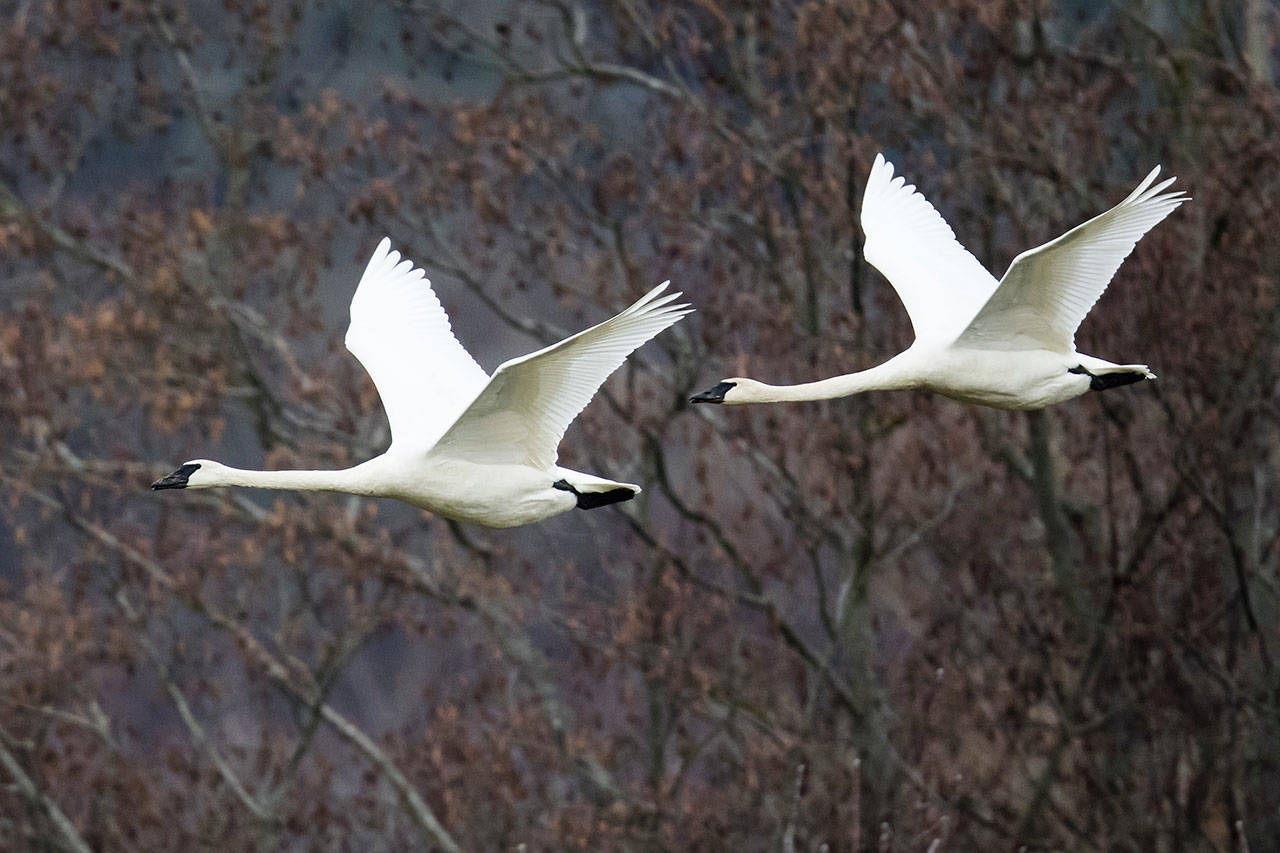
It wasn’t until seven years after members of the Olympic Peninsula Audubon Society started the Christmas Bird Count that trumpeter swans were spotted in the area before flying north to Alaska and Canada. (Ginger and Dan Poleschook)
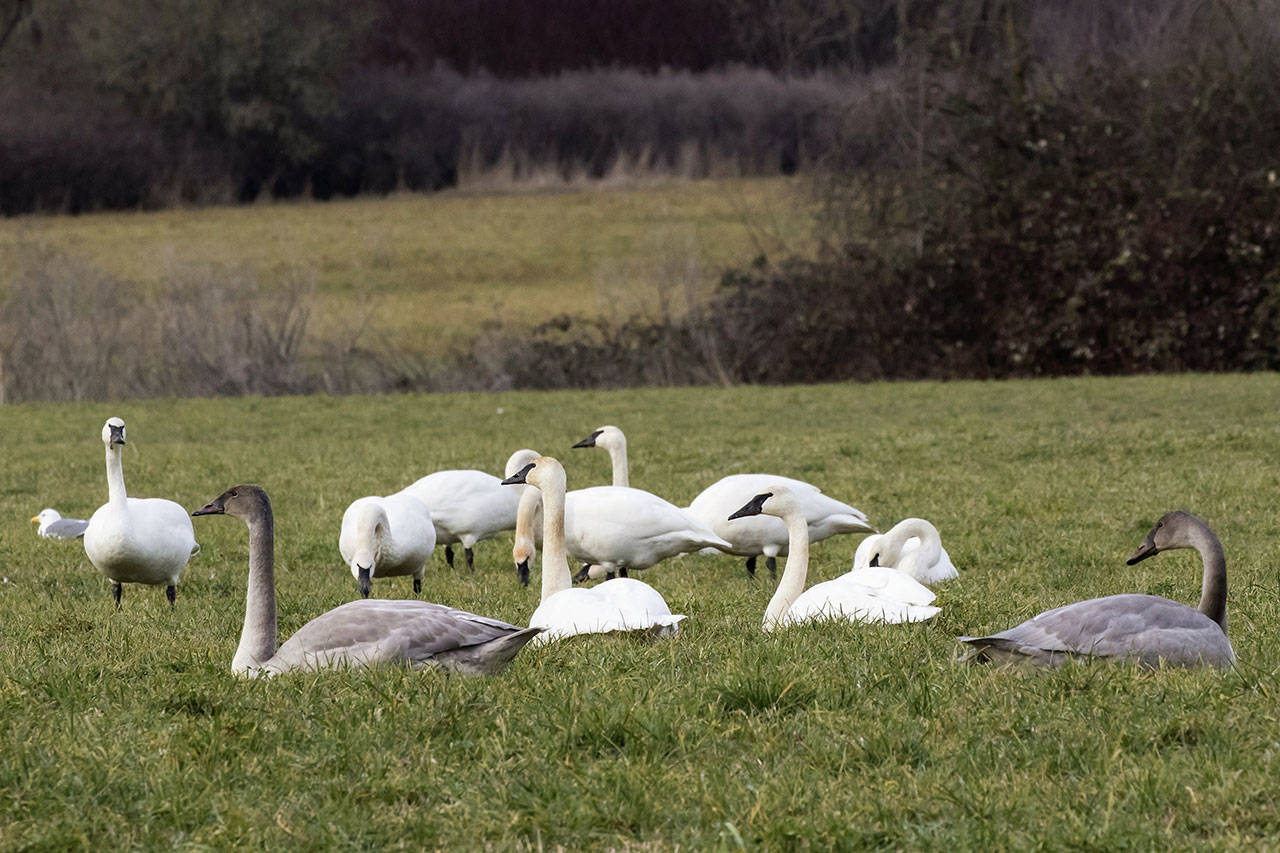
Birders never spotted more than 50 trumpeter swans at a time until 2008, said Bob Boekelheide with the Olympic Peninsula Audubon Society, but in recent years totals have gone as high as 258. (Ginger and Dan Poleschook)

These young swans, or cygnets, look for food in a Sequim-area field. (Ginger and Dan Poleschook)
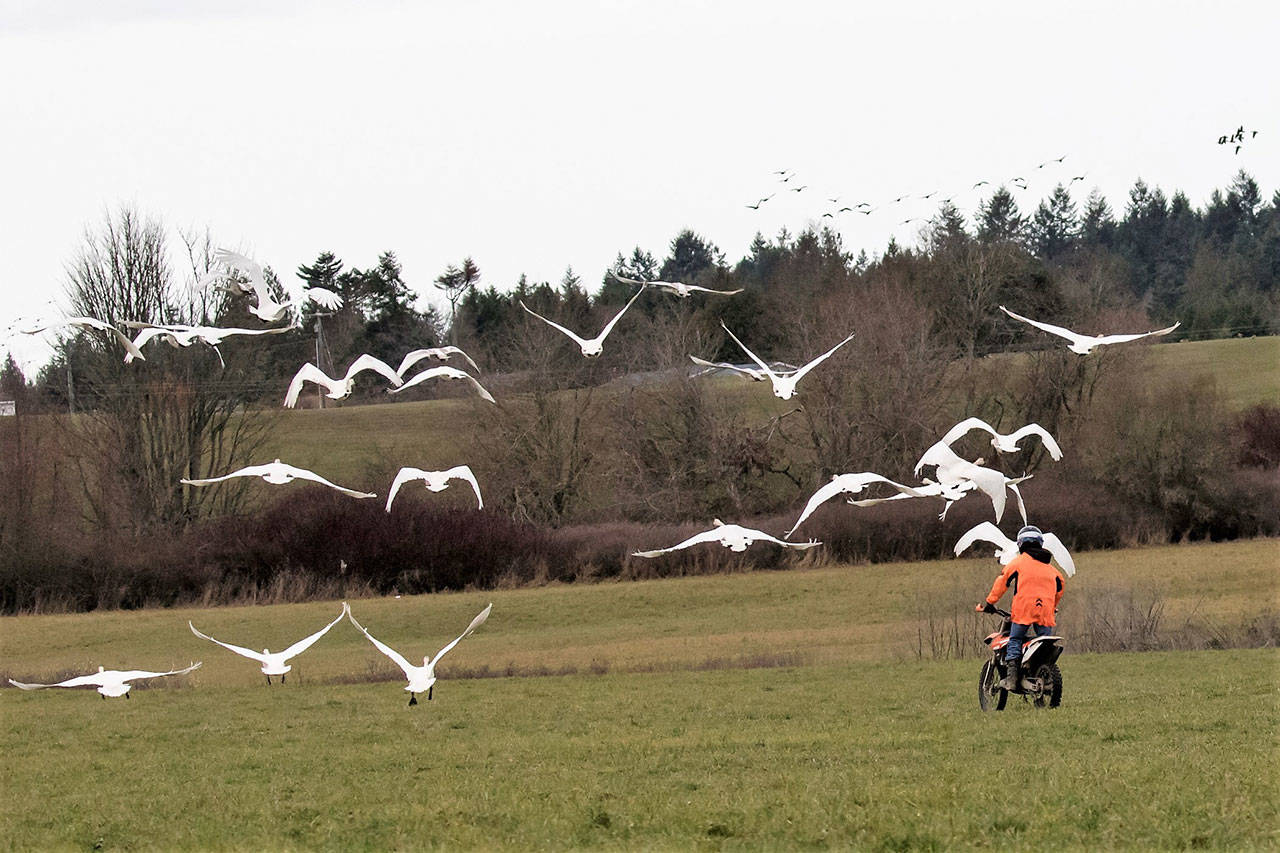
On Jan. 6, this local child was spotted chasing trumpeter swan on private property and reported to local law enforcement. Birders and local law enforcement look to the experience as a learning opportunity for the community that these birds could have flown into power lines or expelled unneccessary energy needed to fly north later. (Ginger and Dan Poleschook)
