
PORT TOWNSEND — Jefferson Healthcare workers have been practicing for emergencies and continue to prepare for small, local events or regional major catastrophes.
“Every hospital is required to play an important role during all kinds of emergencies in the community or at its facility,” said CEO Mike Glenn.
“I think how a hospital responds during a flood or an earthquake or a challenging incident in the community, or even within the hospital, is a result of how well we plan and the policies and procedures we have in place,” he added.
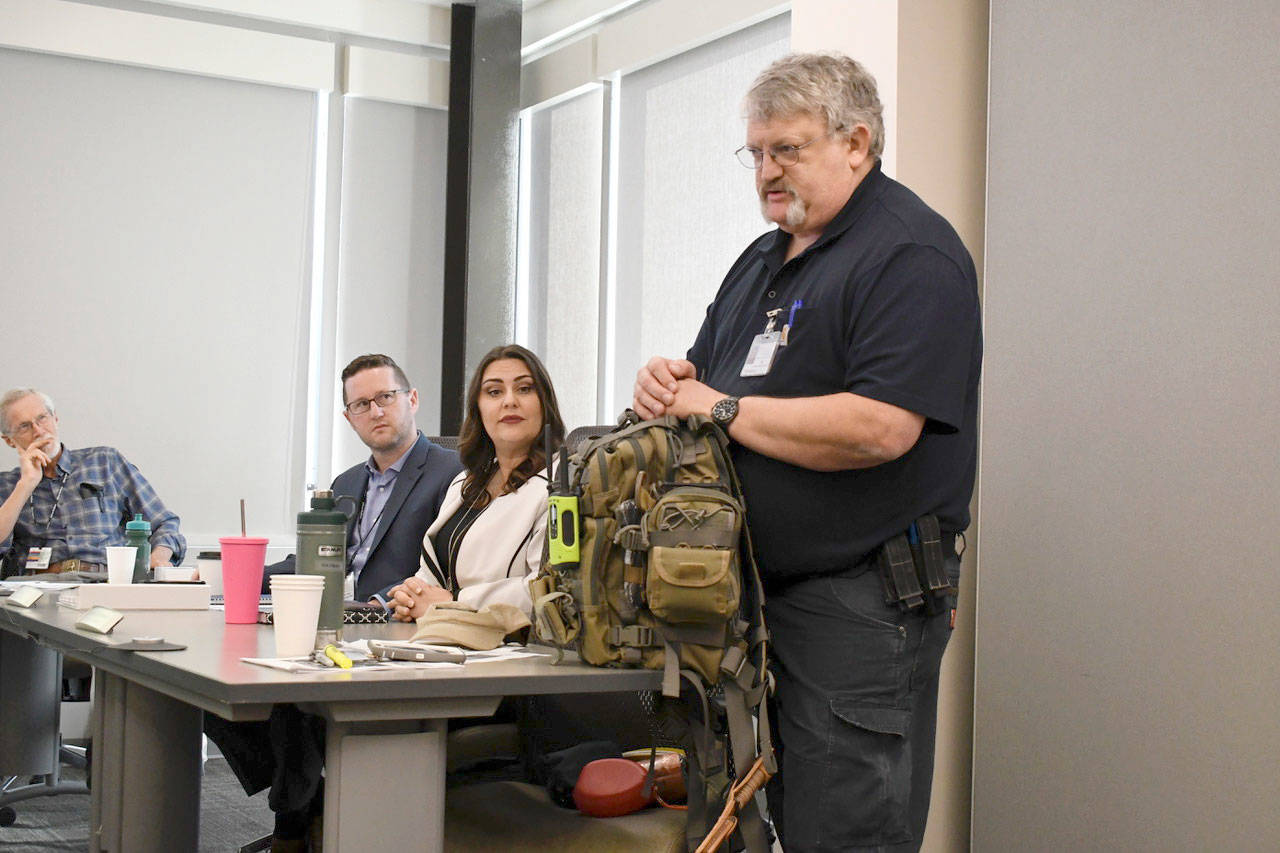
Bill Hunt, Jefferson Healthcare emergency management coordinator, told hospital commissioners Wednesday afternoon it all begins with preparedness and strength of community.
Hunt, an emergency room technician and unit coordinator who has worked in both law enforcement and emergency services, spent two months in New Orleans with Federal Emergency Management Agency (FEMA) after Hurricane Katrina struck the southeast coast in August 2005. He said that people survived because of neighbors, not necessarily because of government services.
“I was driving through St. Bernard Parish and there’s a tavern,” Hunt said. “I talked to the owner who was running out of everything. What he had was a propane cooker. Everyone who stopped in got free beans and rice. FEMA was not there. I drove there myself the next day and delivered MREs [meals ready to eat] and dog food.”
“What impressed me was this guy with his empty tavern was feeding his neighborhood. What I saw were faith-based groups and neighborhoods taking care of each other. The big disaster organizations were not there.”
Hunt said disaster prevention requires staff to do things safely.
“We go through a lot of training,” he said. “Every year, we have an incident command systems class and this year we did our first table-top exercise.”
The scenario was that a medical helicopter hit the roof hard, damaged a couple of rooms and the ICU unit, and landed in the middle of the imaging lab. Surgery and pharmacy areas were described as being affected.
“What are the immediate things that we need to do to make the building stable? We ran this scenario for several hours. This is our own disaster and we figured out our response,” Hunt said.
Hunt said the hospital has a robust emergency operations plan that is used on a smaller scale occasionally.
“Our daily disasters here are locally significant,” he said. “The wind blows and we can’t transport anybody out. People can’t get to work because of fallen trees or a bridge closure. We have a facilities issue with a broken water main or there’s a power problem.
“Those are our internal disasters that we deal with on regular basis. They just don’t become big enough for a bunch of people to get involved.”
Hunt said water is the number one priority during a disaster. He has been talking with some local breweries in town to use their facilities.
“It’s what Budweiser does,” he explained. “Budweiser shut down its beer production and started bottling and canning water during Hurricanes Florence and Katrina. Someone gave me a 40-ounce can that said ‘Budweiser Water.’ That’s what they do, so we should be doing that, too. “
He said the hospital does not store water on site.
“Our water comes from Lake Leland, 20 miles away, a long way in an earthquake. There’s about 6 million gallons of water on Howard Street near the roundabaout. But it’s getting it from there to here. If we had a cistern, that would be ideal, but where do we put it and how do we fund it are the two big questions.”
Hunt said personal preparedness is key during disasters.
“This is a hospital, not a hotel. We take care of injured people,” he said. “Don’t expect to charge your cell phone or have a meal at the hospital. Be prepared to be on your own for 30 days. Transportation will be interrupted. Keep walking shoes in your office or in your car. Keep supplies at work, in your car and at home.”
Personal kits should include water, some way to filter water, sunscreen, basic medical supplies, extra clothes, some hard candy, a contractor’s bag for shelter or rain gear, a space blanket, spare batteries, toilet paper and 30 days of prescription medication.
He also recommended buying a ham radio or portable FRS (family radio service) radios and solar panel chargers.
“In my comfort kit, at the end of the day, I have a little chocolate,” Hunt said.
________
Jefferson County Editor/Reporter Jeannie McMacken can be reached at 360-385-2335 or at jmcmacken@peninsuladailynews.com.
