
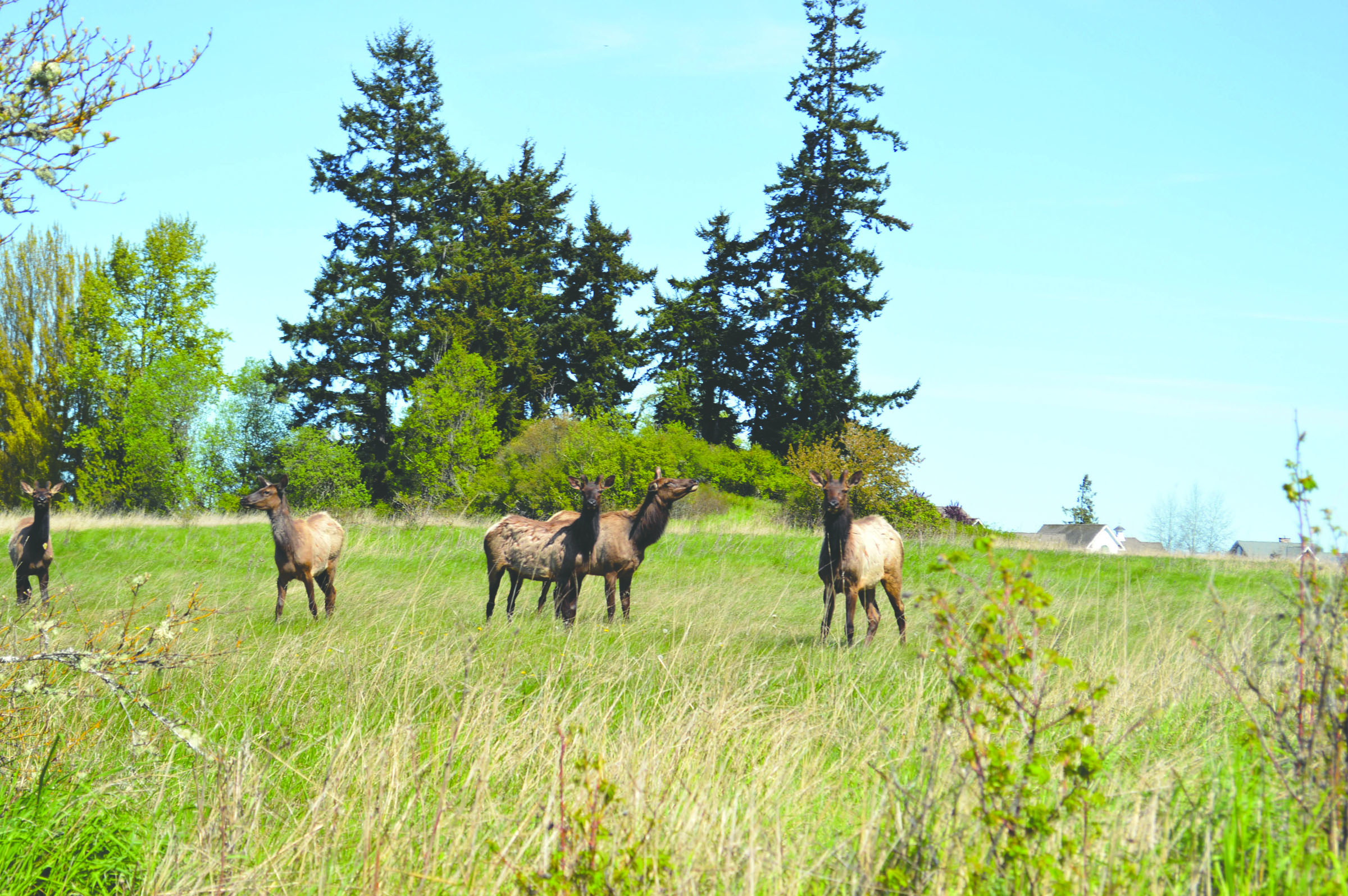
SEQUIM –– Hunters with special permits have killed 13 of Sequim’s trademark Roosevelt elk, focusing largely on harvesting antlered bulls.
Although the hunting season doesn’t officially end until March, Sgt. Eric Anderson of the state Department of Fish and Wildlife said chances are slim more hunting permits will be issued.
“There could be one or two more issued if something were to come up, like they were destroying more crops,” Anderson said Thursday. “But this is probably it.”
With the harvest of six bulls, six “spikes” (juvenile males) and one cow, the herd now numbers 40, with 27 cows and calves in the Dungeness Valley and 13 bulls in the foothills south of the city off Palo Alto Road.
Four of the elk were donated to food programs for tribal elders.
Two went to Jamestown S’Klallam and one each to the Lower Elwha and Port Gamble tribes, Anderson said.
The rest of the meat was kept by the hunters.
The herd swelled to more than 100 elk about 10 years ago. The high number of animals began to wipe out crops in the valley — and residents’ backyard greenery.
In response, wildlife officials began issuing permits to reduce the herd’s numbers.
“Our goal is around 25,” Anderson said.
“That leaves us with plenty of animals to keep the herd going, but a smaller herd means we don’t have as much damage as has been happening.”
The cows and calves for the past 10 to 15 years have been spending most of the year in the farm fields north of Sequim.
Tim Cullinan, a wildlife biologist who monitors the herd for the Point No Point Treaty Council, said development of the herd’s natural summer home on areas like Bell Hill pushed the elk down into the valley.
There, the cows and calves found lush fields of corn, alfalfa and other agricultural crops, and haven’t migrated back into the mountains since.
“They’ve just been so isolated down here for so long that they’re just not going out and exploring new areas,” Cullinan said. “They’ve got it good.
“That’s just the nature of elk. As long as they’re well-fed and they’re safe from predators, they’ve got no reason to move.”
But elk eating crop fields in the valley has taken its toll on area farmers, who have reported tens of thousands of dollars in crops lost to the elk.
Anderson said the damage increases when the bulls come down from the hills to mate.
“When the bulls come down and start doing the rutting, they will do way more damage,” Anderson said.
“They will fight; they will roll around and take out huge swaths of corns.”
Past hunts have focused on removing cows to reduce reproduction.
In October, when the current hunting season opened, Cullinan said, the herd had 17 adult females and 22 bulls with another eight or nine “spikes.”
“For a population the size of 15 or 16 females, you only really need about two bulls,” he said.
Too many bulls leads to more crop damage as they fight more for supremacy and eat more to replace energy lost in those fights, Cullinan said.
“It’s like a 24/7 job to respond to all those challenges from the other males and fight off the young ones,” he said.
In addition to lessening the number of bulls, Cullinan said the hunt for males leaves the herd with a sustainable population of females.
“With 16 or so females and nine or 10 calves, that’s a good-sized herd,” he said.
“Because it’s not so big that it’s going to wipe out crops, but it’s also got that margin of safety that if a disease comes in or something else happens, it’s not going to wipe out the herd.”
The antlerless elk in the valley also have extended life spans because of their new home, Cullinan said.
Wild elk typically live about 10 years, while those in captivity can live to be 20 years old.
“Down in the valley, they’re getting a rich diet. They don’t really have any predators,” Cullinan said.
“I wouldn’t be surprised if the average age of adult females is getting to be 12 or 13 years old.”
In the mid-1990s, elk from the Sequim herd were moved to the Brinnon area to boost the numbers in that herd.
It worked, Cullinan said, boosting the Brinnon herd from 17 elk to more than 60 now.
________
Sequim-Dungeness Valley Editor Joe Smillie can be reached at 360-681-2390, ext. 5052, or at jsmillie@peninsuladailynews.com.
